
Samburu National Reserve: The Complete Safari Guide (Wildlife, Best Time & What to Expect)
You've probably already started looking at Kenya safari options — and you've seen the same names come up again and again: Masai Mara, Amboseli, Tsavo. But if Samburu National Reserve has barely registered on your radar, you're about to discover the part of Kenya that most visitors never find. In this complete guide, you'll learn exactly what makes Samburu different, which animals you'll see that you can't find anywhere else in Kenya, when to go, where to stay, and how to plan every detail of a safari that stays with you long after you're home.
Key Takeaways
- Samburu National Reserve is a 165 km² wilderness in northern Kenya, famous for its remote semi-arid landscape and species found nowhere else in the country.
- The "Samburu Special Five" — Grevy's zebra, reticulated giraffe, gerenuk, Beisa oryx, and Somali ostrich — are endemic to northern Kenya and the reserve's signature draw.
- The best time to visit Samburu is during the dry seasons (June–October and January–February), when wildlife concentrates along the Ewaso Ng'iro River for the most reliable sightings.
- Samburu receives significantly fewer tourists than Masai Mara, giving you a more exclusive and genuinely immersive experience without sharing every sighting with a dozen other vehicles.
- Getting to Samburu is easiest by charter flight from Nairobi's Wilson Airport — you'll be on a game drive within two hours of leaving the city.
- Safari costs in Samburu range from budget camping to ultra-luxury tented camps, with park entrance fees set by Kenya Wildlife Service.
- Plan for a minimum of three nights — that's what it takes to see the Special Five, do a cultural visit, and actually feel the rhythm of the bush.
What Is Samburu National Reserve and Where Is It Located in Kenya?
Samburu National Reserve is a 165-square-kilometre protected wildlife area in Isiolo County, northern Kenya, established in 1985 and managed by Kenya Wildlife Service. When you arrive here, you're standing approximately 350 kilometres north of Nairobi — and you'll feel every one of those kilometres the moment you step off the plane. The landscape is semi-arid, the air is drier, the earth is red, and the wildlife is unlike anything you'll encounter in the south.
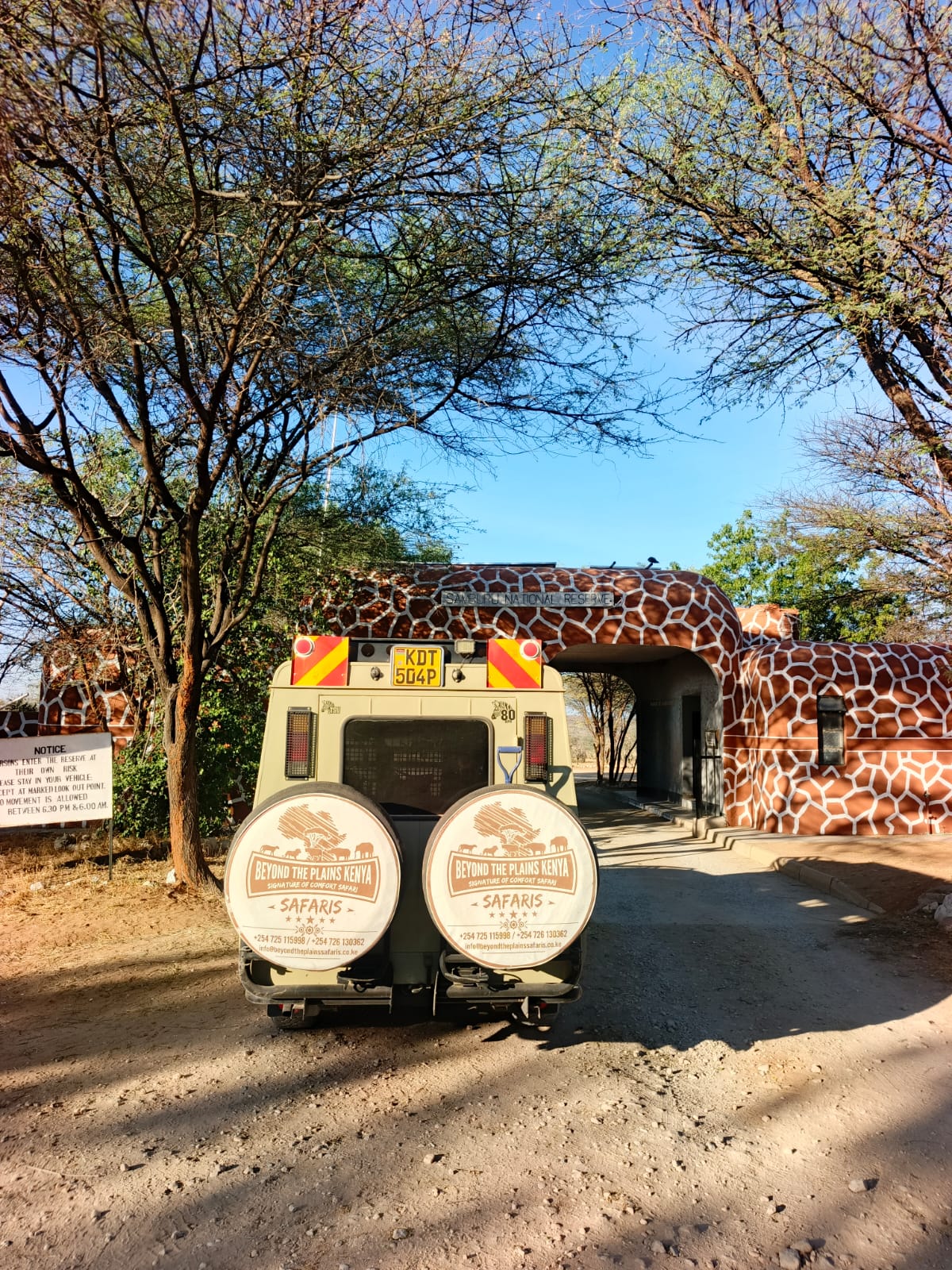
The reserve sits at around 900 metres above sea level along the southern bank of the Ewaso Ng'iro River, a permanent waterway that is essentially the reason everything here survives and thrives. Cross that river heading north and you're in Buffalo Springs National Reserve. Head east and you reach Shaba National Reserve. Together, these three contiguous areas form a combined ecosystem of over 300 square kilometres — and if you factor in the nearby Kalama and Namunyak community conservancies, the wildlife corridor you're exploring extends even further into Kenya's wild north.
What you'll notice immediately is that Samburu looks nothing like the Kenya of most safari brochures. There are no open grasslands stretching to the horizon. Instead, you have red-earth plains scattered with doum palms, riverine acacia woodland along the water's edge, and the dramatic silhouette of the Mathews Range rising to the north. This terrain isn't just beautiful — it's the reason the animals here are so different from what you'd find in the Mara. The semi-arid conditions have shaped a separate suite of species, specifically adapted to this harsher, hotter, more remote world.
The Samburu people have lived on this land for centuries, long before the reserve was officially gazetted. These semi-nomadic Nilotic herders, closely related to the Maasai, continue to practise a traditional pastoral culture shaped entirely by this landscape — and that living cultural layer gives your Samburu safari a depth that most Kenyan parks simply cannot offer. For a broader sense of how Samburu fits into a Kenya-wide itinerary, explore Beyond the Plains Safaris' Kenya destination guide.
[Insert image: Aerial view of the Ewaso Ng'iro River winding through Samburu's red-earth acacia landscape | Alt text: "Ewaso Ng'iro River flowing through Samburu National Reserve Kenya"]
Why Samburu Should Be on Your Kenya Safari Itinerary
Samburu National Reserve earns its place on your Kenya safari itinerary because it gives you wildlife, landscape, and cultural experiences that are simply not available anywhere else in the country. This is not a lesser version of the Masai Mara. It is not a backup option. It is a completely different kind of safari — and once you understand what's waiting for you up here, you'll wonder why you almost missed it.
Start with the animals. Samburu is home to five species collectively known as the Samburu Special Five: the Grevy's zebra, reticulated giraffe, gerenuk, Beisa oryx, and Somali ostrich. You will not find these animals reliably anywhere else in Kenya. If seeing them is on your list — and once you know they exist, it absolutely will be — Samburu is the only place to come.
Then consider what you won't have to share. Samburu draws a fraction of the visitor numbers the Masai Mara handles during peak season. You're far more likely to sit alone at a leopard sighting here, to have the river bank entirely to yourself at sunrise, and to finish a game drive feeling like you've actually been in the wild rather than in a loosely organised convoy. The difference is real, and you'll feel it on your first morning drive.
Add the cultural dimension. The Samburu people live alongside this reserve and continue practising a pastoral culture shaped by centuries in this terrain. When you visit a community homestead here, you're engaging with a living culture — not a reconstructed one. Most Kenyan parks have displaced their indigenous communities entirely. Samburu hasn't, and that changes the texture of your experience in ways that are hard to articulate until you're sitting inside a manyatta listening to a warrior explain his world.
Finally, look at the landscape itself. The red earth, the doum palms, the volcanic rock faces, the wide-open northern skies — it's photogenic in a completely different register from the south. If you have a camera and you care about what you're pointing it at, Samburu will give you images that look like nothing else in your Kenya collection.
The Samburu Special Five: Wildlife You Won't See Anywhere Else in Kenya
The Samburu Special Five refers to five wildlife species endemic to northern Kenya — the Grevy's zebra, reticulated giraffe, gerenuk, Beisa oryx, and Somali ostrich — none of which you'll find in Kenya's southern parks. These aren't animals that occasionally wander north. They have evolved specifically for the semi-arid conditions of this region, which is why Samburu is one of the most reliable places in the entire world to see them. On a well-guided three-night safari, you have a realistic chance of ticking all five.
Grevy's Zebra: The World's Largest Wild Zebra
When you spot your first Grevy's zebra (Equus grevyi), the difference from the common plains zebra you may have seen elsewhere in Kenya is immediately striking. The stripes are much narrower — finely packed pin-stripes rather than the bold, widely spaced bands of zebras in the Mara. The ears are larger, almost comically round. The belly is white with no stripes at all. Grevy's zebra is classified as Endangered on the IUCN Red List, with fewer than 3,000 individuals remaining worldwide — Source: IUCN Red List, 2023. When you realise you're watching one of fewer than 3,000 left on earth, a sighting that might otherwise feel like just another zebra becomes something you'll remember for the rest of your life.
Reticulated Giraffe: The Geometric Giant of the North
Your first look at a reticulated giraffe (Giraffa camelopardalis reticulata) will stop you mid-sentence. The coat pattern is completely different from the giraffes you've seen in photographs — bold geometric polygons separated by sharp white lines, like terracotta tiles cracked clean. It looks designed. On a morning drive, you'll often find tall males silhouetted against the early light with the Mathews Range behind them, and it's one of those wildlife moments that photographers travel specifically to Samburu to capture. A healthy population lives here year-round, browsing the acacia lines along the river edge.
Gerenuk: The Antelope That Stands on Two Legs
Nothing quite prepares you for seeing a gerenuk (Litocranius walleri) for the first time. It stands upright on its hind legs — completely vertical, balancing like a dancer — to browse leaves that other antelopes simply cannot reach. Its neck is extraordinarily elongated, giving it the appearance of a gazelle halfway through becoming a small giraffe. The gerenuk is adapted to survive without drinking water at all, obtaining every drop of moisture it needs from the leaves it browses — a remarkable piece of evolution for a semi-arid environment. Once you've watched one feeding like this for a few minutes, you'll understand exactly why people come back to Samburu just for the gerenuk.
Beisa Oryx: Built to Survive the Harshest Terrain
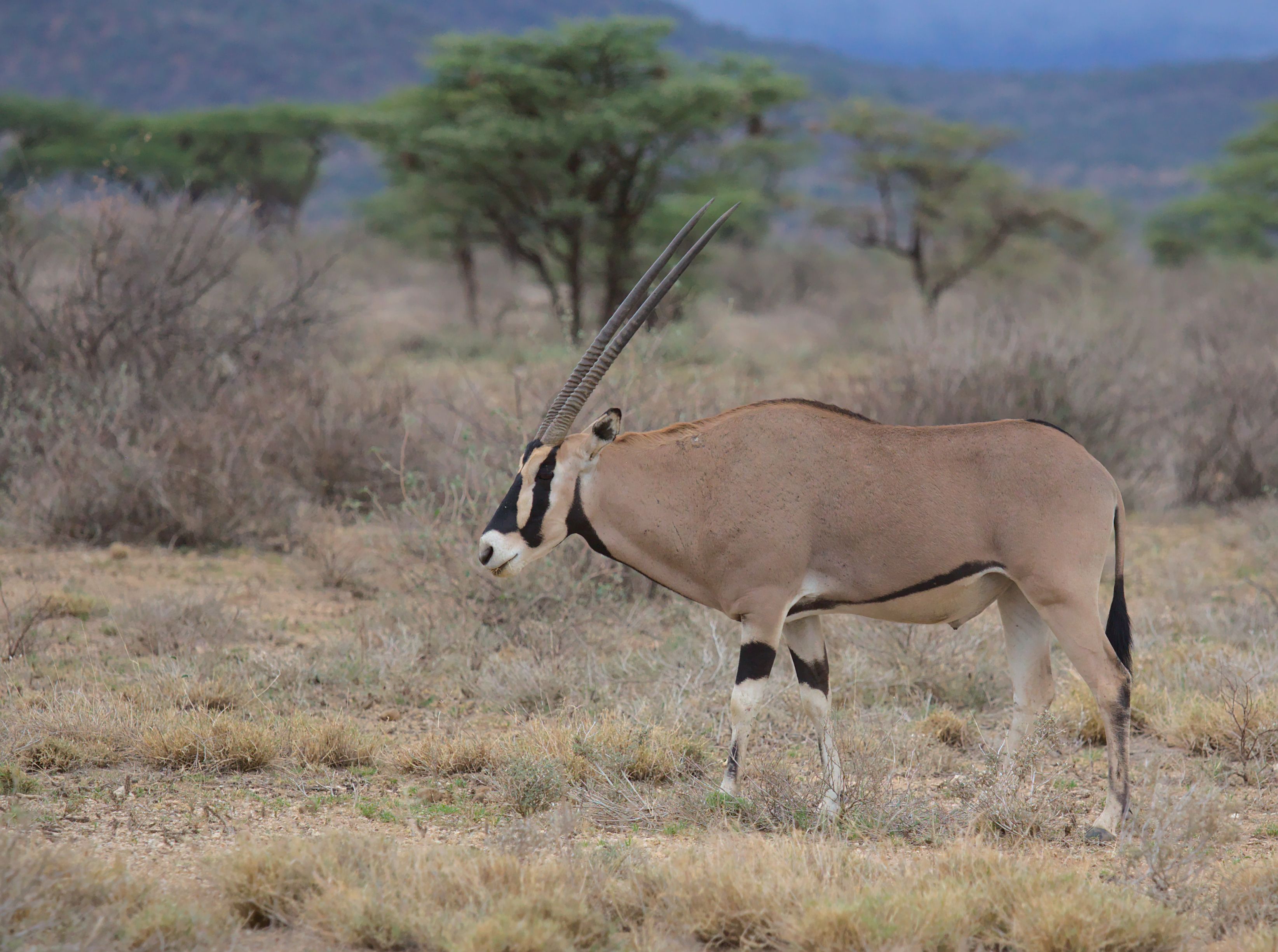
The Beisa oryx (Oryx beisa) is a large, powerfully built antelope with long straight horns and a striking grey-and-white coat marked with bold black lines across the face and flanks. What makes it so well-suited to Samburu is an internal thermoregulation system that lets it tolerate extreme heat without sweating the way most mammals do — an extraordinary adaptation to desert conditions. You'll typically encounter them in small herds on the open plains in the early morning, their pale forms contrasting sharply against the red earth as they move in that unhurried, deliberate way of animals with nothing to fear from the heat.
Somali Ostrich: The Blue-Necked Giant of the North
If you've seen common ostriches elsewhere in Kenya, you'll notice the difference here immediately. The male Somali ostrich (Struthio molybdophanes) has a distinctly blue-grey neck and thighs rather than the pink-red colouring of its southern relative. It was only reclassified as a fully separate species in 2014. At up to 2.7 metres tall and 130 kilograms, it's unmissable even at a distance — and on Samburu's open plains, you'll often spot several at once. They move across the landscape with a loping, confident stride that makes them look like they own the place.
[Insert image: Grevy's zebra on Samburu's red-earth plains with acacia trees | Alt text: "Grevy's zebra Samburu National Reserve Kenya Special Five"]
What Other Wildlife Will You See in Samburu National Reserve?
Beyond the Special Five, Samburu National Reserve gives you big cats, massive elephant herds, Nile crocodiles, hippos, African wild dogs, and over 450 bird species — making the reserve far more wildlife-rich than its relatively compact 165 square kilometres might suggest.
Big Cats and Predators
Lions are here in good numbers, and you'll often find them along the Ewaso Ng'iro River corridor where prey is concentrated. Leopards favour the acacia woodland fringing the river — check the branches carefully on every tree drive, because they rest up there through the hottest part of the day and can be remarkably easy to miss until your guide spots one. Cheetahs roam the more open stretches of the reserve. African wild dogs, one of Africa's most endangered large carnivores with a global wild population estimated at under 6,600 individuals, are occasionally sighted in Samburu — Source: African Wildlife Foundation, 2024. If your guide tells you wild dogs have been seen in the area recently, you cancel your camp lunch plans and you go.
Elephants, Hippos, and Crocodiles
Elephant families are one of Samburu's great constants. Large herds move to the Ewaso Ng'iro River in the late afternoon to drink and play, and the scene — a hundred elephants moving toward you through doum palms in amber light — is something you won't see duplicated anywhere else. Hippos inhabit the deeper river pools and you'll hear them well before you arrive. Nile crocodiles bask on exposed river banks in the morning sun, sometimes two or three metres long, completely still until they're not.
Birdlife: 450+ Species
If you're a birder, Samburu is one of the most exciting destinations in Kenya. With over 450 recorded bird species, the reserve hosts a suite of dry-country species unavailable in Kenya's more famous southern parks — and that's exactly what serious birders come for. Look out for the vulturine guineafowl (it looks almost too spectacular to be real), the Somali bee-eater, the martial eagle circling overhead, and the golden-breasted starling, which is so iridescent it looks like it was dipped in liquid metal. Even if you're not a committed birder, you'll find yourself pointing things out.
[Insert image: Elephant herd approaching the Ewaso Ng'iro River at dusk | Alt text: "Elephant herd Samburu National Reserve Kenya Ewaso Ng'iro River"]
What Is the Best Time to Visit Samburu National Reserve?
The best time to visit Samburu National Reserve is during the dry seasons — June to October, and January to February — when wildlife concentrates along the Ewaso Ng'iro River and your game viewing is at its most reliable. That said, every season in Samburu has something genuine to offer, and the right time for your trip depends as much on your priorities as on the calendar. For a full month-by-month breakdown of Kenya's safari conditions, Beyond the Plains Safaris has published a detailed seasonal guide covering all major parks.
Month-by-Month Breakdown
| Month | Season | Wildlife Viewing | What to Expect |
|---|---|---|---|
| January | Short dry | Excellent | Strong Special Five sightings; lower rates than peak |
| February | Short dry | Excellent | Best predator activity of the year |
| March | Long rains begin | Good | Wildlife more dispersed; lush scenery; fewer visitors |
| April | Long rains | Moderate | Some tracks can close; exceptional birdlife |
| May | Long rains | Moderate | Green, photogenic landscape; best value rates |
| June | Dry begins | Very Good | Vegetation thinning; wildlife drawn toward the river |
| July | Dry peak | Outstanding | Peak season; Special Five highly concentrated |
| August | Dry peak | Outstanding | Best overall game viewing of the year |
| September | Dry peak | Outstanding | Excellent; crowds begin to ease toward month end |
| October | Shoulder | Very Good | Short rains may arrive late month |
| November | Short rains | Good | More dispersed wildlife; birding peaks |
| December | Short dry resumes | Good | Festive season; strong wildlife; higher rates |
June to October: When You'll See Samburu at Its Most Dramatic
This is when Samburu truly delivers. As the dry season deepens, vegetation thins and wildlife has no choice but to pull toward the Ewaso Ng'iro River — which means you position your vehicle near the water and the animals come to you. The Special Five are easiest to find now. Lion prides hunt in the open. Crocodiles are on the banks every morning. The afternoon light between 16:00 and sunset is particularly striking during these months — golden, low, and sweeping across a landscape of red earth and white acacia in a way that makes every photograph look like it was planned. If you're going in July or August, book your camp at least six to eight weeks in advance. The best properties fill fast.
January and February: The Window Most People Miss
Here's what experienced safari travellers know that first-timers often don't: January and February in Samburu are exceptional, and the camps are far quieter than they are in peak season. Wildlife sightings are consistently strong — predator activity is actually at its highest of the year during these months — and you'll pay noticeably less for the same lodges that cost a premium in August. If you want quality over bragging rights about peak-season timing, this is your window.
The Green Season: For Photographers, Birders, and Anyone Who Values Solitude
During the long rains (April–May) and the short rains (November), Samburu transforms. The landscape turns vivid and lush. Rates drop. Visitor numbers thin to almost nothing. The wildlife doesn't disappear — animals simply spread out across the reserve rather than concentrating at the river, which means your guide needs to work harder but the sightings feel more genuinely earned. If you're a photographer chasing dramatic skies and lush settings, or a birder after migratory arrivals that boost the species list, the green season is actually your best option.
How Do You Get to Samburu National Reserve from Nairobi?
The fastest and most seamless way to reach Samburu National Reserve from Nairobi is by scheduled or charter flight from Wilson Airport, putting you on a game drive within two hours of leaving the city. Samburu is approximately 350 kilometres north of Nairobi — achievable by road, but far better by air if your time is valuable.
By Air: The Recommended Option
Scheduled flights depart Wilson Airport daily for Samburu's bush airstrips — Sasaab and Kalama — with most services covering the distance in 45 to 60 minutes. Your lodge will have a vehicle waiting at the airstrip. You land, you transfer, and you're on your first game drive before most city lunches have been ordered. Flying is strongly recommended if you're combining Samburu with Ol Pejeta Conservancy or other northern Kenya destinations, because it eliminates hours of road travel between parks and keeps your days where they belong — in the field.
By Road: The Scenic Alternative
If you prefer the journey to be part of the experience, the drive from Nairobi takes approximately 4.5 to 6 hours via the A2 highway. You'll pass through Nanyuki at the foot of Mount Kenya — with views of the mountain that are genuinely extraordinary on a clear day — before continuing north through Isiolo toward the reserve gates. The road is mostly tarmac, with unpaved stretches close to the gates. A private road transfer arranged through your operator is the right call for first-time visitors — the roads near the reserve are unmarked and variable, and you'll arrive relaxed rather than directionally confused.
Combining Samburu with the Rest of Kenya
Samburu fits naturally into a broader Kenya itinerary. Pair it with the Masai Mara and you'll cover both the north and south of Kenya — different ecosystems, different animals, completely different moods. Add Laikipia and you have the classic northern Kenya circuit. Beyond the Plains Safaris builds multi-destination itineraries that sequence all of these parks efficiently, connecting them by internal flight so your days on the ground are maximised.
How Many Days Do You Need for a Samburu Safari?
A minimum of three nights in Samburu gives you enough time to cover the key circuits, tick the Special Five, do a cultural visit, and actually settle into the rhythm of the bush. Two nights is possible — you'll have meaningful experiences — but it leaves no margin for the natural variability of wildlife movement or the unhurried pace that makes a bush safari genuinely restorative.
Here is what different stay lengths realistically give you:
- 2 nights / 3 days: A focused introduction. Two or three game drives, river corridor coverage, a good shot at most of the Special Five if conditions cooperate.
- 3 nights / 4 days: The recommended minimum. Multiple circuits including Buffalo Springs, a Samburu community visit, flexibility across different times of day, and enough drives to encounter real variety.
- 5 nights / 6 days: The immersive choice. You'll add Shaba National Reserve, a dedicated birding morning, a night game drive, and the kind of unhurried rhythm where the unexpected sighting — the wild dog pack, the leopard with a kill — has time to find you.
If you're visiting Samburu as part of a wider Kenya itinerary, three nights here alongside four or five nights in the Masai Mara makes for one of the most complete Kenya safari experiences it's possible to have.
Where Should You Stay in Samburu: Luxury Camp, Mid-Range Lodge, or Budget Option?
Your choice of accommodation in Samburu shapes your entire experience — not just your comfort level at night, but your proximity to wildlife, the quality of your guiding, and the atmosphere you wake up in each morning. The good news is that Samburu has excellent options across all budget tiers.
Luxury Tented Camps
Elephant Bedroom Camp is the place to stay if you want your tented suite to feel like it was placed on the river for you personally. It sits right on the Ewaso Ng'iro, and the sounds of elephants and hippos in the night become your soundtrack. Sasaab Lodge is the architecturally striking choice — a Moroccan-influenced property on a hillside with sweeping views across the reserve that you'll spend a lot of time just staring at. Samburu Intrepids is the long-established classic: riverside, reliably guided, and consistently excellent for families, couples, and anyone after the full East African bush camp experience with polished service. These are the properties you choose for honeymoons, milestone birthdays, and the kind of trip you've been planning for years.
Mid-Range Safari Camps
Ashnil Samburu Camp is the standout mid-range option — comfortable en-suite tented accommodation, good food, well-managed drives, and a location that keeps you close to the wildlife without the premium price tag. For most first-time Samburu visitors, a well-run mid-range camp delivers everything you actually need for a genuinely excellent safari. The wildlife doesn't check which category your camp falls into. What matters is your guide, your drive timing, and your position relative to the river.
Budget and Community Camps
Several community-run camps operate near the reserve's edges. Staying in one means your money goes directly into the local Samburu community economy, which — if that matters to you, and it probably does — adds a layer of meaning to your trip that the luxury properties can't replicate. The wildlife access is real; the infrastructure is simpler. The right choice if you're budget-conscious and your priority is the animals, not the plunge pool.
The single most important thing to know when choosing where to stay: river proximity and guide quality matter more than price tier. A mid-range camp on the Ewaso Ng'iro with an experienced local guide will outperform an ultra-luxury camp set back from the reserve with a generalist driver every single time.
How Much Does a Samburu Safari Cost?
A Samburu safari costs between approximately $250 and $1,500+ per person per day, depending on your accommodation tier, group size, season, and whether flights are included. Here's a practical cost breakdown to help you budget accurately before you enquire.
| Cost Component | Approximate Range | Notes |
|---|---|---|
| KWS Park Entry Fee | ~$60–80 per person/day | Non-resident adult rate; paid via KWS eCitizen platform |
| Budget Camp | $150–300 per person/night | Full-board; community camps and simpler lodges |
| Mid-Range Camp | $300–600 per person/night | Full-board; solid infrastructure and guiding |
| Luxury Tented Camp | $600–1,500+ per person/night | Full-board; top-tier properties like Sasaab, Elephant Bedroom |
| Nairobi–Samburu Flight | $180–350 per person each way | Wilson Airport to Sasaab or Kalama airstrip |
| Private Road Transfer | $200–350 per vehicle | Private 4WD; approximately 5 hours from Nairobi |
| Cultural Community Visit | $20–50 per person | Bookable through your lodge or operator |
All park fees and transfers are included in Beyond the Plains Safaris package quotes — no surprises at the gate. Request a personalised Samburu safari quote and you'll have a custom figure based on your exact dates, group size, and accommodation preference within 24 hours.
Is Samburu Better Than the Masai Mara?
Samburu and the Masai Mara are not competing for the same title — they offer completely different safari experiences, and the question of which is "better" is really the wrong question. The right question is: which experience do you want — and do you have time for both?
The Mara gives you the Great Migration, the highest big-cat density in Kenya, and the full sweep of classic East African safari spectacle. Samburu gives you the Special Five, far fewer vehicles, deeper cultural access, and a landscape that feels genuinely remote. If you go only to the Mara, you miss the endemic wildlife of the north. If you go only to Samburu, you miss the scale and drama of the south.
The ideal Kenya safari includes at least three nights in Samburu and at least three nights in the Masai Mara. Those two destinations together cover the full breadth of what Kenya's wildlife and landscapes offer. Beyond the Plains Safaris designs combined Kenya safari packages that pair them efficiently — by internal flight, with the parks sequenced so you spend your days game-viewing rather than in transit.
If you genuinely only have time for one, go to Samburu — because the Masai Mara will always be there, and the Samburu Special Five are exactly as rare and exactly as extraordinary as they sound.
What Should You Pack for a Samburu Safari?
Samburu's semi-arid climate means significantly warmer afternoons than you might expect for East Africa, combined with surprisingly cold early mornings — and your packing needs to account for both extremes across the same day.
Clothing
- Neutral colours throughout — khaki, olive, sand, stone, grey — for all game drives. Avoid blue and black, which attract tsetse flies
- Lightweight long-sleeved shirts and trousers for sun protection on the vehicle (the UV exposure from an open roof is significant)
- A warm fleece or down jacket for morning and evening drives — temperatures before sunrise can drop sharply, even in the dry season
- Wide-brimmed hat and UV-rated wraparound sunglasses
- Comfortable, broken-in walking shoes or boots for camp walks and cultural visits
Equipment
- Binoculars — 8×42 or 10×42 are the most useful specifications for wildlife viewing at Samburu distances
- Camera with a zoom lens of at least 200mm; 400–500mm if serious photography is a priority
- Extra memory cards and a portable power bank — electricity access varies significantly by camp
- A dust-proof bag or zip-lock cover for all camera equipment — the dry season roads generate substantial fine dust
Health
- Malaria prophylaxis is essential — Samburu is a malaria zone. Consult your travel doctor at least four to six weeks before departure to choose the right medication for you
- Check yellow fever vaccination requirements for your nationality before travelling
- High-SPF sunscreen (50+) — you'll be in an open vehicle in equatorial sun
- DEET-based insect repellent for dawn and dusk
- Travel insurance with full medical evacuation cover — the nearest hospital with surgical capacity is in Isiolo, approximately 90 minutes from the reserve
What Can You Expect on a Game Drive in Samburu?
On a Samburu game drive, you'll be in an open-sided or pop-roof 4WD vehicle with a certified guide, starting before sunrise and finishing after the light fades — with morning and evening drives timed to match the patterns of the Ewaso Ng'iro River corridor. Here's what to expect from each session.
Your Morning Drive
Your guide will wake you early — typically a 06:00 departure, sometimes earlier. You'll be on the road while it's still cool, the light still golden and low, and the predators potentially still active from the night before. This is when you find cheetahs on the move, track lion prides, and spot the Special Five before the heat of the day sends them into the shade. The window between 06:30 and 09:00 produces the best wildlife activity and the best photography light of any point in the day. Don't be tempted to sleep in.
Your Evening Drive
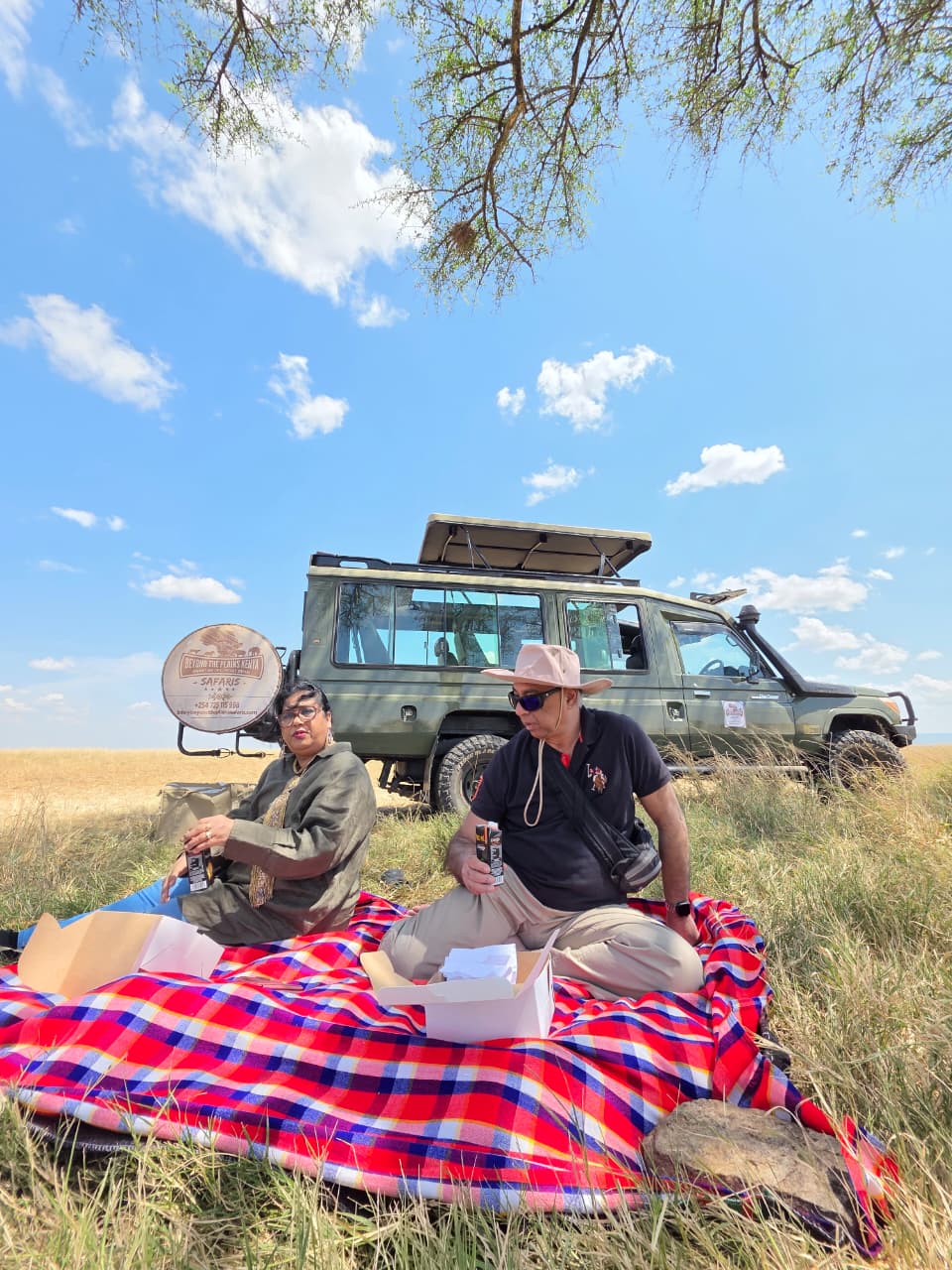
You'll head out again around 15:30–16:00, when the day's heat has begun to ease and the animals start moving again. Position yourself along the Ewaso Ng'iro River and watch what comes in. Elephant families arrive in the late afternoon to drink — sometimes in large groups that take thirty minutes to move through, unhurried, vocal, occasionally crossing right in front of your vehicle. Crocodiles slide off the banks. Hippos resurface. Your guide finds you a sundowner spot by the water. The light turns amber, then pink, then the first stars come out, and you drive back to camp in the dark with your torch scanning the tree line for eye shine.
Night Game Drives
Night drives are available through licensed operators with advance Kenya Wildlife Service approval, and if you're staying three or more nights, you should do one. After dark, Samburu reveals a completely different cast of characters: aardvarks moving through the scrub, honey badgers on their rounds, civets, servals, and leopards on the hunt — all invisible to you on your daytime drives. A night drive in Samburu is one of the most consistently memorable additions to any northern Kenya itinerary.
A Note on Self-Drive
Self-drive is technically permitted in Samburu but is not recommended for first-time visitors. The roads are unmarked, the landscape is disorienting, and you will miss the majority of what's actually out there. Your guide knows which tree the leopard slept in last night, where the Grevy's zebra were this morning, and when to cut the engine and wait rather than drive on. That knowledge is worth more than any map. Beyond the Plains Safaris runs all Samburu drives in custom pop-roof 4WD vehicles with guides who specialise specifically in northern Kenya wildlife patterns — the difference in your experience is substantial.
Can You Visit the Samburu People During Your Safari?
Yes — and you should. Cultural visits to Samburu community homesteads are one of the most genuinely moving experiences available anywhere on the East African safari circuit, and they're built into most multi-night Samburu itineraries. The Samburu people are a semi-nomadic Nilotic community closely related to the Maasai, speaking the Samburu dialect of the Maa language. Their herding culture, their beadwork, their warrior traditions and their age-based social structure have remained largely intact, and when you spend an afternoon with a community, you feel that authenticity in a way that's impossible to fake.
A typical visit takes you into a Samburu manyatta (homestead), where you'll see how the community is structured, watch traditional beadwork being made, and have the chance to buy directly from the artisans who made what you're looking at. Entry fees go directly to the community. Your guide handles the introduction and acts as translator — choose an operator with existing community relationships, because the quality of these visits depends entirely on that trust.
Also worth your time: the Umoja Women's Village near Archer's Post, founded in 1990 by women fleeing domestic violence. It has become one of the most admired models of women's economic empowerment in East Africa. A half-day visit here contributes directly to the village economy and often becomes one of the most talked-about moments of an entire Kenya trip.
Is Samburu National Reserve Safe?
Samburu National Reserve is safe for tourists, with Kenya Wildlife Service, private lodge security teams, and licensed operators maintaining a consistently well-managed environment throughout the reserve. Beyond the Plains Safaris is KATO-registered and TRA-licensed, and was recognised as 1st Runners-Up for Best Tour Operator in Kenya at the 2025 Tourism Excellence Awards — our safety standards across all destinations, including Samburu, are part of what that recognition reflects.
Practical safety on the ground is straightforward. Stay in your vehicle during game drives and follow your guide's instructions around wildlife — elephants in particular require careful positioning. Drink only bottled or filtered water. Take your malaria prophylaxis consistently and apply insect repellent at dawn and dusk. Carry travel insurance that includes medical evacuation; the nearest surgical-capable hospital is in Isiolo, roughly 90 minutes from the reserve.
Your lodge team will brief you on local conditions before your first drive and is reachable throughout your stay. You will not be left to figure things out alone.
How to Plan Your Samburu Safari: Your Four Next Steps
Planning your Samburu safari comes down to four decisions: when you go, how long you stay, where you sleep, and who builds the itinerary for you. Here's how to work through each one.
Step 1: Choose Your Travel Window
Think through what matters most. Peak dry season (July–October) gives you the most reliable sightings and the best photographic light, but you'll pay premium rates and share the reserve with more vehicles. January and February give you almost the same wildlife quality at lower rates with far less competition for sightings. The green season gives you solitude, lush scenery, exceptional birding, and the lowest prices — but requires a more patient approach to game viewing.
Step 2: Decide How Long to Stay
Three nights minimum, five if you can. If you're combining Samburu with the Masai Mara, an 8–12 day Kenya itinerary that includes both parks covers everything you came for. The northern Kenya safari circuit — Samburu combined with Laikipia or Ol Pejeta — is another outstanding option for anyone who wants to go deeper rather than wider.
Step 3: Match Your Accommodation to Your Travel Style
Be honest with yourself about what you want your evenings in camp to feel like. Ultra-luxury tented camps are transformative if that's your register — sunset over the Ewaso Ng'iro from a private deck is a specific kind of magic. But a well-positioned mid-range camp with an excellent guide gives you everything that matters during the hours you're actually in the bush.
Step 4: Book Through a KATO-Registered Kenya Safari Operator
Working with a properly registered, experienced Kenya operator means your park fees are handled correctly, your transfers are coordinated, your guide is vetted, and someone is reachable by phone if anything changes. Beyond the Plains Safaris provides custom Samburu safari proposals within 24 hours — start your planning here and tell us your dates, group size, and what matters most to you.
Your Sample 5-Day Samburu Itinerary
| Day | What You'll Do |
|---|---|
| Day 1 | Fly Nairobi–Samburu (45 min); afternoon game drive along the Ewaso Ng'iro River corridor |
| Day 2 | Full-day drives; morning focused on Special Five; evening sundowner at the river |
| Day 3 | Morning drive into Buffalo Springs; afternoon cultural visit to a Samburu community |
| Day 4 | Full-day game drive; Shaba National Reserve excursion; night drive with KWS permit |
| Day 5 | Early morning drive; airstrip transfer; Nairobi flight departure |
Conclusion: Why Samburu Stays With You
Samburu National Reserve is one of the most genuinely distinctive safari destinations in East Africa — and for every traveller who almost skipped it in favour of a third trip to the Mara, there is a story about what happened when they didn't.
Think about what's waiting for you. A gerenuk standing perfectly upright to feed. A Grevy's zebra — one of fewer than 3,000 left in the world — watching you from across a red-earth plain. Elephants crossing the river in the last light of the day, a hundred of them, unhurried and immense. The silence of a northern Kenya morning before the first bird calls. A Samburu warrior explaining his culture to you without performance, without distance.
You can find lions and leopards in a dozen parks across Kenya and Tanzania. You cannot find this anywhere else. That's what makes Samburu not just worth visiting, but worth prioritising.
Ready to make Samburu part of your Kenya safari? Beyond the Plains Safaris is a KATO-registered, TRA-licensed operator — 1st Runners-Up for Best Tour Operator in Kenya at the 2025 Tourism Excellence Awards — with deep specialist knowledge of northern Kenya's wildlife circuits. Contact the team today or request your free custom safari proposal. You'll have a tailored Samburu itinerary in your inbox within 24 hours.
Written by John Dante Director & Operations Manager, Beyond the Plains Safaris | Professional House, Nairobi, Kenya John Dante has over 15 years of experience guiding and building safaris across East Africa. As Director and Operations Manager of Beyond the Plains Safaris — KATO-registered, TRA-licensed, and recognised as 1st Runners-Up for Best Tour Operator in Kenya at the 2025 Tourism Excellence Awards — John has designed hundreds of itineraries across Kenya and Tanzania, with deep specialist knowledge of northern Kenya's wildlife circuits including Samburu, Laikipia, and Ol Pejeta.
Reviewed by the Beyond the Plains Safaris Expert Safari Team | Nairobi, Kenya










Comments (0)
Leave a Comment
No comments yet. Be the first to comment!