


Kenya Safari Tipping Guide : Exact Amounts, Who to Tip, and How to Do It Right
You've booked your flights, mapped out your game reserves, and budgeted for park fees — but one detail trips up nearly every first-time safari traveler: tipping etiquette in Kenya. Most online guides give vague ranges with no real context, leaving travelers anxious and underprepared at the worst possible moment. This guide gives you exact tipping amounts, tells you precisely who deserves a tip, and walks you through the smartest way to handle gratuities from the moment you land to your final farewell — so you can focus on the wildlife, not the awkwardness.
Key Takeaways
- Kenya safari tipping is customary but not legally mandatory — it is a direct expression of appreciation for skilled, personalized service in a demanding environment.
- Safari guides receive the highest tips because they single-handedly shape the quality of your entire wildlife experience, often working 12–14 hour days.
- Recommended daily tipping amounts range from $10 to $25 per guest, scaling with safari style, group size, and accommodation tier.
- US dollars in small denominations ($1, $5, $10, $20) are the most widely preferred tipping currency across Kenya's safari circuit.
- Group tipping envelopes eliminate awkwardness by pooling gratuities and allowing a private, dignified handoff.
- Preparing your full tipping budget before departure prevents last-minute currency scrambles and shortfall stress at camp.
- Always confirm your operator's tipping policy in advance — some luxury all-inclusive camps include a suggested gratuity; most do not.
What Is Safari Tipping in Kenya?
Kenya safari tipping is a customary gratuity practice that rewards the personalized service of guides, drivers, trackers, and lodge staff who work extended hours to deliver an exceptional wilderness experience. It is not a government-mandated fee or a service charge hidden in your invoice — it is a voluntary expression of gratitude that has become a deeply embedded professional expectation across East Africa's safari industry.
Tipping in this context is structurally different from tipping at a city restaurant. Your safari guide may spend 12 to 14 hours a day with you across pre-dawn and evening game drives, tracking wildlife, reading animal behavior, managing your safety, and narrating the bush in real time. That level of sustained, expert engagement — often across multiple days — is what separates a safari tip from a casual gratuity. The relationship is personal, skilled, and sustained — and tipping reflects all three qualities.
If you are still mapping out the full cost of your trip, read our complete Kenya safari cost breakdown before your first booking call — it covers every line item from park fees to accommodation, so tipping sits in the right context of your total budget.
Why Tipping Matters on a Kenya Safari
Tipping directly supports the livelihoods of safari professionals who operate at the intersection of world-class skill and limited formal social security. Kenya's certified safari guides are trained naturalists — many hold Kenya Professional Safari Guides Association (KPSGA) credentials, speak three or more languages, and have spent decades developing their bush knowledge. Despite this expertise, base salaries in the safari industry reflect the economic realities of a tourism-dependent market, and gratuities form a meaningful part of annual income.
Beyond individual livelihood, tipping shapes service culture at scale. Camps and conservancies where travelers tip consistently retain their most talented guides longer, which directly improves experience quality for every guest who follows you. According to the Kenya Tourism Board, tourism contributes approximately $1.48 billion USD annually to Kenya's economy — Source: Kenya Tourism Board, 2024. Safari staff sit at the human center of that industry. When you tip thoughtfully, you reinforce the professional standards that make Kenya one of the world's great safari destinations.
For broader context on where your safari spend goes and who it benefits, explore our guide to responsible safari travel in Kenya — it covers conservation fees, community levies, and the economic ripple of tourism spending in Maasai and Samburu communities.
Exact Kenya Safari Tipping Amounts
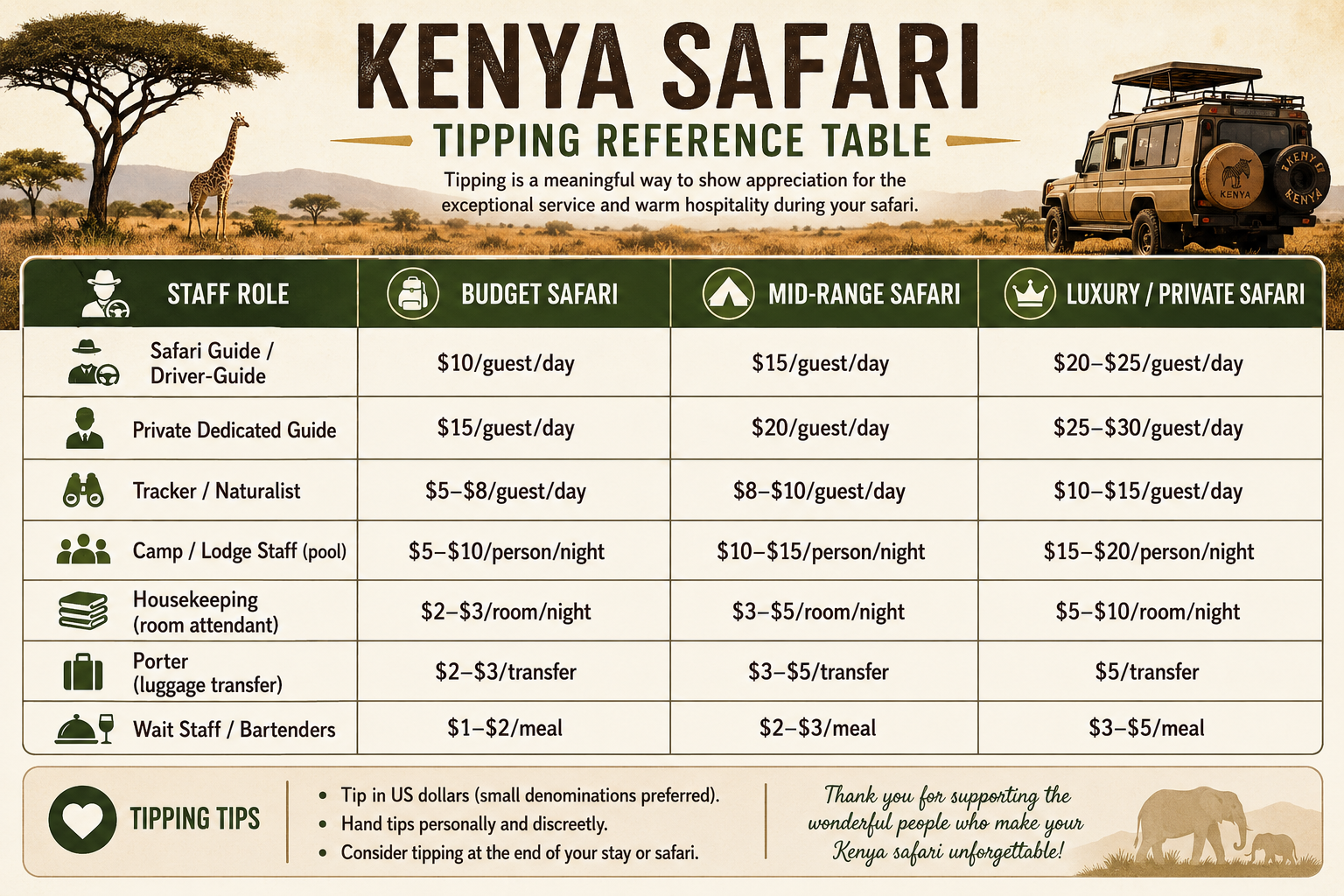
Kenya safari tipping amounts in vary by role, safari style, and group size — the table below reflects current recommended ranges used by reputable operators across the Masai Mara, Amboseli, Samburu, and Laikipia regions.
All amounts are per guest per day unless otherwise specified.
Kenya Safari Tipping Reference Table
| Staff Role | Budget Safari | Mid-Range Safari | Luxury / Private Safari |
|---|---|---|---|
| Safari Guide / Driver-Guide | $10/guest/day | $15/guest/day | $20–$25/guest/day |
| Private Dedicated Guide | $15/guest/day | $20/guest/day | $25–$30/guest/day |
| Tracker / Naturalist | $5–$8/guest/day | $8–$10/guest/day | $10–$15/guest/day |
| Camp / Lodge Staff (pool) | $5–$10/person/night | $10–$15/person/night | $15–$20/person/night |
| Housekeeping (room attendant) | $2–$3/room/night | $3–$5/room/night | $5–$10/room/night |
| Porter (luggage transfer) | $2–$3/transfer | $3–$5/transfer | $5/transfer |
| Wait Staff / Bartenders | $1–$2/meal | $2–$3/meal | $3–$5/meal |
Pro tip: "Per guest per day" means each traveler in your group tips independently. For groups of four or more, pooling tips into a single envelope is cleaner and more dignified for both giver and recipient.
How Much Should You Tip a Safari Guide in Kenya?
Safari guide tipping in Kenya typically ranges from $10 to $25 per guest per day, depending on safari category and service quality — making the guide the single highest-tipped individual on any Kenya safari. This is entirely justified. Your guide controls the rhythm of every game drive, decides which tracks to follow, interprets what you are seeing in real time, and carries responsibility for your safety from the moment you leave camp at 5:30 AM to the final sundowner at dusk.
For a 5-day mid-range Masai Mara safari, a solo traveler should budget approximately $75 in guide tips ($15 × 5 days). For a couple, that is $150. For a family of four, approximately $300 in guide tips alone — a number that sounds significant until you consider that your guide has just spent five full days delivering a once-in-a-lifetime experience. Outstanding guides — those who tracked the leopard, identified 120 bird species, and knew exactly when to position the vehicle for perfect lion light — absolutely warrant tipping above the standard range.
For private dedicated guides on exclusive vehicles, the floor rises to $20–$25 per guest per day. A private guide carries greater logistical responsibility, adapts entirely to your group's pace and interests, and typically has a higher certification level. If you are planning a private safari experience, our private Kenya safari planning guide explains exactly what to expect — and what distinguishes a truly private game drive from a standard shared vehicle.
How Much Should You Tip Camp and Lodge Staff?
Lodge and camp staff tipping in Kenya is best handled through a communal tipping box or a group envelope, with $5–$15 per guest per night being the widely accepted standard across mid-range and luxury properties. Most established tented camps and lodges place a tipping box at the front desk or reception — this is deliberate. It allows gratuities to be distributed equitably across the kitchen team, housekeeping, laundry, grounds, maintenance, and security staff who all contribute to your experience but may never interact with you face-to-face.
Housekeeping deserves individual recognition alongside the communal pool. Leave $3–$5 per room per night on the pillow or bedside table, not in the general tipping box — this signals clearly that the tip is intended for the person who turned down your tent, refreshed your towels, and restocked your minibar twice daily. At luxury lodges where suites are serviced morning and evening, the higher end of that range reflects the standard appropriately.
To understand how accommodation tier affects your total experience — and therefore your tipping context — read our guide to the best Kenya safari lodges and camps, which breaks down what you actually receive at each price tier from budget banda to ultra-luxury conservancy.
How Much Should You Tip Trackers and Naturalists?
Specialist trackers and naturalists on Kenya safaris typically receive $5–$15 per guest per day, reflecting the depth of skill they bring to the bush experience. Not every safari includes a dedicated tracker — they are most common in premium private conservancies like Ol Pejeta, Lewa Wildlife Conservancy, Laikipia Plateau properties, and high-end Masai Mara conservancies where off-road tracking is permitted.
A specialist tracker reads broken grass stems, paw depth in wet soil, behavioral cues invisible to the untrained eye, and scent corridors that no vehicle GPS could replicate. When a tracker is present on your safari, tip them as a separate individual from your guide — not as an add-on to the general lodge pool.
How to Tip Correctly in Kenya: Currency, Timing, and Etiquette
The correct approach to Kenya safari tipping combines the right currency, the right timing, and deliberate discretion — all three elements matter both practically and culturally.
Should You Tip in US Dollars or Kenyan Shillings?
US dollars are the most universally preferred tipping currency across Kenya's safari industry, though Kenyan shillings are equally appropriate and sometimes more practical for smaller, day-to-day gratuities. Safari guides and lodge staff at established operations often favor USD because it holds value more predictably against local inflation and is straightforward to save or convert. That said, KES is never unwelcome — and for smaller tips like a porter, a camp waiter, or a gate attendant, shillings are entirely natural.
The practical rule: Before departure, assemble $150–$250 per traveler in small USD bills — specifically $1, $5, $10, and $20 denominations. Avoid $50 and $100 bills for tipping. Large bills create change-making complications in remote camps and can result in your guide effectively receiving less than the intended amount due to unfavorable bush exchange rates.
Can You Tip by Credit Card at Kenya Safari Lodges?
Credit card tipping at Kenya safari lodges is rarely available and should never be your primary tipping plan. While a small number of high-end Nairobi hotels or beach resorts allow gratuity to be added to a card bill, the vast majority of safari tented camps — particularly mobile camps in the Masai Mara or Samburu — operate in cash-only environments. Mobile data coverage in game reserves is unreliable, and digital transfer platforms like M-Pesa, while excellent for everyday Kenyan commerce, are not standard in tourist-to-staff gratuity situations.
Cash is non-negotiable. Plan around it before you travel.
Daily Tipping vs. End-of-Stay Tipping: What Works Better?
End-of-stay tipping is the preferred approach for safari guides and drivers; daily tipping works better for individual lodge staff interactions. Tipping your guide at the conclusion of the full safari — rather than at the end of each game drive — allows you to evaluate the complete experience holistically and reward proportionally. It also avoids repeated cash handoffs inside a shared vehicle.
For lodge staff, however, daily tipping is more practical and fair. Multi-day itineraries often move between multiple properties, and camp housekeeping staff at Property A deserve recognition before you leave for Property B. Leave daily housekeeping tips on the pillow each morning and drop a lodge staff contribution into the communal tipping box at each property before checkout.
Group Tipping Envelopes: The Right Way to Do It
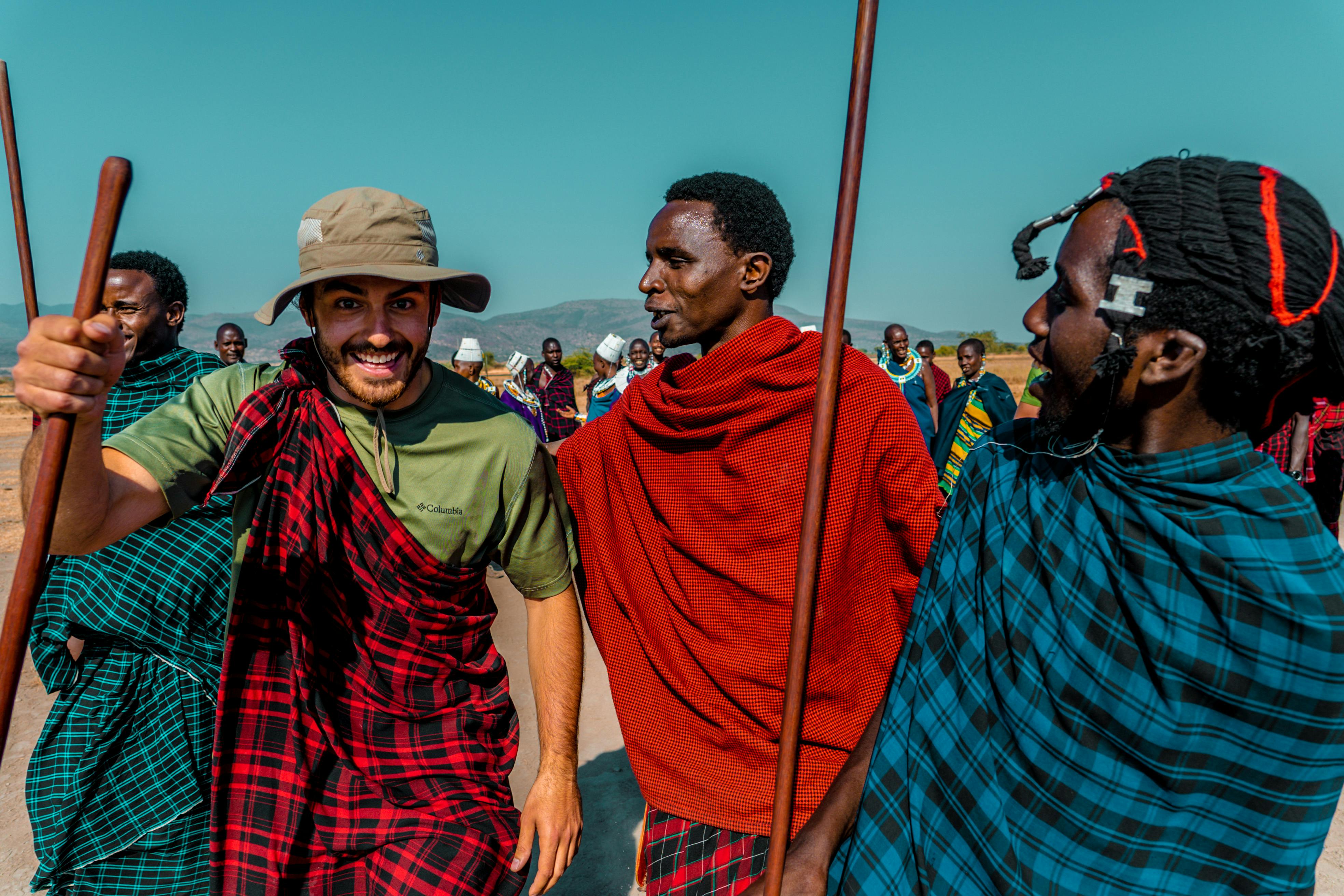
Group safari tipping involves pooling gratuities from all travelers in the vehicle and presenting them in a single labeled envelope at the end of the safari — quietly, privately, and with intention. This is the most widely recommended approach by experienced safari operators for three clear reasons: it simplifies the arithmetic, avoids public cash handoffs in a shared vehicle, and allows your guide to receive the tip privately rather than in front of strangers.
Here is the exact system: the evening before your final drive, collect the agreed contribution from everyone in your group. Place the pooled total in a plain envelope — many camps provide these at the front desk — write the guide's name on the front, and include a brief handwritten note if you are willing. After the final game drive or at the farewell dinner, hand it directly to your guide with eye contact and a firm handshake. That combination of financial generosity and personal acknowledgment is what guides across Kenya remember long after the tip itself is spent.
Practical Tipping Budget Examples
Your total Kenya safari tipping budget depends on group size, trip duration, and accommodation tier — the examples below give you precise, real-world figures for the most common safari profiles.
For full trip cost planning beyond gratuities, our Kenya safari pricing guide walks through every line item so nothing catches you off guard on the ground.
Budget Safari (4 Days, 2 Guests)
| Recipient | Calculation | Total |
|---|---|---|
| Guide / Driver | $10 × 2 guests × 4 days | $80 |
| Lodge Staff Pool | $5 × 2 guests × 4 nights | $40 |
| Housekeeping | $3 × 1 room × 4 nights | $12 |
| Porters | $3 × 2 guests × 2 transfers | $12 |
| Total | ~$144 |
Mid-Range Safari (5 Days, 2 Guests)
| Recipient | Calculation | Total |
|---|---|---|
| Guide / Driver | $15 × 2 guests × 5 days | $150 |
| Lodge Staff Pool | $10 × 2 guests × 5 nights | $100 |
| Housekeeping | $4 × 1 room × 5 nights | $20 |
| Porters | $4 × 2 guests × 3 transfers | $24 |
| Total | ~$294 |
Luxury Private Safari (7 Days, 2 Guests)
| Recipient | Calculation | Total |
|---|---|---|
| Private Guide | $25 × 2 guests × 7 days | $350 |
| Specialist Tracker | $12 × 2 guests × 7 days | $168 |
| Lodge Staff Pool | $15 × 2 guests × 7 nights | $210 |
| Housekeeping | $8 × 1 room × 7 nights | $56 |
| Porters | $5 × 2 guests × 4 transfers | $40 |
| Total | ~$824 |
Family Safari (5 Days, 2 Adults + 2 Children Under 12)
Children under 12 are generally not expected to tip as independent guests. Most operators treat a family of two adults and two young children as 2–2.5 tipping units, not four.
| Recipient | Calculation | Total |
|---|---|---|
| Guide / Driver | $15 × 2.5 units × 5 days | $187.50 |
| Lodge Staff Pool | $10 × 4 guests × 5 nights | $200 |
| Housekeeping | $4 × 2 rooms × 5 nights | $40 |
| Total | ~$427 |
For family safari planning specifics — including how to structure game drives around young children's schedules — read our family Kenya safari planning guide and our Masai Mara travel guide, which covers the best reserves for first-time family visitors.
Are Tipping Expectations Different for Luxury vs. Budget Safaris?
Yes — luxury Kenya safaris require meaningfully higher gratuity budgets because of elevated staff-to-guest ratios, more personalized service touchpoints, and higher professional expectations on both sides. At a budget camp where one guide manages a shared 6-to-8 seat vehicle, $10 per guest per day is fair and appropriate. At a luxury private conservancy where your vehicle is exclusively yours, your guide customizes every drive around your interests, and a camp manager checks in with you daily — $20–$30 per guest per day accurately reflects the caliber of service delivered.
The practical benchmark: If your lodge rate exceeds $500 per person per night, tip at the upper end of every range in the table above. If it falls under $150 per person per night, the lower-to-mid range is completely appropriate. For a deeper look at what separates these tiers, our mid-range vs. luxury Kenya safari comparison breaks down exactly what you receive at each accommodation level — from vehicle access and guide exclusivity to meal quality and suite size.
What to Do Before Departure: Your Kenya Safari Tipping Checklist
Preparing your tipping cash and logistics three to four weeks before departure is the single most effective way to eliminate tipping stress during your safari. Follow this checklist:
- Calculate your total estimated tips using the budget tables above, then add a 20% buffer for spontaneous moments of exceptional service.
- Withdraw small-denomination USD bills — a mix of $1, $5, $10, and $20 notes. Do this at your home bank before travel; airport exchange kiosks rarely stock small denominations in sufficient quantity.
- Separate tip funds from travel spending money — use a dedicated envelope, pouch, or travel wallet clearly labeled "tips only."
- Contact your safari operator in advance to ask whether tipping is individual or pooled at each property, and whether the camps provide tipping envelopes.
- Pre-label envelopes by role — Guide, Lodge Staff, Housekeeping, Tracker — before you travel. It sounds trivial; it removes all decision fatigue at the end of a long game drive.
- Write a short thank-you note for your guide's envelope. Even a single sentence in Swahili — Asante sana kwa kazi nzuri ("Thank you very much for excellent work") — is remembered long after the cash is spent.
- Confirm staff names before arrival — your operator can provide your lead guide's name in advance so you can personalize the envelope.
Before you pack your tipping envelopes, make sure everything else is ready too. Our Kenya safari packing checklist for first-time travelers covers clothing, camera gear, medications, and everything you need for a seamless departure.

Common Kenya Safari Tipping Mistakes to Avoid
The most costly Kenya safari tipping mistakes are not about the amounts — they are about timing, preparation, and forgetting entire categories of staff who contributed to your experience.
- Tipping only your guide and forgetting the lodge team. Your guide is visible; the kitchen staff who prepared your bush breakfast at 5 AM, the laundry team, and the grounds crew are not. They contribute directly to your experience. Always leave a contribution in the lodge tipping box before checkout at every property.
- Bringing only large bills. $50 and $100 notes are difficult to use for tips in remote camps and can result in your guide losing value when changing them. Small denominations are always better.
- Assuming tips are included in your package. Some ultra-luxury all-inclusive properties build a suggested gratuity into their per-night rate — but the vast majority do not. Always confirm this in writing with your operator before departure. Never assume.
- Tipping publicly in front of other guests. Handing cash to your guide in front of a vehicle full of fellow travelers creates uncomfortable social comparisons. Always tip privately, discreetly, and with deliberate eye contact.
- Under-tipping after genuinely exceptional service. The ranges in this guide are appropriate for solid, professional service. If your guide spent two hours patiently positioning the vehicle while a cheetah hunted, or taught your children to identify 40 bird species by call — tip above the range. Outstanding service deserves outstanding recognition.
- Carrying no Kenyan shillings at all. Even if you tip primarily in USD, having KES on hand for small spontaneous interactions — a gate attendant, a cultural village host, a roadside craftsperson near camp — shows cultural awareness and avoids the awkwardness of offering nothing.
For broader first-trip preparation, our Kenya safari travel tips for first-time visitors covers visa requirements, health precautions, wildlife etiquette, and communication in the bush.
Frequently Asked Questions About Kenya Safari Tipping
Is tipping mandatory on a Kenya safari?
Tipping is not legally mandatory on a Kenya safari. However, it is a deeply ingrained professional expectation across the industry. Safari guides and lodge staff rely on gratuities as a meaningful supplement to base salaries. Choosing not to tip after good service is not illegal — but it is widely considered poor form and will be noticed by both staff and fellow travelers.
How much cash should I bring for tips on a Kenya safari?
A practical rule of thumb is to budget $30–$50 per traveler per day in combined tipping allowance, covering guides, lodge staff, housekeeping, and porters across all safari days and nights. For a 5-day safari with two travelers, that means bringing $300–$500 in dedicated tipping cash, in small USD denominations. Always carry a 20% buffer above your calculated estimate.
Should I tip at the beginning or end of the safari?
Tip your guide at the end of the full safari, once you can evaluate the complete experience. Tip lodge staff daily at each property, since you may be moving between camps and the same staff will not be present at checkout. Leave housekeeping tips on the pillow each morning before your game drive.
What is the tipping etiquette for a group safari in Kenya?
On a group safari, each guest tips their own share independently, or the group pools contributions into a single envelope per recipient. Pooled group tipping is generally preferred — it simplifies the math, creates a more meaningful total amount, and allows a single dignified handoff rather than multiple individual cash exchanges. Appoint one person in the group to collect and manage the envelopes.
Can I tip in Kenyan shillings instead of US dollars?
Yes. Kenyan shillings are completely acceptable and never inappropriate. USD is simply preferred by many guides and lodge staff because it is easier to save and holds value more reliably. If you have KES, use it — particularly for smaller tips like porters, wait staff, or day-to-day interactions at camp.
What if I forget to bring enough cash for tips?
If you arrive at camp short on tipping funds, ask your camp manager or lodge reception whether there is an ATM or money exchange within driving distance — some mid-range lodges near towns have access. In remote mobile camps, no ATM access exists. This is why preparing before departure is critical. In a genuine shortfall situation, tip what you have, explain your situation honestly to your guide, and consider a bank transfer or digital payment via your operator's recommended method after you return home.
Do children need to tip on a Kenya safari?
Children under 12 are generally not expected to tip as independent guests. Most experienced operators treat a family unit with young children as 2–2.5 tipping units rather than the full headcount. Teenagers (13+) are typically included in the per-person calculation. Confirm the expectation with your specific operator before travel.
Is it appropriate to tip in advance to get better service?
No. Tipping in advance — before service has been delivered — is not standard practice in Kenya's safari industry and can create awkward professional dynamics. Tips are a reward for service received, not a pre-payment for preferential treatment. Your guide's professionalism does not require an advance gratuity; it is already built into their character and training.
How do I tip if I am on an all-inclusive luxury safari?
Some ultra-luxury properties include a suggested gratuity or service fee in their per-night rate. Read your booking documents carefully and ask your operator directly before departure. If a gratuity is included, you may still choose to tip above that amount for exceptional individual service — particularly for your guide — but you are not obligated to.
What is the best way to thank a Kenyan safari guide beyond money?
Beyond tipping, a written review on TripAdvisor or Google naming your guide specifically is enormously valuable. It contributes to their professional reputation, influences future bookings, and lasts far longer than cash. A handwritten note left with the tip envelope, a social media mention tagging the camp or operator, or a post-trip email to the safari company praising your guide by name — all of these carry meaningful professional weight that guides genuinely appreciate.
What's Next: How to Use This Guide Before Your Trip
Apply this guide three to four weeks before departure — that is the optimal window to source correct USD denominations, communicate with your operator about property-specific tipping norms, and build your final budget with precision.
First, use the budget tables above to calculate your total expected tips for your specific trip profile. Second, call or email your safari operator and ask two direct questions: Does our package include any gratuity? And does each property provide tipping envelopes or a communal box? Third, withdraw your tipping budget in small bills at least one week before travel — last-minute airport exchanges rarely produce the denominations you need.
Finally, spend five minutes on Swahili. Asante sana (thank you very much) and Kazi nzuri (good work) delivered with a genuine smile when handing over a tip elevate the entire interaction from a financial transaction to a human moment. Guides across Kenya consistently note that being thanked in even imperfect Swahili makes the handoff genuinely memorable.
For the best time to plan your Kenya safari — including Great Migration timing and peak wildlife density windows — our Kenya safari seasonal guide aligns your travel dates with the experiences that make guiding — and witnessing — the Mara so extraordinary. And if you are still mapping out the full financial picture, our hidden Kenya safari costs guide covers every fee, levy, and add-on so your final budget is completely accurate.
Conclusion: Tip Confidently, Travel Respectfully
Kenya safari tipping is straightforward the moment you have the right framework: understand the roles, apply the correct ranges, prepare your cash before departure, and give with intention rather than obligation.
Your guide woke before dawn to find you lions. Your camp housekeeper turned down your tent at sunset with a flower on the pillow. Your tracker walked silent bush for two hours to locate a rhino for your children. These moments do not happen by accident — they are the result of skilled, dedicated professionals who bring profound pride to demanding, physically taxing work. A thoughtful tip honors that dedication, sustains their livelihoods, and strengthens Kenya's safari industry for every traveler who follows in your footsteps.
Tip generously when service is exceptional. Tip proportionally when it is solid. Tip always.
If you are ready to plan your Kenya safari and want expert guidance on itinerary, lodges, and what to expect on the ground — get in touch with us and start planning your Kenya safari today. We will include a full pre-departure tipping briefing as part of your planning process, so you arrive at camp informed, prepared, and ready to experience East Africa at its finest.
Written by John Dante — Director & Operations Manager, Beyond The Plains Kenya Safaris. With 15+ years guiding travelers across East Africa, John turns safari dreams into journeys people never stop talking about.
Reviewed by The Beyond The Plains Editorial Team — East Africa safari specialists with deep on-the-ground expertise across Kenya's Masai Mara, Amboseli, Samburu, Laikipia, and Tsavo circuits.
Disclaimer: This article was initially drafted using AI assistance. However, the content has undergone thorough revisions, editing, and fact-checking by human editors and subject matter experts — including a 15-year Kenya safari professional — to ensure accuracy and reflect 2026 industry standards.










Comments (0)
Leave a Comment
No comments yet. Be the first to comment!