


What Our Guides Do in the First 15 Minutes of Every Game Drive — and Why It Changes Everything You See
By Beyond the Plains Safaris | Kenya Safari Experts | Nairobi, Kenya
Reading time: 9 minutes Category: Safari Tips | Game Drive Guide | Kenya Safari Advice Published by: Beyond the Plains Safaris — 4.9 ⭐ TripAdvisor · Travelers' Choice 2022–2024 · 2025 Tourism Excellence Awards · KATO Member
Most guests climb into the Land Cruiser at 5:45 AM thinking the game drive begins when the first animal appears. It doesn't.
By the time you spot that lion or leopard, our guides have already been working for fifteen minutes. Reading the bush. Listening to signals most guests never notice. Positioning the vehicle in ways that will shape the next four hours of wildlife viewing. Making decisions — dozens of them, quietly — before anyone says a word.
This is the part of a Kenya game drive that nobody ever writes about. We're writing it now, because understanding it will transform the way you experience your next safari.
Why the First 15 Minutes Determine the Rest of the Drive
A safari guide's most important work happens before the first sighting. Not during it.
The Maasai Mara and Kenya's wider game-viewing landscape are not static. Wildlife moves constantly — with temperature, light, wind, prey availability, and dozens of variables our guides have spent years learning to read. The difference between a game drive that yields a cheetah hunt and one that doesn't often comes down to decisions made in the first quarter of an hour.
Two vehicles can leave the same camp at exactly the same time, drive the same roads, and return with completely different stories. The guide is almost always the reason.
Here is what ours are doing.
Minute 0–3: The Radio Debrief Before You Even Board
Before our guides greet you at the vehicle, they've already done something critical: debriefed with the camp's night staff and checked in on the guide radio network.
Throughout the night, camp askaris (security guards) and lodge staff monitor what moves through the area. A distant roar heard at 2 AM. Lion tracks crossing the road near the river. Hyena clan noises from the north ridge. This information doesn't disappear with the sunrise — it narrows the entire map.
Our guides cross-reference overnight intelligence with what they personally observed on the previous afternoon drive: where predators were heading as the light faded, which pride looked hungry, whether a leopard had successfully made a kill or retreated empty. That prior-day observation isn't just memory — it's the foundation of a hypothesis our guides carry into the morning.
On private Kenya safari game drives — which we strongly recommend over shared vehicles — this debrief shapes a specific, reasoned plan for the morning before a single wheel turns. Guests on shared drives rarely benefit from this level of intentional pre-drive strategy.
Seen in our TripAdvisor reviews: "The driver has a very good relationship with other drivers and they communicate frequently regarding where to spot the best action on the Masai Mara. We never spent more than 10 minutes before seeing some action." — Verified guest review
→ Learn more about why private game drives change what you see: Masai Mara Safari Tour Packages
Minute 3–6: Reading the Departure Road Like a Morning Newspaper
The road out of camp is driven slowly. Very slowly.
Guests often assume the guide is simply warming up the vehicle or being cautious on an unlit track. They're actually doing something far more precise: reading the departure road as a live record of everything that happened between midnight and dawn.
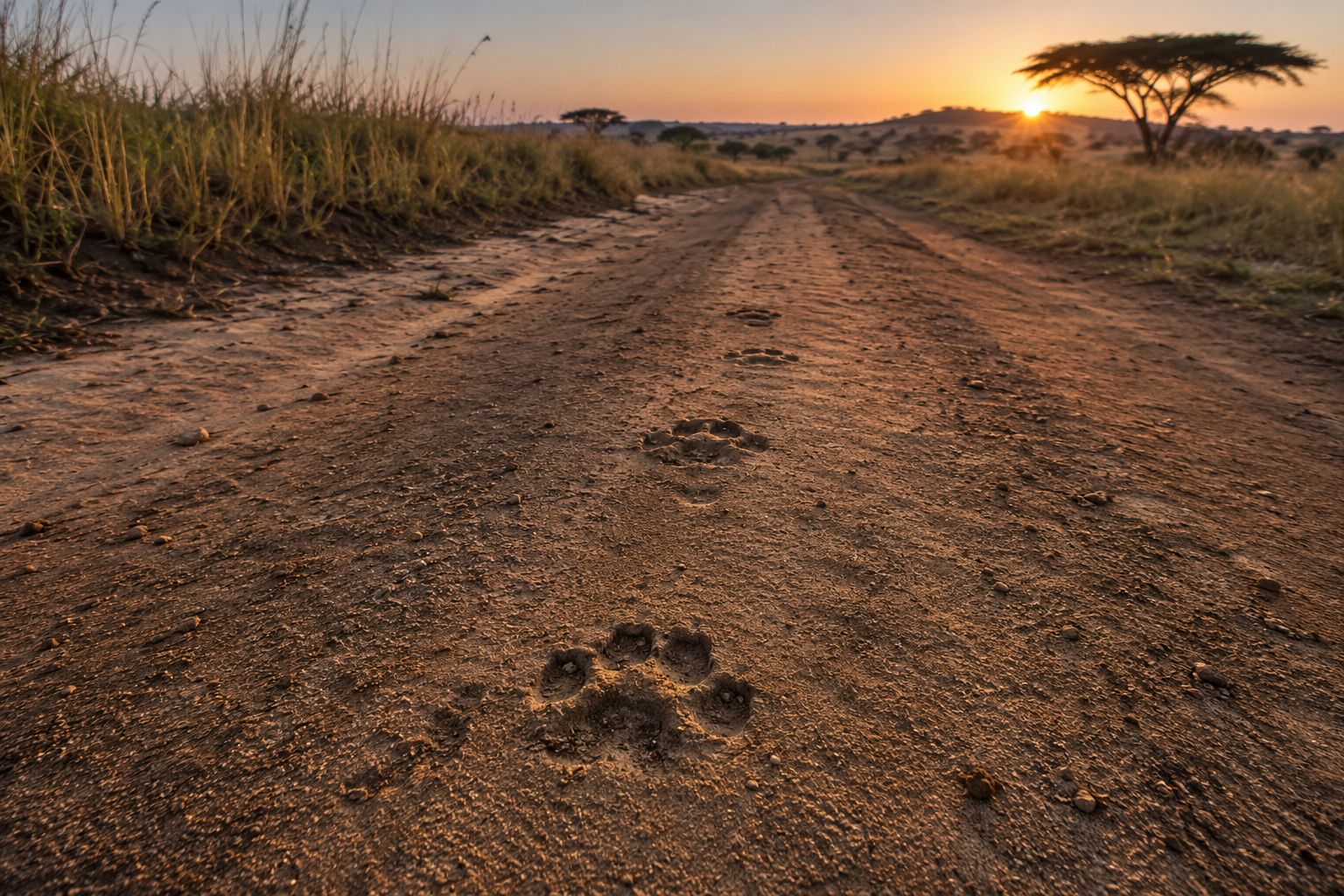
Sand and murram roads in the Mara and Amboseli retain footprints with extraordinary clarity. Our guides scan for:
- Track freshness — a print with sharp, moist edges was made within the last two hours. One with dry, wind-rounded edges is older. The difference changes where you drive next.
- Direction and gait — a lion walking steadily in one direction is likely heading to a resting spot. One whose tracks show irregular spacing was hunting, or recently fed.
- Cross-species evidence — buffalo prints overlaid by hyena tracks tells a story of a predator following prey. It's a complete overnight narrative written in the dust.
- Absence of tracks — if no impala have crossed the road, something has pushed them off their usual route. Something that scared them enough to change their morning pattern.
This is not guesswork. It is field craft built over years of mornings on these exact roads. Our guide Kevin — repeatedly singled out by name in guest reviews across TripAdvisor and SafariBookings — describes this phase as "reading the bush's overnight report."
→ Planning a Maasai Mara safari? See our game drive routes: Maasai Mara National Reserve
Minute 6–10: Wind Positioning — the Invisible Geometry Most Guests Never Know About
Here is the decision that separates good guides from exceptional ones, and it's one guests almost never see: our guides don't drive toward where animals are. They drive to where they can approach animals from downwind.
Every predator in East Africa — lion, leopard, cheetah, wild dog — relies on scent as its primary warning system. A vehicle approaching from the wrong direction floods the air with diesel, human scent, and metal. Animals that would otherwise be relaxed, viewable, and potentially in the middle of hunting behaviour simply melt away.
Wind direction in the Mara shifts as the sun heats the land. Our guides check it the moment they step out of camp — often simply wetting a finger or watching how grass moves — and plan the first route accordingly. They position the vehicle so that when they approach a likely area, the wind is in their favour.
This single decision explains why two vehicles leaving at the same time can have completely different mornings. One approaches a drainage line where lions are resting from the correct angle; the lions remain calm, curious, visible. Another drives in from upwind; the pride shifts and disappears before the guests even knew they were there.
At Amboseli National Park, where our guides work in the wide open flats beneath Kilimanjaro, wind geometry is everything. The same applies in the dense riverine bush of Samburu Game Reserve, where Grevy's zebra and reticulated giraffe require completely different approach strategies.
Minute 10–13: The Alarm Call Network — the Bush's Own Early Warning System
While the vehicle moves slowly, our guides are listening.
The African savanna has its own alarm system, and it is extraordinarily specific. Once you understand it, a game drive in Kenya becomes a conversation you can follow in real time.
Impala snort: Short, sharp exhalation. Predator nearby, likely within 200 metres. The impala has caught a scent or movement. If several impala snort in sequence and all stare in the same direction, the predator is visible to them.
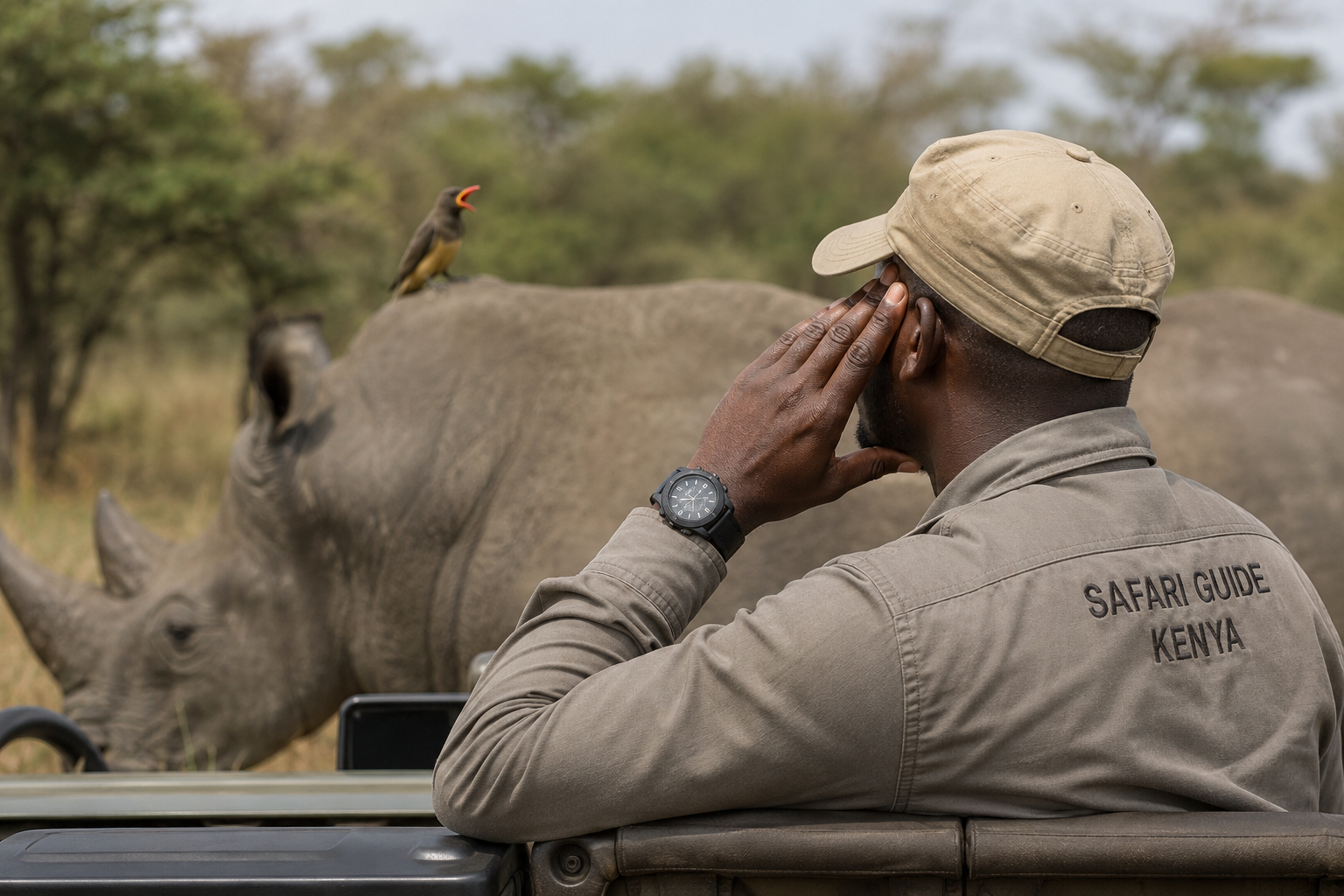
Oxpecker alarm: A rapid, hissing chatter from red-billed or yellow-billed oxpeckers. They're almost always perched on a large mammal — buffalo, giraffe, rhino, elephant. The alarm tells our guides two things at once: the host animal is nearby, and something has disturbed it.
Superb starling and yellow-throated longclaw: These ground-feeding birds flush vertically when a ground predator moves through grass. A sudden flush in a specific area tells a guide that something is moving low and fast — almost certainly a cat.
Baboon bark: Deep, rhythmic alarm barking from a baboon troop is one of the most reliable large-predator indicators in East Africa. Baboons have excellent eyesight and will alarm at leopard, lion, and wild dog from significant distances. Our guides triangulate — if baboons in two separate trees are both barking while facing the same point, something is there.
Francolin screech: High, sustained alarm call. Often indicates a ground-level threat, including snakes, but also walking big cats moving through cover.
Our guides process these signals simultaneously, building a real-time acoustic map of the area around the vehicle. Guests who ask what a sound means almost always get a detailed answer — our team loves sharing this knowledge, and it turns passive observers into active participants.
From a verified SafariBookings review of our guide Kennedy: "He somehow managed to show us all the animals possible on safari, including a lioness with three cubs, leopards, crocodiles, hippos, hyenas, cheetahs, zebras... beyond his qualities as a guide, Kennedy was an extremely pleasant interlocutor."
→ Experience this on a Samburu drive: Samburu Game Reserve
Minute 13–15: The Guest Calibration Conversation
This is the most overlooked skill in safari guiding, and the one that most reliably determines how meaningful the next three to four hours will be.
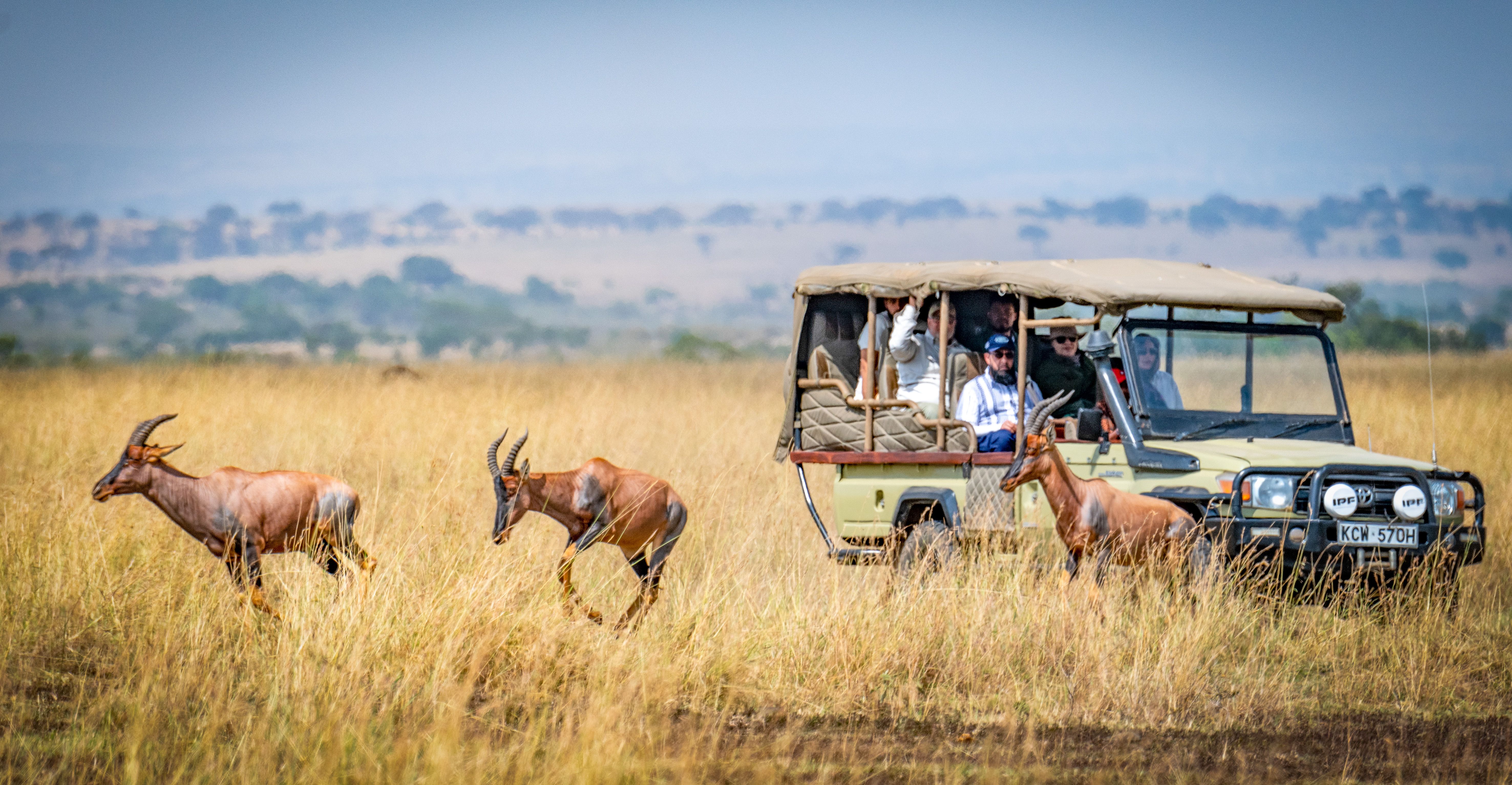
Within the first quarter of an hour, our guides have a quiet conversation — sometimes several short exchanges — that calibrates the entire drive to the specific people in the vehicle.
Some guests want to move quickly and cover ground, prioritising the chance of multiple sightings. Others want to stop for fifteen minutes at a single elephant and watch it eat, studying trunk technique and social dynamics. Some guests are passionate birders who'd happily spend twenty minutes on a lilac-breasted roller while others in the vehicle are waiting for a predator. Some have children who need things named, explained, and made exciting. Some need silence and space to simply absorb.
Our guides read cues and ask simple questions: What have you been hoping to see most? Have you been on safari before? Is there anything that makes you nervous?
The answers shape routing decisions for the rest of the drive. A guest who says "I've seen lions before but never a cheetah" means our guide will weight morning positioning toward open plains rather than riverine areas. A guest who's never been on safari and seems overwhelmed means the guide will slow down, name things more carefully, and build the experience rather than rushing it.
This is the human dimension of guiding that our reviews mention repeatedly — guides who "went at our pace," who "answered every question," who made guests "feel at home in the bush." That outcome is not accidental. It begins in these first fifteen minutes.
From our TripAdvisor listing: "Our guide, Anthony, accompanied us throughout the trip. Thanks to his kindness and knowledge, we connected with African culture and enjoyed every single moment."
→ Plan your personalised game drive: Schedule a Free Consultation
What This Means for the Rest of Your Drive
By the time fifteen minutes have elapsed from camp departure, a Beyond the Plains guide has:
- Gathered overnight intelligence from the guide radio network and camp staff
- Read fresh tracks on the departure road and formed a hypothesis about animal location
- Checked wind direction and planned approach angles accordingly
- Processed the morning's first alarm calls into a working map of activity zones
- Calibrated the drive to the specific interests and experience level of the guests
What follows — the sightings, the encounters, the moments you'll describe to friends for years — is not luck. It is the product of deliberate, expert preparation that most guests never see.
This is why, on our Kenya safaris, we say the guide is not a bonus. The guide is the safari.
The Difference Between a Vehicle and a Guide
We use Toyota Land Cruisers — the most capable safari vehicles in East Africa, customised for game viewing with pop-up roofs and tiered stadium seating. They're important. But no vehicle makes a good game drive.
What makes a good game drive is a guide who was up before you, listening to the radio, checking the wind, already building the morning's plan. A guide whose years on these specific roads have trained them to see the landscape as a living, communicating system rather than a static backdrop.
Our guides — Kevin, Kennedy, Ronnie, Anthony, Joseph, and the rest of the team that guests mention by name in their reviews — carry this knowledge onto every drive, every morning, regardless of season or conditions.
It's why guests who book private vehicles with us describe not spending more than ten minutes without sighting action. It's not magic. It's the first fifteen minutes.
Plan a Game Drive That Starts Before You Get in the Vehicle
Beyond the Plains Safaris is a Nairobi-based Kenya and Tanzania safari operator, rated 4.9 on TripAdvisor, recognised as 1st Runners-Up for Best Tour Operator in Kenya at the 2025 Tourism Excellence Awards, and a fully bonded KATO member.
We operate private custom safaris across the Maasai Mara, Amboseli, Samburu, Lake Nakuru, Tsavo, Ol Pejeta, and Tanzania including the Serengeti, Ngorongoro Crater, and Tarangire. Every drive is led by a named guide whose expertise is matched to the terrain you're visiting.
Ready to experience what the first fifteen minutes can unlock?
- Get a Free Safari Quote
- Schedule a Planning Consultation
- Browse All Kenya Safari Packages
- View Our Masai Mara Safari Tours
- Kenya and Tanzania Combined Safaris
Frequently Asked Questions
What time do game drives start in Kenya? Morning game drives typically depart between 5:30 and 6:30 AM, when predators are still active from the night and the light is ideal for both wildlife viewing and photography. At Beyond the Plains Safaris, our guides are preparing well before departure — checking radio intel, reading conditions, and planning the route.
How long does a typical game drive in Kenya last? Morning drives run three to five hours, returning to camp for breakfast before the midday heat. Afternoon drives begin around 3:30–4:00 PM and extend to sunset or slightly beyond. Full-day drives, including a bush breakfast stop, are available and popular in the Maasai Mara and Amboseli.
What's the difference between a private and shared game drive in Kenya? A private vehicle means the guide calibrates the entire drive — pace, focus, routing — to your group alone. Shared vehicles average 6–9 guests with different interests and experience levels, which limits the guide's ability to adapt. We strongly recommend private game drives for guests who want the full benefit of expert field guidance.
What should I do in the first 15 minutes of a game drive? Listen. Let your guide work. The temptation to make noise, check your phone, or ask the vehicle to move toward the first thing you see is understandable — and worth resisting. Your guide is gathering information in those first minutes. The quieter you are, the more they can hear, and the better your morning will be.
Why do Beyond the Plains guides get mentioned by name so often in reviews? Because they're not interchangeable. Our guides develop deep personal knowledge of specific landscapes, seasons, and animal behaviour patterns. Guests mention Kevin, Kennedy, Ronnie, Anthony, and others by name because those individuals made decisions — specific to that morning, that vehicle, those guests — that produced moments nothing else could have created.
Explore More From the Beyond the Plains Blog
- 10-Day Private Kenya and Tanzania Safari Review
- Kenya Destinations Overview
- Maasai Mara National Reserve Guide
- Amboseli National Park — Elephants and Kilimanjaro
- Ol Pejeta Conservancy — Rhino and Wild Dog Territory
- East Africa Safari Tours Overview
Beyond the Plains Safaris is headquartered in Nairobi, Kenya. We are members of KATO (Kenya Association of Tour Operators), ASTA, the East Africa Wildlife Society, AMREF, and Nature Kenya. Our safaris are operated in partnership with Kenya's Tourism Regulatory Authority.
4.9 ⭐ TripAdvisor | 4.7 ⭐ Google | Travelers' Choice 2022, 2023, 2024 | 2025 Tourism Excellence Awards — 1st Runners-Up Best Tour Operator in Kenya










Comments (0)
Leave a Comment
No comments yet. Be the first to comment!