
Mid-Range vs. Luxury Safari: The Definitive Guide to Choosing the Right Experience for Your Trip
You've decided to go on safari — one of the most extraordinary travel experiences on earth — and you're now staring at a price range that spans from $200 to $2,000 per night for what seems like the same lions and sunsets. What you might not realize is that the difference between a mid-range and a luxury safari isn't just about thread counts and champagne — it's about wildlife access, guide expertise, and how deeply the bush actually gets under your skin. In this guide, we break down exactly what each tier delivers, where the value truly lies, and how to choose the one that's right for your trip, your group, and your budget.
Key Takeaways
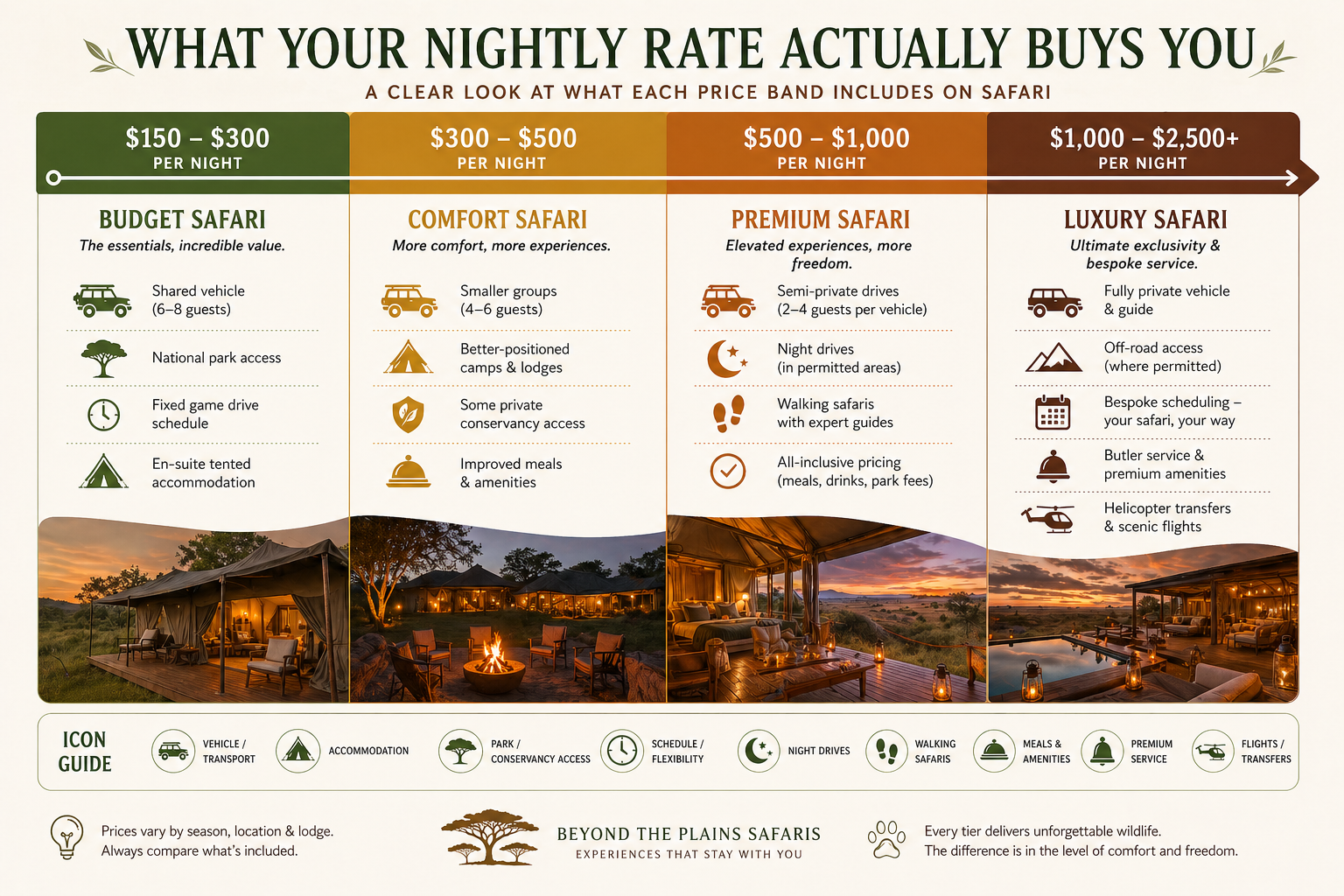
- Mid-range safaris typically cost $150–$500 per person per night and include comfortable tented camps or lodges, shared game drives, and most meals — making them an excellent entry point for first-time safari-goers.
- Luxury safaris ($500–$2,500+ per person per night) provide private concessions, exclusive game drives, and personalized service that significantly reduce crowd exposure and maximize wildlife access.
- The most important differences between mid-range and luxury safari are guide-to-guest ratios, access to private conservancies, and the flexibility to customize game drive timing and routes.
- Travelers on a mid-range budget can unlock near-luxury experiences by booking during shoulder season, choosing off-the-beaten-track parks, or selecting highly rated owner-operated camps.
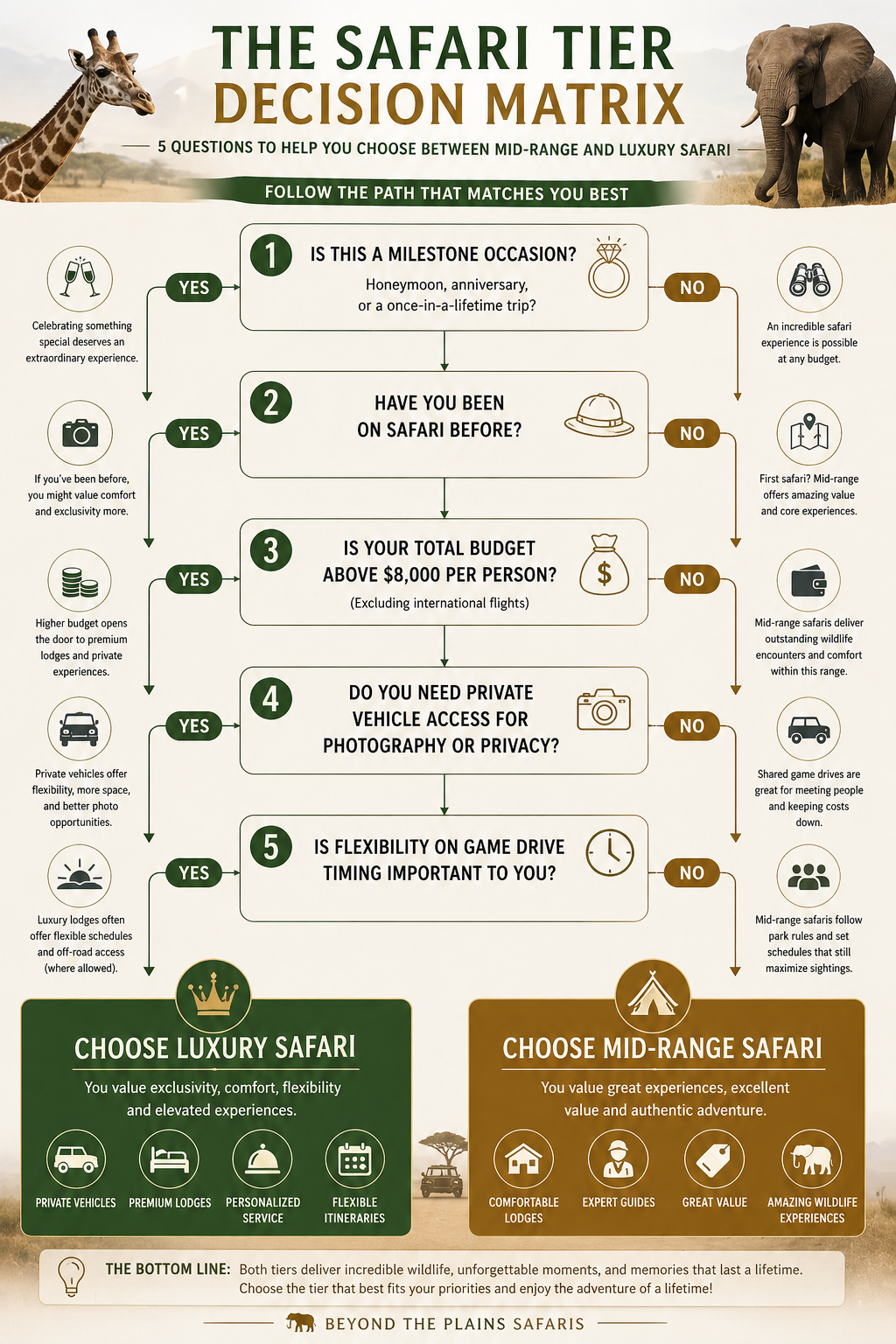
- Luxury safaris are best suited for milestone occasions, repeat visitors seeking deeper exclusivity, and travelers who prioritize privacy and bespoke service over sheer destination coverage.
- Both mid-range and luxury safaris offer genuine opportunities to witness Africa's iconic wildlife — the Big Five, the Great Migration, and unforgettable bush sunrises are not exclusive to five-star camps.
- The right safari tier is determined by your priorities — budget, comfort expectations, occasion, and travel group — not by a universal quality standard.
What Is a Mid-Range Safari and What Does It Include?
A mid-range safari is a guided wildlife experience that typically costs between $150 and $500 per person per night and includes accommodation in a tented camp or lodge, shared game drives, and most meals — making it accessible to travelers seeking a quality wildlife experience without a luxury price tag. This tier sits comfortably between budget backpacker camping and ultra-exclusive private concession camps, offering genuine safari immersion at a realistic price point for most travelers.
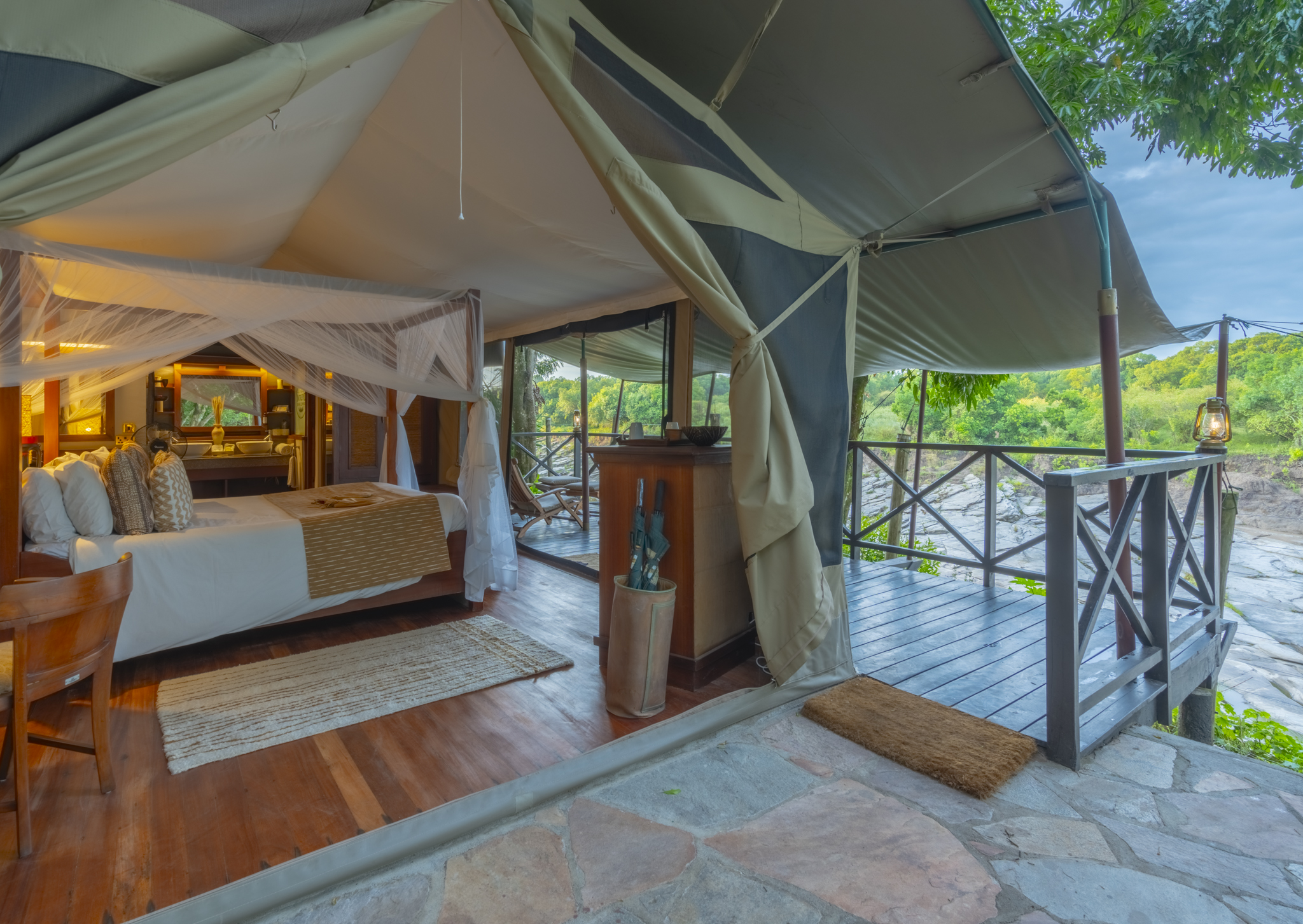
Mid-range accommodation generally takes the form of permanent tented camps, bush lodges, or mobile camps. These are real tents — but don't let that word mislead you. Most mid-range tented camps feature solid wooden floors, en-suite bathrooms, comfortable beds with proper linen, and verandas overlooking the bush. Think glamping elevated to a serious wildlife experience. For a deeper look at how to plan your first safari from scratch, explore our guide to planning your first safari.
What Does a Mid-Range Safari Typically Include?
Most mid-range safari packages include the following:
- Accommodation (tented camp, safari lodge, or mobile camp)
- Full board meals (breakfast, lunch, and dinner)
- Shared morning and evening game drives in a 4×4 safari vehicle (usually 6–8 guests per vehicle)
- Park and conservancy fees (varies by operator — always confirm this)
- An assigned guide shared across the group
What is typically not included at mid-range level: airport transfers, alcoholic beverages, laundry service, tips, and any specialist activities like hot air balloon rides or walking safaris (though some camps do offer walking safaris as add-ons).
Geographic Availability of Mid-Range Safaris
Mid-range options are widely available across East and Southern Africa. Kenya and Tanzania offer the most extensive mid-range infrastructure, with well-established camps in the Masai Mara, Serengeti, Amboseli, and Ngorongoro regions. South Africa's Kruger National Park has a strong network of mid-range lodges, including the popular SANParks-managed rest camps. Botswana is historically expensive, but mid-range options exist in Chobe and the Tuli Block. Uganda and Rwanda offer mid-range gorilla trekking packages, though permit fees add significantly to the total cost.
According to a 2023 market analysis by Skift Research, the mid-range safari segment has grown by approximately 18% since 2019, driven largely by millennial travelers and remote workers seeking immersive experiences over luxury hotels — Source: Skift Research, 2023.
What Is a Luxury Safari and What Justifies the Higher Price?
A luxury safari is defined by access to private game concessions, exclusive-use vehicles, personalized itineraries, and a higher guide-to-guest ratio — features that collectively provide superior wildlife access and a more intimate bush experience than standard shared safaris. The price for a luxury safari typically ranges from $500 to $2,500+ per person per night, and at the top end of that range, the experience bears little resemblance to a standard guided tour.
What separates luxury from mid-range is not always immediately visible in a photograph. The real differences are operational. Luxury camps operate in private conservancies or concessions adjacent to — or within — national parks, granting them access to vast stretches of wilderness that shared vehicles cannot enter. This means your game drive is not competing with twenty other vehicles for a sighting. It means your guide can follow a leopard into thick bush, off the main track, for as long as the sighting lasts. For a full breakdown of what to expect from all-inclusive safari packages, read our guide on all-inclusive safari packages explained.
What a Luxury Safari Actually Includes
At the $500–$1,000 per person per night level, luxury camps typically offer:
- Private or semi-private game drives (2–4 guests per vehicle)
- All-inclusive pricing covering meals, house beverages, laundry, park fees, and often transfers
- Dedicated butler or camp manager service
- Swimming pool, spa treatments, and curated dining experiences
- Walking safaris and night drives (often restricted in national parks but permitted on private land)
Above $1,500 per person per night, the experience becomes genuinely bespoke. Guests at this level may have access to helicopter transfers between camps, private use of entire aircraft, fly-camping in the wilderness under the stars, or exclusive-use of the entire camp — meaning you and your group are the only guests.
Leading Luxury Safari Destinations
The luxury safari market is strongest in Botswana's Okavango Delta, Kenya's Laikipia Plateau and private Mara conservancies, Tanzania's Selous (Nyerere National Park), Zimbabwe's Hwange and Mana Pools, and Zambia's South Luangwa Valley. These destinations combine serious wildlife density with the private land access that defines the luxury experience.
Botswana, in particular, has built its entire tourism model around low-volume, high-value travel — Source: Botswana Tourism Organisation, 2022. With fewer than 350,000 tourist arrivals annually compared to Kenya's over 1.5 million, Botswana offers a fundamentally less crowded safari environment at every price tier.
Why the Safari Tier You Choose Directly Shapes Your Experience
Choosing between mid-range and luxury safari is one of the most consequential decisions in your trip planning — and it extends well beyond accommodation comfort. The tier you select determines your wildlife access, guide expertise, crowd density, game drive flexibility, and the overall intimacy of your time in the bush.
Wildlife access is the clearest example. Mid-range camps operating inside national parks follow strict vehicle rules: no off-roading, no night drives (in most parks), and a mandatory return to camp by a set time. This creates predictable, enjoyable game drives — but not unconstrained ones. Luxury camps on private conservancies operate under different rules set by the landowner. Your guide can drive off the track to follow a cheetah hunt, stop in open bush for a sundowner, or conduct a night drive to observe nocturnal species like civets, porcupines, and aardvarks. To understand how private conservancies differ from national parks in terms of access, read our article on private conservancy vs. national park safari.
Guide expertise also varies significantly by tier. Mid-range operations employ qualified guides, often with national certification, but with less financial incentive to invest in ongoing specialist training. Luxury camps, particularly those operated by the top safari houses, employ guides who are actively mentored, often hold advanced tracker certifications, and are retained year-round — giving them an intimate knowledge of their specific landscape that generalist guides simply cannot match.
Crowd density is perhaps the most underappreciated factor for first-time safari-goers. During peak season in the Masai Mara or Serengeti, popular sightings — a lion pride, a leopard in a tree — can attract 20 to 40 vehicles. Mid-range operators working within national parks cannot avoid this. Luxury operators in private conservancies limit vehicle numbers by contractual agreement, often to as few as three or four per sighting.
Mid-Range vs. Luxury Safari: Side-by-Side Comparison Across Key Dimensions
The most useful way to understand the difference between mid-range and luxury safari is to compare them across the dimensions that matter most: cost, accommodation, wildlife access, guide quality, and privacy.
How Much Does a Safari Cost: Mid-Range vs. Luxury Price Breakdown
| Dimension | Mid-Range Safari | Luxury Safari |
|---|---|---|
| Price per person per night | $150 – $500 | $500 – $2,500+ |
| Accommodation type | Tented camps, lodges, mobile camps | Private tented suites, exclusive-use villas |
| Game drives | Shared (6–8 guests) | Private or semi-private (2–4 guests) |
| Guide-to-guest ratio | 1:6–8 | 1:2–4 |
| Inclusions | Meals, shared drives; some park fees | Full board, all beverages, laundry, park fees, specialty activities |
| Park/concession access | National parks and reserves | Private conservancies + national parks |
| Night drives | Rarely available | Standard offering |
| Off-road driving | Not permitted in most parks | Permitted on private land |
| Flexibility | Fixed schedule | Fully customizable |
| Best for | First-timers, budget travelers, families | Honeymoons, milestone trips, repeat visitors |
A 10-day Kenya–Tanzania itinerary at mid-range level (Masai Mara + Serengeti + Ngorongoro) will typically cost $3,500–$6,000 per person including flights, park fees, and accommodation. The same itinerary at a luxury level — private conservancy camps with all-inclusive pricing — will run $12,000–$22,000 per person. That is not a small gap, and understanding what fills it is the key to making a confident decision.
What Are the Biggest Differences Between Mid-Range and Luxury Game Drives?
The most significant practical difference between mid-range and luxury safari is not accommodation comfort but game drive exclusivity: luxury camps in private conservancies can go off-road, track animals at will, and conduct night drives that are often restricted in national parks used by mid-range operators. This single factor — off-road driving and night access — fundamentally changes what you are able to witness.
At mid-range level, a game drive typically departs at 6:00 AM and returns by 10:00 AM, then departs again at 4:00 PM and returns by 6:30 PM — a schedule dictated by park rules rather than animal activity. At luxury level, drives depart when the animals are most active, pause when a sighting develops, and sometimes continue into darkness. The pace is entirely different.
Specialist activities like walking safaris, horseback safaris, fly-camping, and canoeing are almost exclusively the domain of luxury operations on private land. These activities require guides with advanced wilderness training and insurance frameworks that mid-range operations in national parks typically don't carry.
Does Luxury Safari Guarantee Better Wildlife Sightings Than Mid-Range?
Both mid-range and luxury safaris offer genuine opportunities to witness Africa's iconic wildlife, including the Big Five — the defining factor is not whether you will see animals, but the conditions, privacy, and depth of experience under which you encounter them. A shared vehicle in the Masai Mara during the Great Migration will witness wildebeest crossings that rival anything a private concession can offer in terms of sheer scale.
That said, consistency of sightings over a week-long safari tends to favor luxury operations. Guides in private conservancies know their land — specific leopard territories, pride home ranges, cheetah coalition routes. They move proactively, not reactively. Mid-range guides in high-traffic parks follow radio chatter from other vehicles to locate animals, which is effective but creates the convoy effect that many travelers find disruptive.
Which Safari Tier Offers the Best Value for Money in Africa?
Value for money in safari is inherently subjective, but a useful framework is to ask: what are you paying per meaningful wildlife encounter? At mid-range pricing, you pay less overall but share more and see less on a per-hour basis. At luxury pricing, you pay significantly more but your per-encounter quality — intimacy, duration, exclusivity — is dramatically higher.
For a first-time safari-goer, a well-chosen mid-range camp will almost certainly exceed expectations. For a repeat visitor who has already done a shared game drive in the Mara and wants to experience tracking a pack of wild dogs on foot in the Selous, the jump to luxury is likely worth every dollar. For guidance on where each tier offers the best return on investment across specific destinations, check our Tanzania safari price guide.
When Is a Mid-Range Safari the Right Choice for Your Trip?
A mid-range safari is the right choice when your goal is to experience authentic African wildlife in genuine comfort, without overextending a travel budget that also needs to cover flights, park fees, and multiple countries. Mid-range is not a compromise — it is the appropriate tier for the majority of safari travelers.
Specific Use Cases for Mid-Range Safari
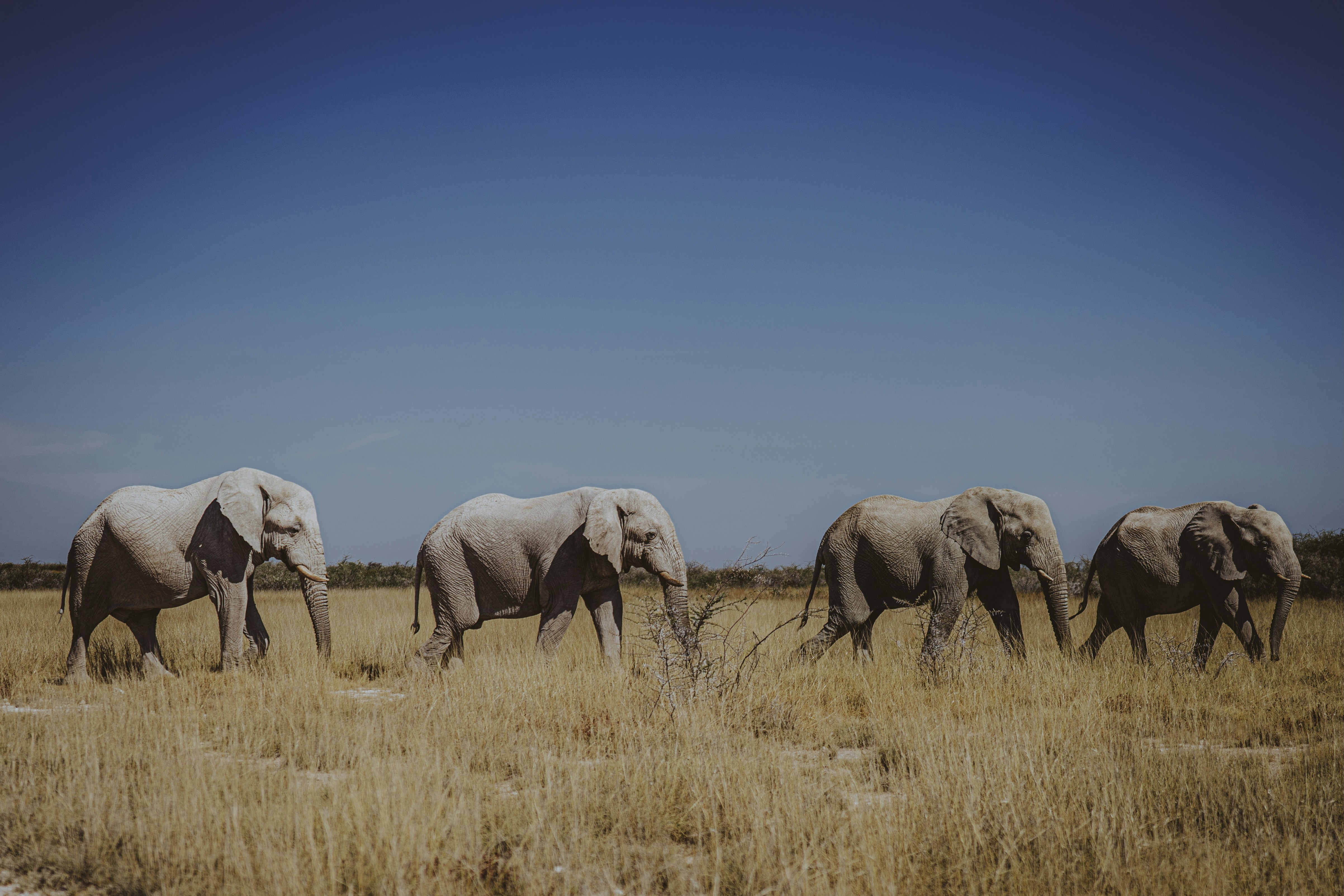
First-time safari-goers are the natural audience for mid-range. If you've never sat in silence as an elephant herd crosses a dry riverbed ten meters from your vehicle, that experience is just as powerful in a shared 4×4 as it is in a private one. The magic of Africa is not dependent on a $1,500-a-night room.
Budget-conscious travelers who want to maximize time in the bush across multiple countries. A $6,000 budget, carefully deployed across Kenya and Tanzania using mid-range camps, can fund 10–12 nights of excellent safari. The same budget at luxury level would purchase three nights with little left for flights. For families with children, mid-range lodges often accommodate kids more flexibly than luxury camps — some of which have minimum age requirements of 12 or 16.
Shoulder season travelers can unlock mid-range camps that punch well above their price point. Camps that cost $450 per person per night in peak season (July–October in Kenya) may drop to $250–$300 in the green season (April–June), yet offer the same guide, the same landscape, and — with far fewer vehicles on the road — a quieter experience. For timing your trip to catch the best conditions without peak-season pricing, read our guide on the best time to visit Kenya for a safari.
Travelers combining safari with other destinations (beach, city, gorilla trekking) benefit from mid-range pricing that leaves budget room for add-ons. A Kenya safari followed by a Zanzibar beach extension is far more affordable if the safari portion runs $300 per night rather than $1,200.
When Does a Luxury Safari Experience Make Sense?
A luxury safari makes sense when the occasion, the traveler's experience level, or specific physical requirements justify an investment in privacy, personalization, and premium wildlife access that the mid-range tier genuinely cannot replicate. There are circumstances where spending more is not indulgence — it is necessity.
Specific Use Cases for Luxury Safari
Honeymooners and anniversary travelers are the clearest use case for luxury safari. The bush at sunrise, a private vehicle, champagne under an acacia tree at sunset — these are the experiences that define a honeymoon safari. Mid-range camps can be romantic, but they cannot offer the solitude, the private bush dinners, or the undivided guide attention that defines a luxury honeymoon. For curated honeymoon itinerary ideas, explore our guide to honeymoon safari destinations in Africa.
Once-in-a-lifetime milestone trips — 50th birthdays, retirement celebrations, bucket-list completions — often justify the luxury premium on the logic that this trip is unlikely to be repeated. If you're going once, go properly.
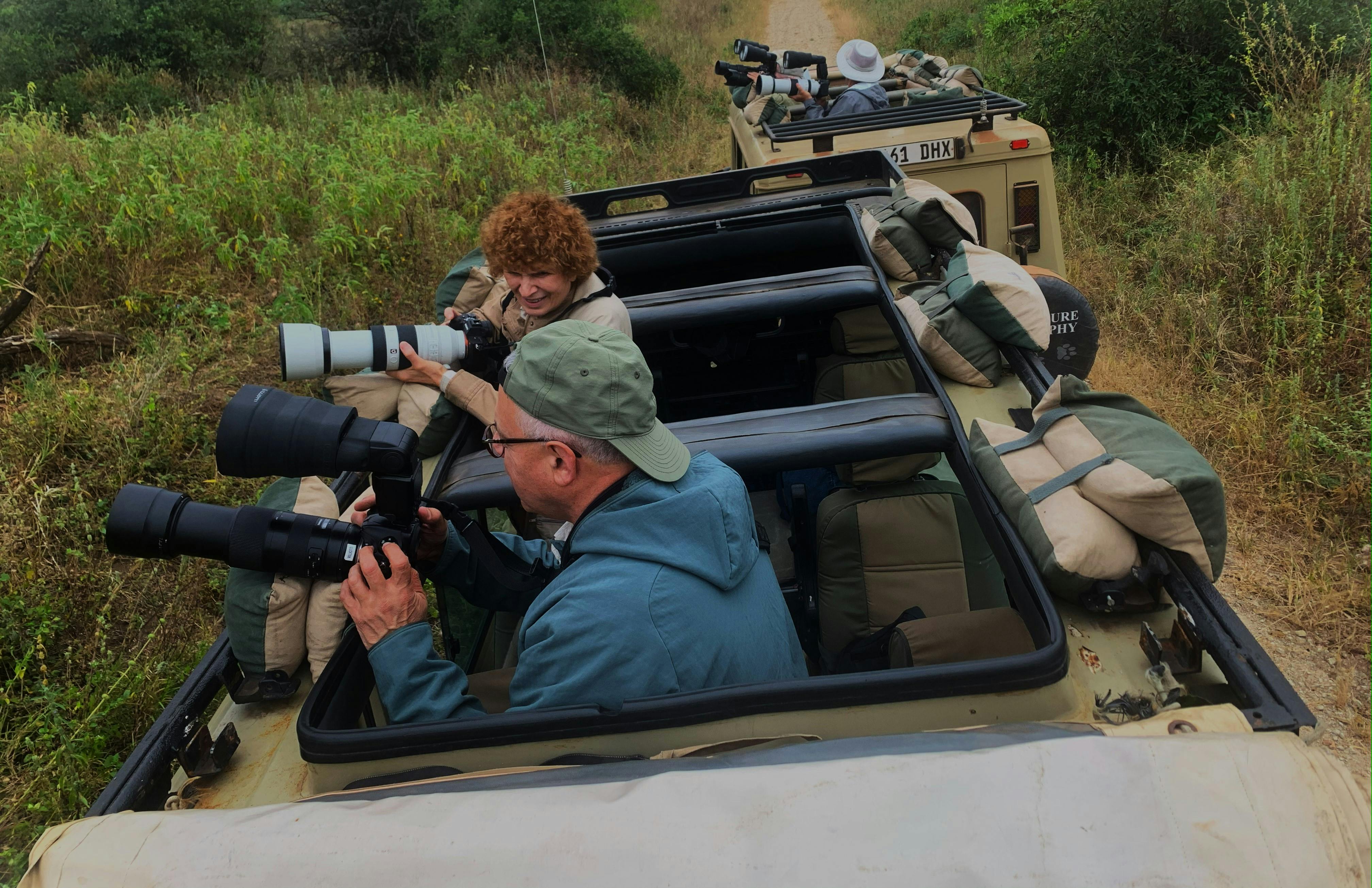
Wildlife photographers requiring private vehicle access are perhaps the most practically justified luxury safari guests. Photography requires the ability to position a vehicle for optimal light, to wait at a sighting for as long as needed, and to move slowly without eight other guests growing impatient. A private vehicle with a knowledgeable guide is not a luxury for a serious photographer — it's a working requirement.
Travelers with mobility considerations benefit from the higher service ratios, more accessible room designs, and flexible scheduling that luxury camps provide. Several top-tier operators actively cater to guests with physical limitations, offering modified vehicles, accessible walkways, and personalized support. Mid-range camps are not equipped for this level of customization.
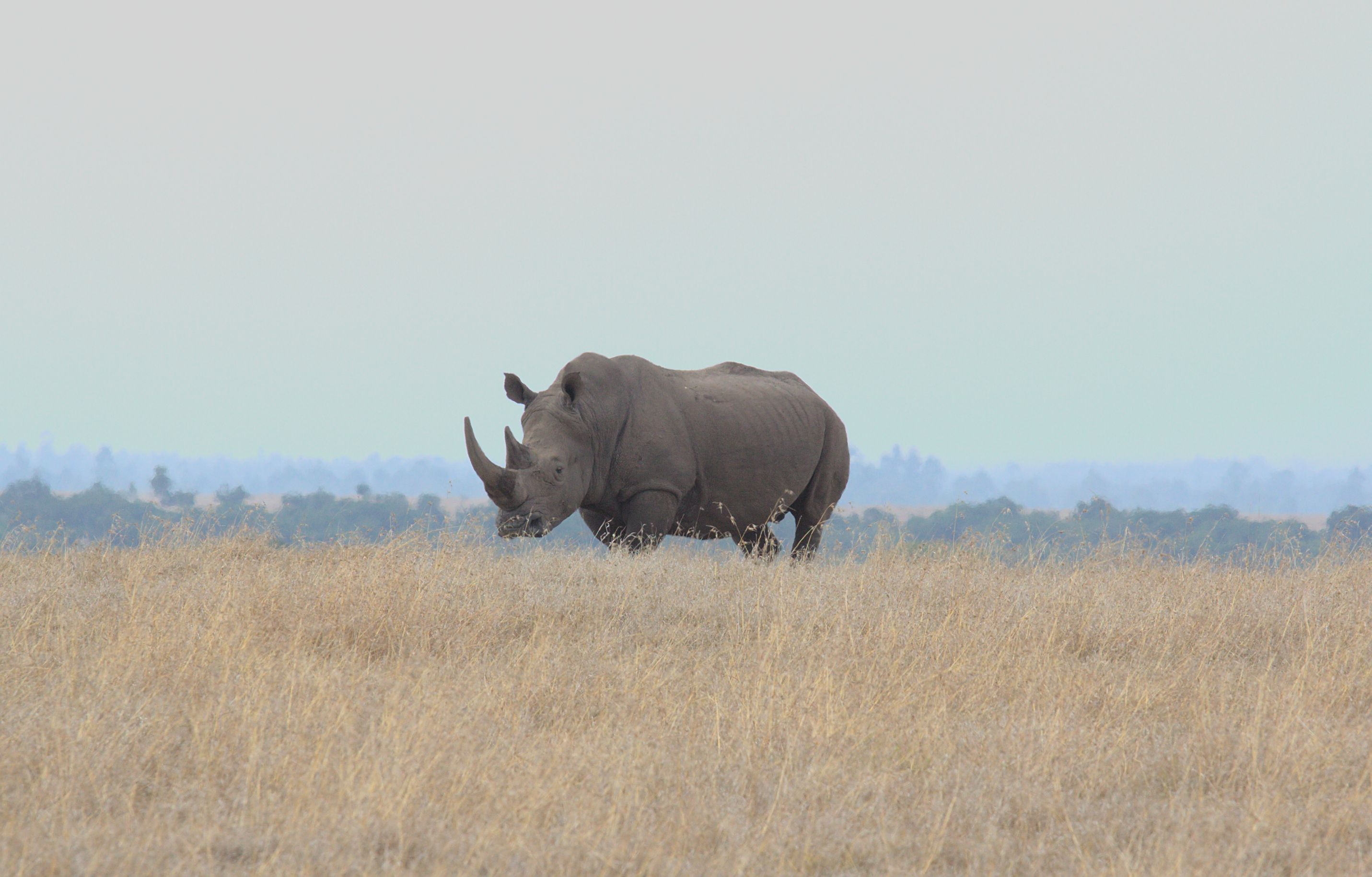
Repeat safari visitors are the final and most common luxury safari audience. If you've already done the Mara and the Serengeti at mid-range and want to experience wild dogs in Botswana's Moremi or black rhino tracking in Zimbabwe's Matobo Hills, you need a luxury camp that operates on private land with specialist guides. These are not experiences available through shared-vehicle operations. For a look at the world-class wildlife encounters possible in Botswana, visit our guide to the best safari lodges in Botswana.
Best Mid-Range and Luxury Safari Operators, Camps, and Booking Platforms
Choosing the right operator is as important as choosing the right tier — a poorly run luxury camp is a worse experience than an excellently run mid-range one. Here are concrete recommendations across both tiers in East and Southern Africa.
Best Mid-Range Safari Camps and Lodges in Africa
Kenya (Masai Mara):
- Basecamp Masai Mara — A community-owned, eco-certified camp in a private conservancy with a strong sustainability record and excellent guides. Nightly rates from around $350 per person.
- Mara Intrepids Tented Camp — A reliable Heritage Hotels property with solid infrastructure, experienced guides, and a consistent mid-range offering. Rates from $280 per person per night.
Tanzania (Serengeti & Ngorongoro):
- Serengeti Pioneer Camp — An Elewana property that bridges the mid-range and premium tiers with excellent positioning along the migration route.
- Tloma Lodge, Karatu — An excellent mid-range base for Ngorongoro with sweeping views and a family-friendly atmosphere. Rates from $200 per person per night.
South Africa (Kruger Region):
- Kapama River Lodge — A well-appointed lodge on a private game reserve near Kruger offering private game drives at mid-range pricing. Rates from $300 per person per night.
- SANParks Rest Camps (Satara, Skukuza) — Government-managed camps within Kruger offering basic but atmospheric accommodation from $80–$150 per unit per night.
Booking Platforms for Mid-Range:
- SafariBookings.com — The most comprehensive comparison platform for vetted safari operators with transparent pricing and user reviews.
- Responsible Travel — Curates ethical, community-supporting operators with honest pricing.
- Booking directly with the camp often yields the best rate and allows you to ask detailed questions about inclusions.
For guidance on identifying operators who deliver genuine quality at the mid-range price point, read our full guide on how to choose a reputable safari operator.
Top Luxury Safari Operators Worth the Splurge
Beyond the Plains Safaris — A specialist East Africa safari operator focused on highly curated, private safari experiences in Kenya and Tanzania. Known for personalized itinerary design, access to exclusive conservancies, and expert local guides, they deliver seamless, high-touch journeys tailored to each traveler. Ideal for those seeking a balance of authenticity, flexibility, and refined comfort. Rates vary by itinerary and level of exclusivity.
Wilderness Safaris — Operating across Botswana, Zimbabwe, Zambia, Kenya, Rwanda, and South Africa, Wilderness is the gold standard for private concession access, conservation partnerships, and guide training. Their Botswana camps (Vumbura Plains, Little Vumbura, Jao) are among the finest in Africa. Rates from $800–$1,800 per person per night.
&Beyond — A South African operator with camps across East and Southern Africa known for their Care of the Land, Care of the Wildlife, Care of the People philosophy. Their Ngorongoro Crater Lodge and Mara Plains Camp are benchmark luxury properties. Rates from $900–$2,000 per person per night.
Singita — The most aspirational name in African luxury safari, with properties in South Africa, Tanzania, Rwanda, and Zimbabwe. Singita's exclusivity, conservation work, and service levels are unmatched. Rates from $1,500–$3,000+ per person per night.
Asilia Africa — A Kenya and Tanzania specialist with a strong private conservancy presence, particularly in the Northern Serengeti (Namiri Plains) and Mara conservancies (Naboisho, Ol Kinyei). A more accessible luxury entry point than Singita or &Beyond, with rates from $600–$1,200 per person per night.
Robin Pope Safaris — The premier choice for Zambia's South Luangwa, offering walking safari expertise and intimate camp sizes that deliver an extraordinarily immersive experience. Rates from $700–$1,200 per person per night.
Can You Get a Luxury Safari Feel on a Mid-Range Budget?
Travelers can approximate a luxury safari experience on a mid-range budget by booking in shoulder season (typically April–June or November), selecting owner-operated camps with smaller guest capacities, and prioritizing lesser-visited parks with lower park fees. This is not about cutting corners — it is about strategic allocation of a fixed budget toward the variables that matter most.
Practical Tips for Maximising Value on a Mid-Range Budget
Travel in shoulder season. April through June in East Africa brings the green season — lush landscapes, baby animals, fewer vehicles, and rates 20–35% lower than peak season. The wildlife is no less active; in fact, predator-prey dynamics are often more intense. Many mid-range camps in the Mara run rates below $250 per person per night in this period.
Choose owner-operated camps. Small camps run by their founders typically employ better guides, serve better food, and care more deeply about their guests' experience than large chain-managed properties. Look for camps with fewer than 16 beds. Owner-operators often know their guides by name, train them personally, and respond to direct enquiries with genuine expertise.
Prioritize lesser-visited parks. Kenya's Samburu, Laikipia, and the Matthews Range offer exceptional wildlife (rare northern species like Grevy's zebra and reticulated giraffe) with a fraction of the Mara's vehicle traffic. Tanzania's Ruaha and Katavi national parks offer wild dog, buffalo herds, and lion densities that rival anywhere in Africa — at significantly lower park fees and accommodation rates than the Serengeti.
Book directly with the camp. Agent commissions typically add 10–20% to advertised rates. Booking directly, especially in shoulder season, often yields complimentary upgrades, room-rate reductions, or added value (free activity, airport transfer, or welcome bottle of wine). Always ask.
Use a local East African operator rather than a Western travel agent. Local specialists operating from Nairobi, Arusha, or Cape Town have lower overheads and direct relationships with camps, enabling them to offer genuine value that overseas agents cannot. For tips on self-drive options that dramatically reduce per-night costs in South Africa, read our guide on South Africa self-drive safari tips.
How to Plan and Book Your Safari Based on Your Tier
Planning a safari well requires a clear sequence of decisions — starting with budget, then destination, then operator — rather than the reverse. Most travelers start with a destination and then discover the budget doesn't stretch; a better approach starts with what you can comfortably spend and works outward from there.
Step 1: Set a Realistic Total Budget
Include everything: flights, visa fees, park fees, accommodation, activities, tips, and travel insurance. A common mistake is budgeting only for accommodation and discovering that park fees in Kenya's Masai Mara add $80–$100 per person per day, or that a balloon safari over the Serengeti costs $600 per person. For a full breakdown of costs and entry requirements, consult our guide on Africa safari visa and entry requirements.
Step 2: Choose Your Destination Based on Budget and Wildlife Goals
- $3,000–$6,000 total per person (flights + safari): Kenya, Tanzania, or South Africa at mid-range level for 7–10 nights.
- $6,000–$12,000 total per person: Kenya or Tanzania with a mix of mid-range and one luxury camp for a special night or two; or Uganda gorilla trekking plus a wildlife safari.
- $12,000–$25,000+ total per person: Botswana, Zambia, or Zimbabwe at luxury level; or a multi-country East African itinerary with private conservancy camps throughout.
Step 3: Work With a Specialist
Safari planning is complex. A good safari specialist — whether a local operator or a specialist agency — saves you money by knowing which camps are performing well this season, which guides are exceptional, and where the best wildlife sightings are happening. They also protect you from booking mistakes that are expensive to undo.
Step 4: Ask the Right Questions Before Booking
Before committing to any camp, ask:
- Are park fees included in the quoted rate?
- What is the maximum vehicle capacity for game drives?
- Does the camp operate on private land or within a national park?
- Are night drives and walking safaris available?
- What is the guide's certification level and years of experience?
- What is the cancellation policy?
For a complete packing checklist and pre-departure preparation guide, read our article on what to pack for an African safari.
How Do You Choose Between Mid-Range and Luxury Safari for a Honeymoon?
Choosing between mid-range and luxury safari for a honeymoon depends primarily on budget flexibility and the specific experience you want to centre the trip around. Both tiers can be romantic — but they deliver romance very differently.
At mid-range, a honeymoon safari in the Masai Mara or Serengeti offers the authentic wilderness experience that most couples associate with an African honeymoon: the sounds of the bush at night, communal dining around a fire, shared game drives. Many mid-range camps have honeymoon suites or will arrange a private bush dinner for a supplement. The intimacy is real; it is simply shared more broadly with other guests.
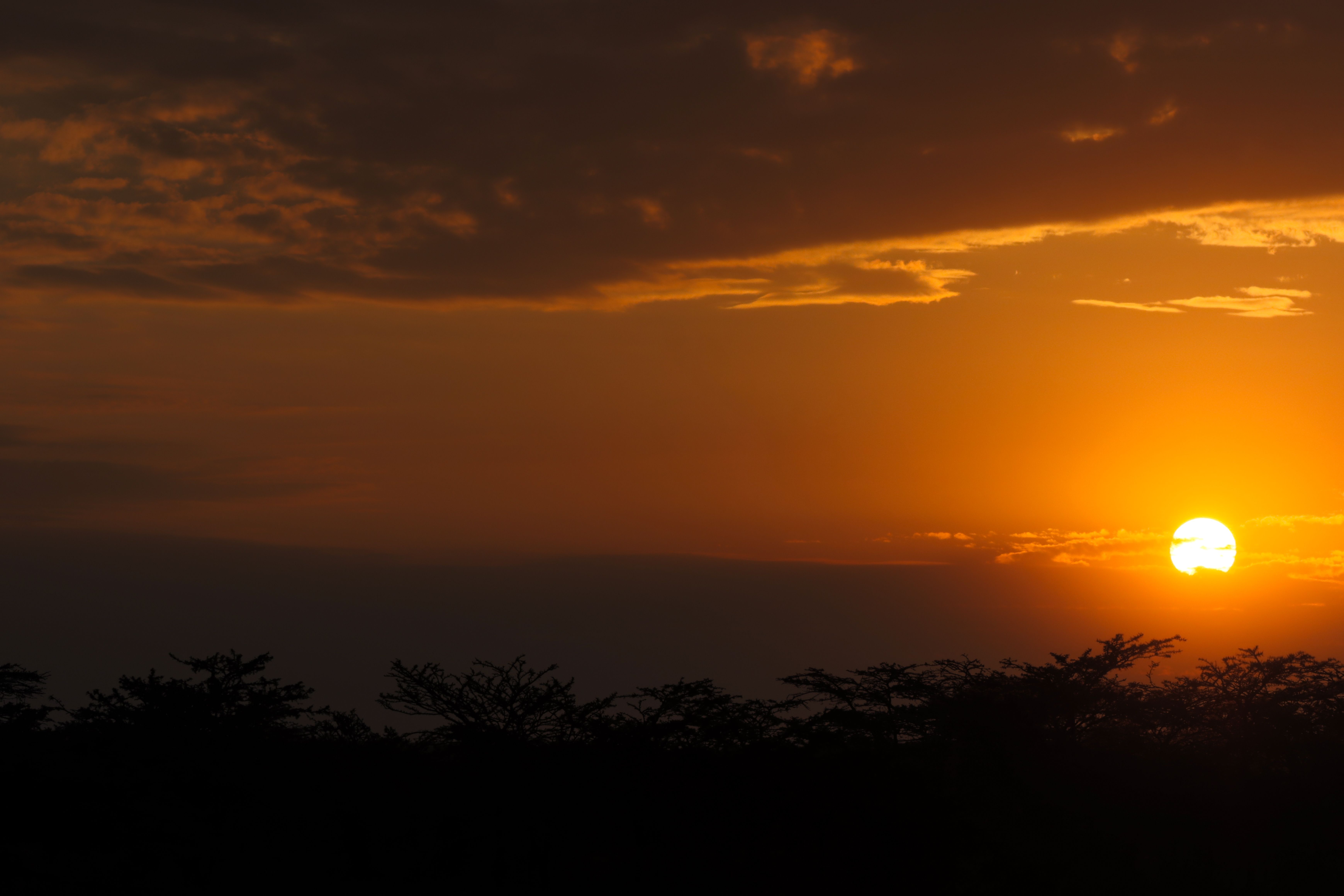
At luxury level, a honeymoon safari becomes genuinely private. You and your partner in your own vehicle, your own guide, stopping wherever the mood takes you. Sundowners served from the back of the Land Cruiser in the middle of the Serengeti as the sky turns amber and violet. A private plunge pool. A bush breakfast laid out at the edge of a waterhole. These are experiences that mid-range camps simply cannot replicate at scale.
A pragmatic honeymoon approach: use mid-range accommodation for the bulk of the itinerary and splurge on one or two luxury nights for a milestone moment. Many couples book three nights at a luxury conservancy camp in the Mara — where the game viewing is extraordinary and the private drive experience is transformative — and combine it with four nights at a well-chosen mid-range camp for the rest of the trip. This structure delivers the emotional peaks of luxury safari at a blended cost of $400–$600 per person per night across the itinerary.
Conclusion: The Right Safari Is the One That Fits Your Life
Both mid-range and luxury safaris deliver genuine wildlife magic. They deliver it differently — in different vehicles, under different skies, at different price points — but the elephant that crosses in front of your vehicle at dawn doesn't know what you paid for your room. The magic of Africa is not a luxury-exclusive experience.
What is exclusive to the luxury tier is the depth of access, the unhurried pace, and the feeling of having the wilderness to yourself. What is exclusive to the mid-range tier is the accessibility, the sociable atmosphere of shared discovery, and the freedom to explore multiple destinations without depleting your savings.
Choose mid-range if you're visiting Africa for the first time, you want to maximize time in the bush across multiple countries, or you're traveling with a family on a sensible budget. You will not be disappointed. Thousands of travelers return from mid-range safaris declaring it the best experience of their lives — because it is.
Choose luxury if the occasion demands it, you've done the basics and want to go deeper, or you have a specific experience in mind — walking safaris, night drives, private tracking — that mid-range operations cannot offer. The investment is significant, but the experiences it unlocks are genuinely irreplaceable.
The best safari is not the most expensive safari. It is the one that aligns with your budget, your travel group, your occasion, and your appetite for adventure. Africa will take care of the rest.
Ready to plan your safari? Contact our team at Beyond the Plains Safaris for a personalized itinerary tailored to your budget, destination preferences, and travel dates. Whether you're drawn to the Mara at mid-range or Botswana at luxury level, we'll build a trip that fits — and one you'll be talking about for the rest of your life.
Written by Felix Obari Senior Safari Specialist, Beyond the Plains Safaris Felix has over 14 years of experience designing safari itineraries across Kenya, Tanzania, Uganda, Botswana, Zambia, and Zimbabwe. He has personally stayed in more than 80 camps across East and Southern Africa and specializes in helping first-time and repeat safari travelers find the right balance between budget, comfort, and wildlife access.
Reviewed by the Editorial Team Beyond the Plains Safaris
Disclaimer: This article was initially drafted using AI assistance. However, the content has undergone thorough revisions, editing, and fact-checking by human editors and subject matter experts to ensure accuracy. All price ranges are indicative as of 2024–2025 and may vary by season, operator, and booking timing.









Comments (0)
Leave a Comment
No comments yet. Be the first to comment!