


The Ultimate Kenya & Tanzania Safari Guide: How to Combine Both Destinations Seamlessly
By John Dante, Owner and Lead Guide, Beyond the Plains Safaris
Most travelers know that Kenya and Tanzania are two of the greatest safari destinations on earth — and most assume they'll have to choose one or the other. What they don't realize is that these two countries share the same wildlife ecosystem, the same migration route, and in many cases, the same game-viewing season — meaning combining them isn't just possible, it's the smarter way to experience East Africa. In this guide, you'll find everything you need to build a seamless Kenya-Tanzania safari: the ideal itinerary sequence, the logistics decoded, the costs broken down, and the expert insider tips that most travel blogs leave out.
Key Takeaways
- A Kenya and Tanzania combined safari lets travelers follow the Great Migration across both its Serengeti and Maasai Mara phases in a single trip, maximizing wildlife sightings across the full ecosystem.
- The two countries share a continuous wildlife corridor, meaning combining them creates a richer, more complete safari experience than visiting either destination alone.
- Itinerary sequencing should be driven by the Great Migration calendar: the wildebeest are in Tanzania's Serengeti from December to June and cross into Kenya's Maasai Mara from July to October.
- Travelers can connect Kenya and Tanzania by short domestic flights (as little as 45 minutes from Nairobi to Kilimanjaro) or by overland border crossing at Namanga, making logistics far more manageable than most first-timers expect.
- A combined 12–14 day itinerary is widely considered the minimum to do both countries justice, while a 21-day trip allows for a Zanzibar beach extension after the safari.
- Safari costs for a dual-country trip typically range from $400 to $1,500+ per person per night depending on accommodation tier, with a single operator covering both countries often delivering better value and smoother logistics.
- Booking with one safari operator experienced in both Kenya and Tanzania — rather than two separate operators — is the single most effective way to ensure seamless transfers, consistent quality, and simplified planning.
What Is a Kenya and Tanzania Combined Safari?
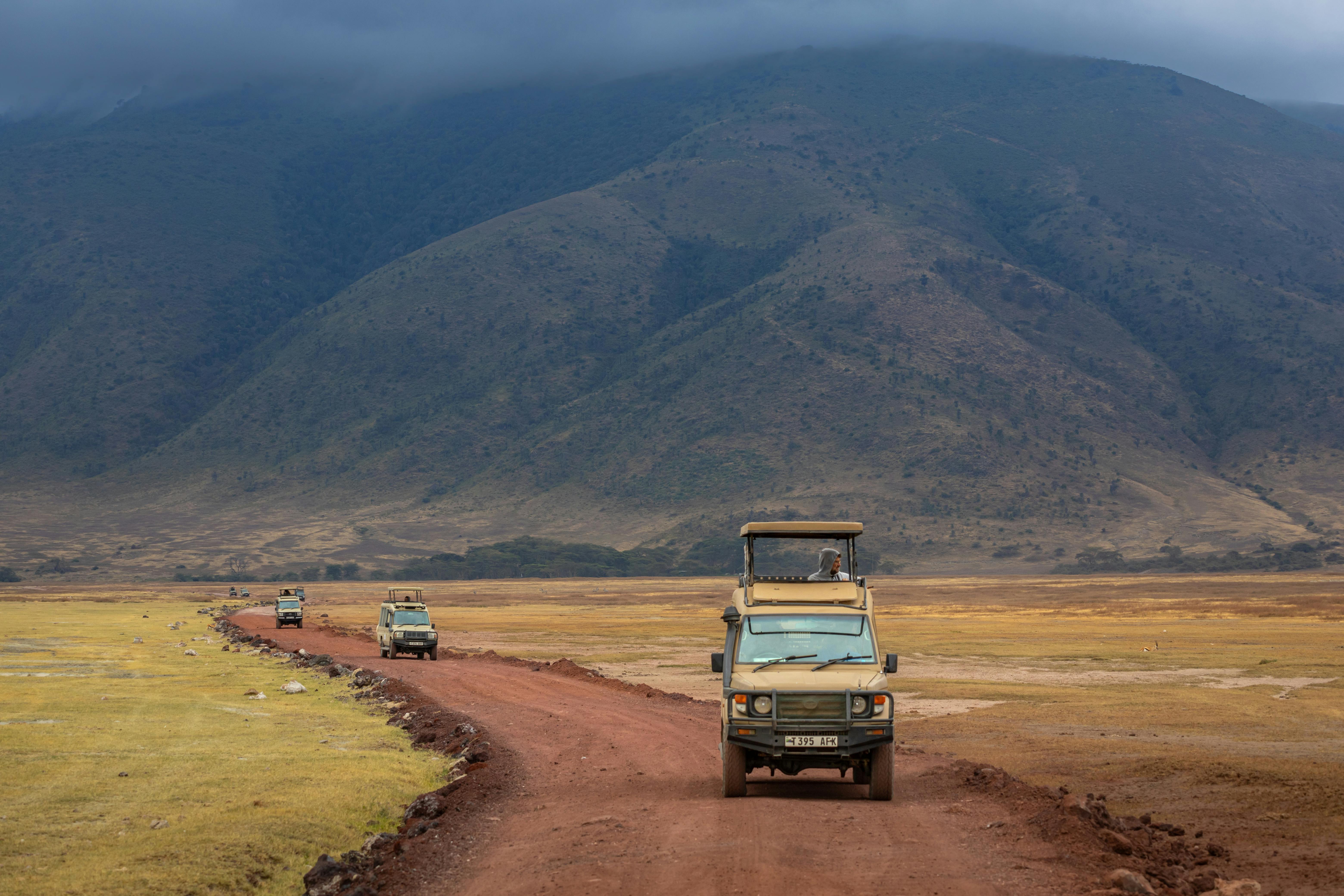
A Kenya and Tanzania combined safari is a single, multi-country wildlife journey that takes travelers through the premier game reserves of both East African nations in one continuous trip. Rather than treating these as two separate vacations, a dual-country safari is built around the shared ecological reality that Kenya and Tanzania form a single, unbroken wildlife ecosystem — most visibly expressed through the annual Great Migration of over 1.5 million wildebeest that move between Tanzania's Serengeti and Kenya's Maasai Mara.
What separates a combined safari from a single-country trip is strategic sequencing. Instead of spending all your days in one destination, you move through a curated selection of parks and reserves across both countries, following wildlife patterns, optimizing your time in the field, and experiencing dramatically different landscapes — from Tanzania's ancient volcanic crater to Kenya's red-soiled Samburu desert — within the same journey.
This kind of trip is not an extreme logistical undertaking. In practice, crossing between Kenya and Tanzania is straightforward: travelers can fly between Nairobi and Kilimanjaro in under an hour, or cross the Namanga land border in a safari vehicle with minimal hassle. The result is an East Africa experience that is, quite simply, greater than the sum of its parts.
Why Should You Combine Kenya and Tanzania Instead of Visiting Just One?
Combining Kenya and Tanzania gives travelers access to the complete Great Migration corridor — an ecological event that cannot be fully experienced within either country alone. The wildebeest migration is circular. The herds spend different months in different ecosystems, which means visiting only one country means catching only half the story.
Beyond the migration, each country offers landscapes and wildlife experiences that genuinely complement each other. Kenya's Amboseli National Park delivers the iconic Kilimanjaro backdrop with vast elephant herds. Tanzania's Ngorongoro Crater offers the highest density of predators on earth in a setting that looks like a lost world. Neither country can replicate what the other offers. Doing both removes the most common post-safari regret: "I wish I'd gone to the other one."
From a practical standpoint, combining both countries on a single trip also often delivers better value than two separate trips. A well-structured dual-country itinerary with one operator can reduce total costs through shared logistics, bundled park fees, and optimized routing. Over 70% of travelers who visit East Africa say they wish they'd planned more time or included more countries — Source: Virtuoso Luxury Travel Survey, 2023.
The Great Migration Corridor: Two Countries, One Wildlife Event
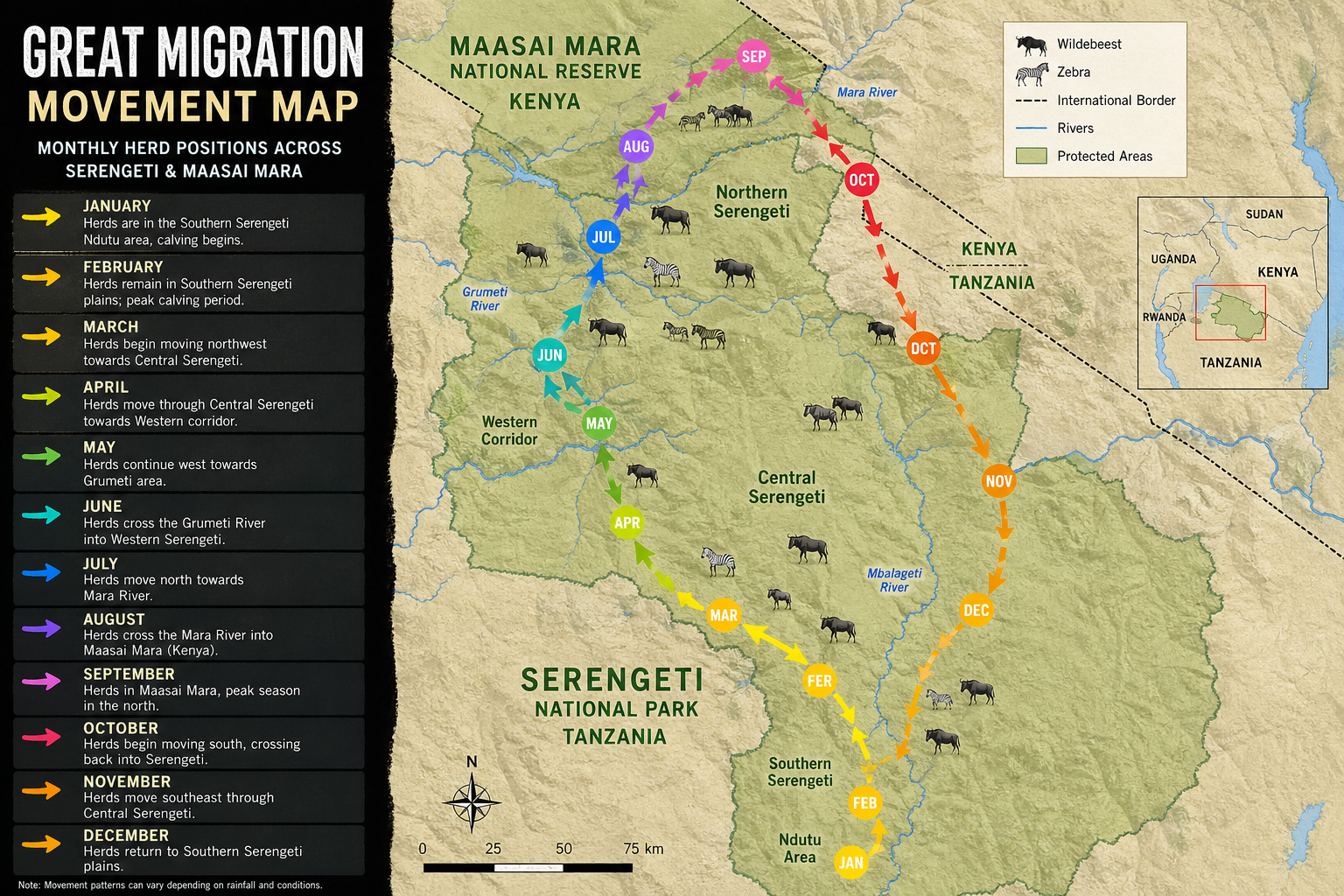
The Great Migration is a single, continuous wildlife cycle that spans both Tanzania and Kenya, covering approximately 1,800 miles of annual movement. A combined Kenya-Tanzania safari allows travelers to intercept this movement at multiple points — calving season in Tanzania's southern Serengeti (January–February), river crossings in the western corridor (May–June), and the dramatic Mara River crossings in Kenya's Maasai Mara (July–October).
No other safari destination on earth offers this scale of wildlife movement. Experiencing both sides of the corridor — the Serengeti's vast open plains and the Mara's lush, riverine ecosystem — reveals the full ecological drama that single-country visitors can only partially witness.
A Richer, More Varied Safari Experience
A combined East Africa safari exposes travelers to greater habitat diversity than any single-country trip can provide. In one journey, you can move from the montane forests of Kenya's highlands, across the alkaline soda lakes of the Rift Valley, into Tanzania's ancient volcanic landscapes, and end on the white-sand shores of Zanzibar. Each environment supports different species, different behaviors, and a completely different aesthetic.
This variety matters enormously for repeat safari-goers, but it also makes the combined trip ideal for first-timers. Rather than returning to East Africa multiple times over many years, a well-planned combined itinerary delivers a comprehensive introduction to the continent's most iconic wildlife and landscapes in a single journey.
When Is the Best Time to Visit Kenya and Tanzania on the Same Safari?
The best time to visit Kenya and Tanzania on a combined safari depends almost entirely on which phase of the Great Migration you most want to witness, though both countries offer exceptional game viewing year-round. Understanding the migration calendar is the most important planning decision you'll make for this trip.
The wildebeest migration follows a predictable annual cycle driven by rainfall and grass availability. The broad outline: herds are in Tanzania from November through June, calving in the southern Serengeti from January to March and moving north through the western corridor from April to June. They enter Kenya's Maasai Mara between July and October, producing the famous river crossings before returning south in November.
Month-by-Month Migration Timeline
| Month | Location | Highlight |
|---|---|---|
| January–February | Southern Serengeti, Tanzania | Calving season — 8,000 births per day |
| March–April | Central Serengeti, Tanzania | Herds consolidating, predator activity high |
| May–June | Western Corridor, Tanzania | Grumeti River crossings begin |
| July–August | Northern Serengeti / Entering Maasai Mara | Mara River crossings peak |
| September–October | Maasai Mara, Kenya | Peak crossing season, high predator density |
| November | Returning south through Maasai Mara | Herds begin southern migration |
| December | Southern Serengeti, Tanzania | Pre-calving buildup |
Should You Start in Kenya or Tanzania?
Which country you start in should be determined by your travel dates and the current position of the migration. As a general framework: if you're traveling between July and October, start in Tanzania (Serengeti, Ngorongoro) and end in Kenya (Maasai Mara) to catch the migration at its Kenyan peak. If you're traveling between January and June, reverse the sequence — begin in Kenya (Amboseli, Maasai Mara's year-round wildlife) and move into Tanzania as the herds consolidate in the Serengeti.
For travelers without specific migration timing in mind, starting in Tanzania is often recommended. Tanzania's parks — the Serengeti, Ngorongoro Crater, and Tarangire — tend to require more ground travel and benefit from being done while travelers are freshest. Kenya's parks, particularly the Maasai Mara and Amboseli, are slightly easier to reach by air and make an excellent finale to an East African journey.
Shoulder Seasons and Value Windows
The shoulder seasons — November and April–May — offer some of the best value in East Africa, with lodge rates 20–40% lower than peak season and significantly fewer vehicles in the parks. April and May bring the long rains to both countries, with wet afternoons but clear mornings that produce extraordinary photography light. November brings short rains, which green up the landscapes dramatically and trigger the calving season's start in Tanzania — Source: Kenya Tourism Board, 2024.
What Are the Must-Visit Safari Parks in Kenya for a Combined Itinerary?
Kenya's top safari parks for a combined itinerary are the Maasai Mara, Amboseli, Samburu, Lake Nakuru, and Ol Pejeta — each offering distinct wildlife experiences that complement Tanzania's parks without duplicating them. For a combined trip, most travelers focus on two to three Kenyan parks to avoid overcrowding the itinerary.
Maasai Mara National Reserve
The Maasai Mara is Kenya's most celebrated wildlife reserve and the northern terminus of the Great Migration corridor. Covering approximately 1,510 square kilometers, the Mara is renowned for its extraordinary density of big cats — lions, cheetahs, and leopards are reliably sighted year-round. The Mara River crossings between July and October, when thousands of wildebeest plunge into crocodile-filled water, represent one of the most dramatic wildlife spectacles on earth.
Ideal duration for a combined itinerary: 3–4 nights. Use the Maasai Mara safari guide to plan game drives around the Triangle, which receives fewer vehicles and consistently delivers excellent sightings. Fly into the Mara from Nairobi on Safarilink or Air Kenya for maximum efficiency — the flight takes 45 minutes.
Amboseli National Park
Amboseli National Park is Kenya's premier destination for elephant photography, offering the continent's most iconic view: massive bull elephants moving against the snow-capped backdrop of Mount Kilimanjaro. The park's open, marshy landscape — fed by underground streams from the mountain — supports over 1,600 elephants and provides exceptional visibility for all wildlife sightings.
Ideal duration: 2 nights. Amboseli works perfectly as a Tanzania-Kenya connector: the park sits directly on the border, and travelers coming from Tanzania by road can enter Amboseli en route to Nairobi. Read more in our Amboseli National Park safari guide.
Samburu National Reserve
Samburu is Kenya's northern frontier — a remote, arid landscape that supports species found nowhere else in the country, including the reticulated giraffe, Grevy's zebra, Somali ostrich, and gerenuk (the long-necked antelope that feeds standing upright). The reserve sits six hours north of Nairobi and is best accessed by charter flight, making it a natural extension for travelers with 14+ days.
Ideal duration: 2–3 nights. Samburu adds genuine ecological diversity to a combined itinerary and rewards travelers who want something beyond the migration circuit.
Lake Nakuru and Ol Pejeta
Lake Nakuru National Park is best known for its rhino sanctuary — both black and white rhinos are reliably found here — and for the flamingos that gather on its alkaline shores when conditions are right. Ol Pejeta Conservancy in the Laikipia plateau is home to the world's last two northern white rhinos, chimpanzees (unusual for East Africa), and an outstanding lion population.
Both parks work well as add-ons for travelers with extra days in Kenya. Ol Pejeta in particular is an extraordinary experience for conservation-minded travelers who want to witness active rhino conservation in practice.
What Are the Essential Tanzania Safari Destinations You Shouldn't Skip?
Tanzania's essential safari destinations for a combined itinerary are the Serengeti, Ngorongoro Crater, Tarangire, and Lake Manyara, with Zanzibar as an optional beach extension. Tanzania's northern circuit is one of the most efficiently routed safari regions in the world — these four destinations sit within a compact geographic corridor that can be covered by road or air without significant backtracking.
Serengeti National Park
The Serengeti National Park is Tanzania's iconic centerpiece and one of the oldest and largest ecosystems on earth, covering approximately 14,763 square kilometers of open savannah, kopjes (rocky outcrops), and riverine woodland. The Serengeti is the engine of the Great Migration and supports the highest concentration of large mammals of any habitat on earth — including approximately 70 large mammal species and 500 bird species — Source: Tanzania National Parks Authority, 2023.
For a combined itinerary, the Serengeti deserves 4–5 nights minimum, ideally split between the central Seronera area and a mobile camp in whichever sector holds the migration during your dates. The Serengeti National Park overview provides a full breakdown of the park's different regions and when to visit each.
Ngorongoro Crater
The Ngorongoro Crater is the world's largest intact volcanic caldera and one of Africa's most extraordinary wildlife habitats, covering 260 square kilometers and home to an estimated 25,000 large animals that live permanently on the crater floor. Because the crater's steep walls naturally contain most species, predator sightings are remarkably reliable — the black rhino, extremely rare elsewhere, is regularly spotted here.
Ideal duration: 1–2 nights. The Ngorongoro Crater travel guide covers the best lodges on the crater rim, what wildlife to expect by season, and how to sequence your visit with the Serengeti. Most Tanzania northern circuit itineraries combine Ngorongoro with Tarangire and the Serengeti in a natural routing sequence.
Tarangire National Park
Tarangire National Park is Tanzania's most underrated safari destination — a vast, baobab-studded park that holds the highest density of elephants in Tanzania and extraordinary birdlife year-round. During the dry season (June–October), Tarangire's river becomes the only water source for miles, drawing wildlife in concentrations that rival any park in Africa.
Ideal duration: 2 nights. Tarangire is typically the first stop on Tanzania's northern circuit, positioned between Arusha and the Serengeti. It offers exceptional game viewing with a fraction of the crowds found in the Serengeti.
Lake Manyara National Park
Lake Manyara National Park is compact but wildlife-rich, famous for its tree-climbing lions, large hippo pods, and enormous flocks of flamingos on the lake's alkaline shores. The park serves as an ideal half-day or full-day stop between Arusha and Ngorongoro Crater — it's rarely worth a separate overnight for a combined itinerary but adds excellent variety to a Tanzania circuit.
Zanzibar: The Beach Extension
Zanzibar is an archipelago of Indian Ocean islands off Tanzania's coast, offering turquoise water, coral reefs, historic Stone Town, and some of the most beautiful beaches in the world. Adding a Zanzibar extension to a Kenya-Tanzania safari transforms the trip into a complete "bush-and-beach" experience — a rest-and-recover reward after 10–14 days of early morning game drives.
The Zanzibar beach guide covers the best areas to stay, whether to add Zanzibar before or after your safari, and how to reach the island from Arusha or Nairobi by short domestic flight. Most operators recommend placing Zanzibar at the end of the itinerary so the safari drives the trip's narrative.
How to Structure Your Kenya-Tanzania Itinerary: Sample Plans for Every Trip Length
The ideal Kenya-Tanzania itinerary structure depends on your total travel days, migration timing, and which parks you prioritize — but most combined safaris fall into three practical lengths: 10 days (focused), 14 days (comprehensive), and 21 days (including Zanzibar). Each length requires a different sequencing logic.
10-Day Kenya-Tanzania Safari Itinerary
A 10-day combined safari is a focused, high-impact itinerary that covers the essential parks in both countries without filler days. It works best between July and October, when the Maasai Mara's migration makes Kenya the unmissable finale.
- Days 1–2: Arusha arrival, Tarangire National Park
- Days 3–4: Ngorongoro Crater
- Days 5–7: Serengeti National Park (central / northern depending on season)
- Day 8: Fly Serengeti to Nairobi (Wilson Airport), transfer to Amboseli
- Days 8–9: Amboseli National Park
- Day 10: Fly to Maasai Mara or return to Nairobi for departure
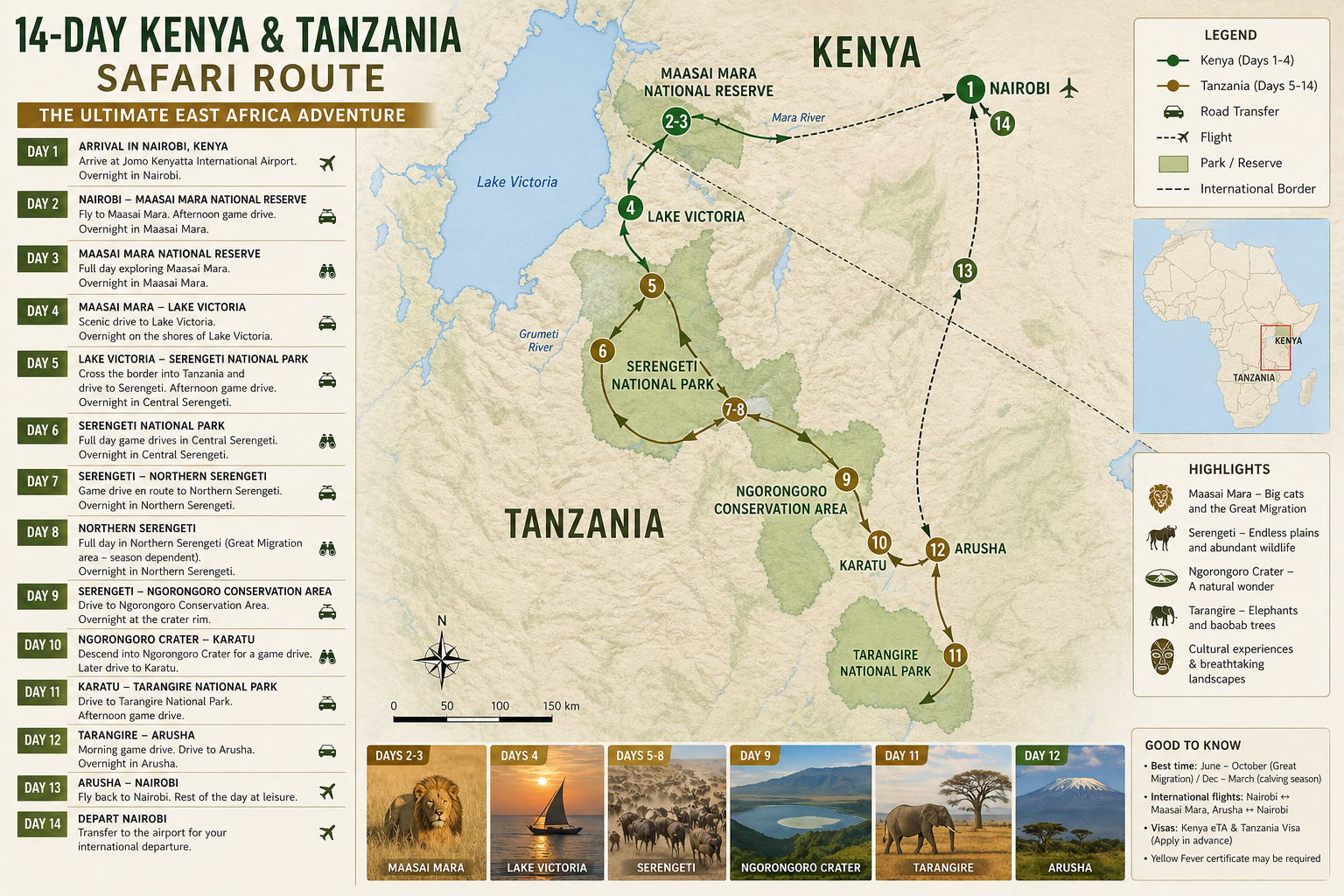
14-Day Kenya-Tanzania Safari Itinerary (Recommended)
A 14-day combined safari is the most commonly recommended itinerary length by experienced operators, offering enough time in each park to move beyond surface-level game viewing and experience the rhythms of each ecosystem.
- Days 1–3: Tarangire + Lake Manyara, Tanzania
- Days 4–6: Serengeti National Park (central Seronera)
- Days 7–8: Northern Serengeti (migration) → fly to Maasai Mara
- Days 9–11: Maasai Mara, Kenya
- Days 12–13: Amboseli National Park
- Day 14: Nairobi departure
21-Day Kenya-Tanzania Safari with Zanzibar
A 21-day combined safari is the definitive East Africa experience, adding the Samburu wilderness in Kenya's north and a Zanzibar beach extension in Tanzania. This length suits travelers who want to immerse themselves fully and avoid the rushed pace of shorter itineraries.
- Days 1–3: Nairobi, fly to Samburu National Reserve
- Days 4–5: Ol Pejeta Conservancy
- Days 6–8: Maasai Mara (fly in via Nairobi)
- Day 9: Fly Nairobi → Kilimanjaro, transfer to Arusha
- Days 10–11: Tarangire + Lake Manyara
- Days 12–14: Serengeti (western corridor or central)
- Days 15–16: Northern Serengeti (migration)
- Days 17–18: Ngorongoro Crater
- Days 19–21: Zanzibar beach extension
How Do You Get Between Kenya and Tanzania on a Safari Trip?
Travelers can connect Kenya and Tanzania by scheduled domestic flights, charter flights, or overland border crossing — and the right choice depends on your itinerary, budget, and time constraints. All three options are routinely used by safari operators, and none requires significant advance planning beyond booking.
Flying Between Kenya and Tanzania
Scheduled domestic flights are the fastest and most convenient option for most combined safari travelers. The key routes are:
- Nairobi (Wilson Airport) to Kilimanjaro International Airport: approximately 1 hour 15 minutes; operated by multiple charter and scheduled services
- Nairobi (Wilson) to Arusha Airport: approximately 45 minutes; several departures daily via Safarilink, Coastal Aviation, and Air Kenya
- Maasai Mara airstrips to Serengeti airstrips: direct charter flights, approximately 45–60 minutes; no commercial scheduled service, but easily arranged through your operator
Bush plane flights within each country use small Cessna or Caravan aircraft with a strict 15kg (33lb) luggage limit in soft-sided bags. This is non-negotiable on most bush flights and shapes your packing strategy for the entire trip.
Overland Border Crossing: Namanga
The Namanga border crossing between Kenya and Tanzania is the most commonly used land border for safari travelers and is a straightforward, well-established crossing for those traveling in a safari vehicle. The crossing point sits approximately 165km south of Nairobi and 270km from Arusha.
At Namanga, expect to stop for immigration processing for both countries — typically 30–60 minutes total if crowds are minimal. Your operator will handle vehicle paperwork and assist with visa processing on site. Many travelers complete this crossing while en route between Amboseli (Kenya) and Arusha (Tanzania) without it feeling like a significant interruption to the journey.
The Isebania border crossing is used for travelers moving between the Maasai Mara and Tanzania's western Serengeti or Mara Triangle, though this route is less commonly used by standard itineraries.
What Visas Do You Need for a Kenya and Tanzania Combined Safari?
Travelers visiting both Kenya and Tanzania on a combined safari must obtain separate visas for each country — the East Africa Tourist Visa (which covers Kenya, Uganda, and Rwanda) does not include Tanzania. This is the single most common visa misconception among first-time combined safari planners.
Kenya Visa Requirements
Kenya requires most international visitors to obtain an Electronic Travel Authorization (eTA) before arrival, replacing the previous e-visa system in 2024. The eTA is applied for online through Kenya's immigration portal, costs $32.50 USD, and is typically processed within 72 hours. Citizens of East African Community member states are exempt.
Tanzania Visa Requirements
Tanzania offers a visa on arrival at Kilimanjaro International Airport and Julius Nyerere International Airport (Dar es Salaam) for most nationalities, priced at $50 USD for most Western passport holders. Tanzania also offers an online e-visa application that avoids queues at the airport — recommended for travelers arriving at busy hours.
Citizens of the United States, European Union countries, United Kingdom, Canada, and Australia are typically eligible for Tanzania's visa on arrival, though travelers should verify current requirements with the Tanzania Immigration Department before travel, as policies are updated periodically.
Practical Visa Tips
Yellow fever vaccination is mandatory for entry into both Kenya and Tanzania if you are traveling from or through a yellow fever-endemic country. Carry your yellow fever certificate (the ICVP yellow card) with you at all times — border officials check for it at land crossings. Most safari health clinics recommend completing yellow fever vaccination at least 10 days before departure to ensure immunity.
How Much Does a Combined Kenya-Tanzania Safari Cost Per Person?
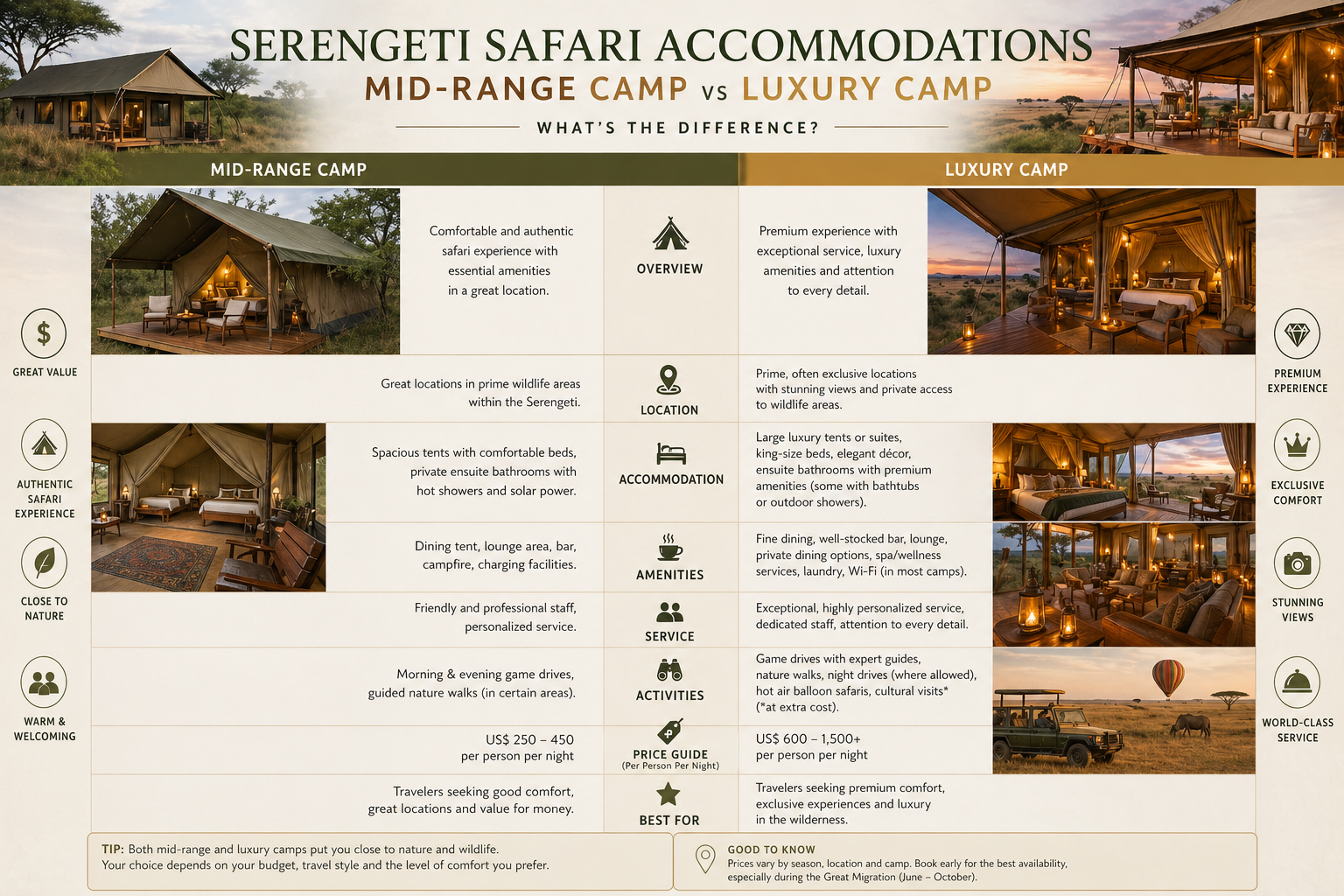
A combined Kenya-Tanzania safari costs between $400 and $1,500+ per person per night, depending on accommodation tier, time of year, and the specific parks included. Understanding how costs are structured helps travelers build a realistic budget and identify where to spend more versus less.
Safari Cost Tiers
| Tier | Per Person Per Night | Accommodation Type | Typical Inclusions |
|---|---|---|---|
| Budget/Camping | $400–$600 | Tented camping, budget lodges | Game drives, meals, park fees sometimes separate |
| Mid-Range | $600–$900 | Comfortable lodges, classic tented camps | Full board, game drives, most park fees |
| Luxury | $900–$1,500+ | Luxury tented camps, boutique lodges | All-inclusive, private game drives, transfers, park fees |
| Ultra-Luxury | $1,500–$3,000+ | Private conservancy camps, exclusive camps | Full exclusive use, charter flights, private guiding |
Park Fees by Country
Park fees are a significant component of safari costs and vary considerably between Kenya and Tanzania. Key fees to budget for:
- Serengeti National Park (Tanzania): $82 per person per day (non-resident adult)
- Ngorongoro Conservation Area (Tanzania): $80 per person per day + $30 vehicle fee
- Maasai Mara National Reserve (Kenya): $80–$200 per person per day (varies by zone and season)
- Amboseli National Park (Kenya): $90 per person per day
Most mid-range and luxury safari packages include park fees within the quoted price. Budget packages often list them separately — always confirm what's included before comparing quotes.
How Booking with One Operator Saves Money
Booking a combined Kenya-Tanzania safari with a single operator that covers both countries consistently delivers better value than booking each country separately. A dual-country operator eliminates duplicated logistics costs (two separate transfer arrangements, two separate camp communication systems), can negotiate bundled park fee rates, and removes the coordination risk of two separate suppliers needing to synchronize on the ground.
For a more detailed breakdown, read our guide on how to budget for an African safari, which covers per-day cost structures, what's typically included versus excluded, and how to evaluate operator quotes accurately.
How Do You Choose a Safari Operator That Covers Both Kenya and Tanzania?
The right safari operator for a combined Kenya-Tanzania trip is one with active, licensed operations in both countries — not simply a Kenya specialist who subcontracts Tanzania to a third party. This distinction matters enormously for itinerary quality, crisis management, and the consistency of your experience.
What to Look For
A qualified dual-country operator should have their own licensed vehicles, employed guides, and camp relationships in both Kenya and Tanzania. Ask directly: Do you operate your own vehicles in both countries, or do you use ground handlers in Tanzania? The answer reveals whether your operator genuinely manages both legs of your trip or delegates the Tanzania portion to a separate company.
Additionally, look for:
- Membership in the Kenya Association of Tour Operators(KATO), Tourism Federation, Tanzania Association of Tour Operators (TATO), or ATTA (African Travel and Tourism Association)
- Safari-specific reviews on TripAdvisor or SafariBookings.com — not generic hotel reviews, but trip-specific accounts from travelers who did the same dual-country route you're planning
- Flexibility in itinerary customization — rigid, fixed-departure group safaris offer less value for a dual-country itinerary than a private, customized journey
For recommendations on vetted operators, read our guide on best safari operators in East Africa, which includes a current shortlist with response times, pricing transparency, and direct booking contacts.
Red Flags to Avoid
The most common red flag in safari booking is suspiciously low pricing. A legitimate dual-country safari including flights, park fees, full-board accommodation, and professional guiding cannot be delivered for less than approximately $350 per person per day at the absolute budget floor. Any operator quoting below this range for a legitimate combined itinerary is cutting corners somewhere — typically on accommodation quality, guide experience, or vehicle maintenance.
Practical Tips for a Seamless Combined Kenya-Tanzania Safari
A seamless combined safari requires attention to a handful of practical details that most first-timers don't discover until they're already in the field. Getting these right before you leave home transforms a good safari into an exceptional one.
Packing for Two Countries and a Bush Plane
The 15kg soft-bag luggage restriction on bush plane flights shapes everything you pack. This weight limit is strictly enforced — in many small aircraft, every kilogram is counted and balanced before departure. Invest in a soft-sided duffel bag (not a hard-sided suitcase) of approximately 40 litres and practice packing to weight before you leave home. Read our full what to pack for a safari guide for a gear checklist by category.
Key clothing principles: neutral colors (khaki, olive, beige, light grey) for game drives; a fleece or light down jacket for cold early-morning drives; a wide-brimmed hat and SPF 50+ sunscreen; and broken-in, ankle-supporting walking shoes. Avoid blue and black clothing — tsetse flies are attracted to dark colors in certain areas.
Health Requirements
Malaria prophylaxis is recommended for all travelers visiting Kenya and Tanzania, as both countries contain malaria-endemic regions, particularly in low-altitude areas like the Maasai Mara and Serengeti. Consult a travel medicine clinic at least 6–8 weeks before departure to discuss medication options — typically atovaquone/proguanil (Malarone), doxycycline, or mefloquine — and their respective side effect profiles. For more detail, read our guide on malaria prevention for safari travelers.
Additionally, bring a basic travel health kit including oral rehydration salts, an insect repellent containing at least 30% DEET, antihistamines, blister care supplies, and any prescription medications in sufficient quantity for the trip plus a buffer. Keep all medications in your carry-on bag — never in checked luggage.
Connectivity, SIM Cards, and Tipping
Mobile connectivity in East Africa's safari parks is limited but not absent. Most lodges and tented camps offer Wi-Fi in common areas, though connection speeds vary dramatically. For personal data access between camps, purchase a local SIM card: Safaricom is Kenya's most reliable network; Vodacom Tanzania and Airtel Tanzania both provide reasonable coverage along the northern circuit. Purchase SIM cards at the airport on arrival.
Tipping is expected and culturally important in both countries. Standard tipping rates for combined safari trips:
- Guides: $15–$25 USD per person per day (private guide); $10–$15 for group guides
- Camp staff (collective tip box): $10–$15 per person per day
- Trackers and specialist guides: $10 per person per game drive
- Lodge porters: $2–$5 per bag
Carry small USD bills (singles, fives, tens) throughout the trip. USD is universally accepted for tips across both countries and is preferred over local currencies.
Photography Gear Recommendations
East Africa's light, subjects, and distances reward telephoto reach. For wildlife photography from a vehicle, a zoom lens in the 100–400mm or 200–600mm range is the working lens for most situations. A 70–200mm covers closer subjects and in-camp moments. Wide-angle lenses (24mm, 35mm) work beautifully for landscapes and dawn/dusk shots at camp.
Protect gear from dust — dust is significant in the dry season — with a dry bag or camera bag insert. Carry more memory cards and batteries than you think you need; charging opportunities in remote camps are limited. A beanbag placed on the vehicle window ledge stabilizes shots better than a tripod in a moving vehicle.
What to Do Next: How to Start Planning Your Kenya-Tanzania Safari
The most effective way to start planning a combined Kenya-Tanzania safari is to define your travel window first, then build everything else around your dates. The Great Migration calendar (and therefore which country to start in and end in) is determined almost entirely by when you can travel — and no other planning decision matters more.
Follow these steps in sequence:
- Define your travel dates. Even a broad window (e.g., "somewhere in July–August" or "we're flexible between March and May") is enough to determine your migration sequence and starting country.
- Choose your itinerary length. Honestly assess how many days you can realistically dedicate. Twelve to fourteen days is the minimum; sixteen to twenty-one days is ideal. Shorter trips exist but will feel rushed.
- Shortlist two or three operators. Use review platforms like SafariBookings.com and TripAdvisor alongside personal referrals. Focus on operators with documented experience in both countries and transparent pricing.
- Request detailed quotes. A good quote includes a day-by-day itinerary, named accommodation, all inclusions and exclusions clearly listed, and a transparent breakdown of park fees. Any quote that arrives as a single total number without this detail is insufficient.
- Consult a specialist before booking. A 30-minute conversation with an operator or independent safari consultant who knows both countries can prevent costly itinerary mistakes. Ask about current conditions in the parks, the realities of specific camp-to-camp transfers, and which parks are currently overrun with vehicles.
- Read the fine print on deposits and cancellation. Safari bookings typically require a 25–50% non-refundable deposit. Understand your operator's cancellation and date-change policies before paying.
Conclusion: Why East Africa Is Best Experienced as One Journey
East Africa is not two safari destinations — it is one ecosystem, one migration, and one extraordinary wildlife story that happens to cross a national border. Combining Kenya and Tanzania in a single trip isn't a logistical complication; it's the natural, intelligent way to experience a region where the wildlife follows the rain, not the political map.
The logistics are far simpler than most travelers imagine before they start researching. A single operator, a clear migration calendar, and the right itinerary length are all it takes to move seamlessly between two of the world's greatest wild places. The river crossings of the Mara, the ancient crater of Ngorongoro, the elephant herds below Kilimanjaro, the golden plains of the Serengeti at dawn — none of these experiences competes with the others. They complete each other.
Plan this trip once. Do it properly. East Africa, experienced whole, will stay with you for the rest of your life.
Ready to build your itinerary? Contact Beyond the Plains Safaris for a customized Kenya-Tanzania safari quote tailored to your travel dates, interests, and budget.
Written by John Dante, Owner and Lead Guide, Beyond the Plains Safaris. John has guided and designed safari itineraries across Kenya and Tanzania for over 15 years, with specialist knowledge of the Great Migration corridor, northern Kenya's frontier parks, and Tanzania's northern circuit.
Reviewed by the Beyond the Plains Safaris editorial team, who verify all logistical, visa, and pricing information against current ground conditions before publication.
Disclaimer: This article was initially drafted using AI assistance. However, the content has undergone thorough revisions, editing, and fact-checking by human editors and subject matter experts to ensure accuracy.










Comments (0)
Leave a Comment
No comments yet. Be the first to comment!