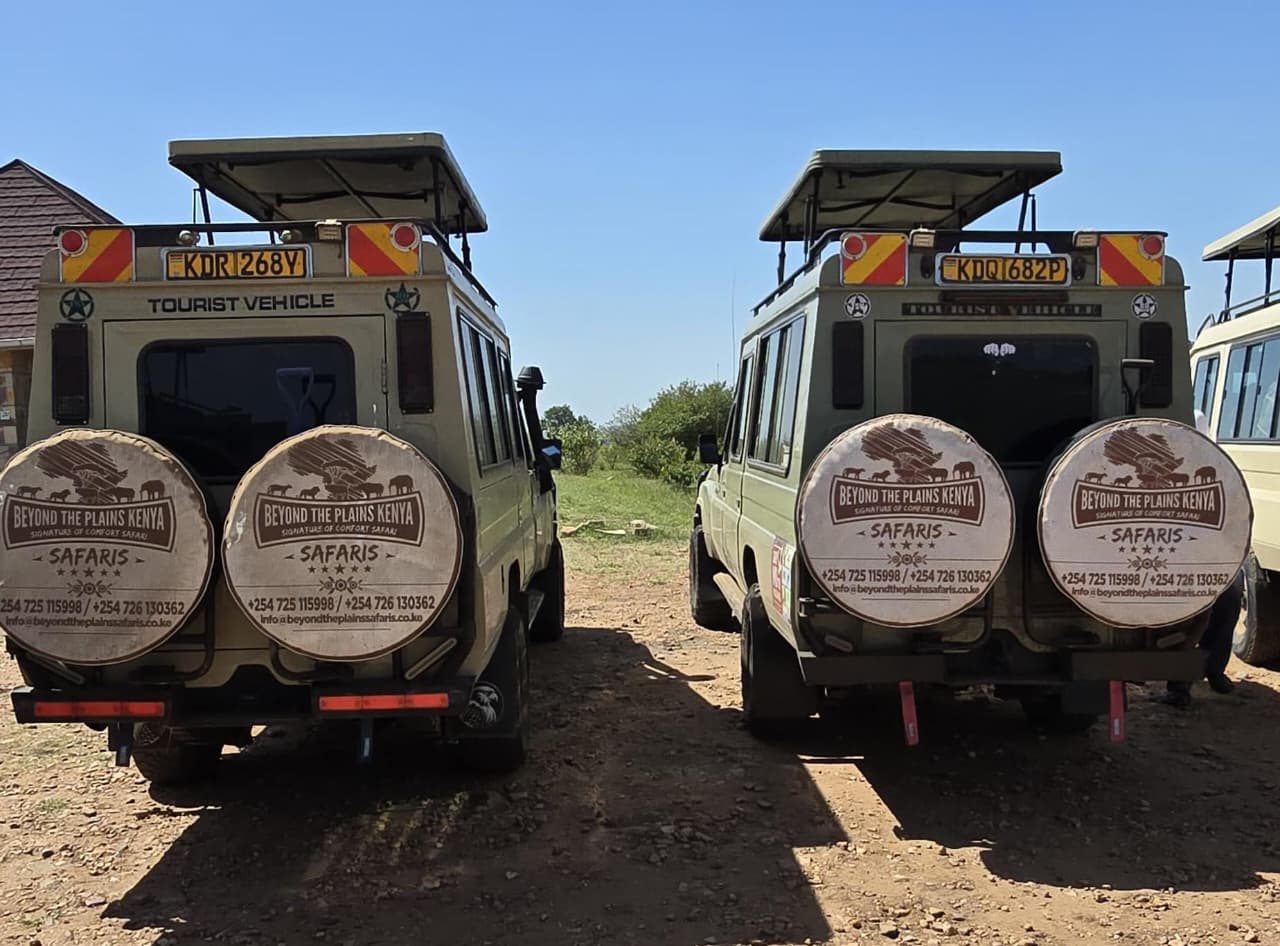
You've probably seen photos of travelers popping out of a safari vehicle's roof, camera in hand, with lions grazing just meters away. What most first-time visitors don't realize is that the vehicle itself — its drivetrain, roof design, and seating layout — shapes almost every moment of that experience. In this guide, we'll break down exactly how Kenya's safari vehicles work, from 4x4 Land Cruisers to seating, so you know what to expect before you ever step foot in one.
Key Takeaways
- Safari vehicles in Kenya are typically customized 4x4 Land Cruisers with pop-up roofs, built specifically to handle rough, unpaved terrain in national parks and reserves.
- 4-wheel drive is essential in Kenya because parks like the Maasai Mara have muddy, uneven, and seasonally flooded tracks that standard vehicles cannot navigate safely.
- Most reputable safari operators use vehicles with elevated seating and large windows, designed so every passenger has a clear, unobstructed view of wildlife.
- Pop-up roof hatches allow travelers to stand and photograph animals at eye level without leaving the vehicle, improving both safety and photo quality.
- Seating position affects visibility, but well-designed safari vehicles minimize this difference by giving every row equal window access.
- Group size and vehicle type both affect comfort — smaller groups in extended Land Cruisers generally get more space and better sightlines than larger minivan tours.
- Asking a tour operator about vehicle type and seating configuration before booking helps travelers set realistic expectations for comfort and game-viewing quality.
What Is a Safari Vehicle and How Is It Different From a Regular Van?
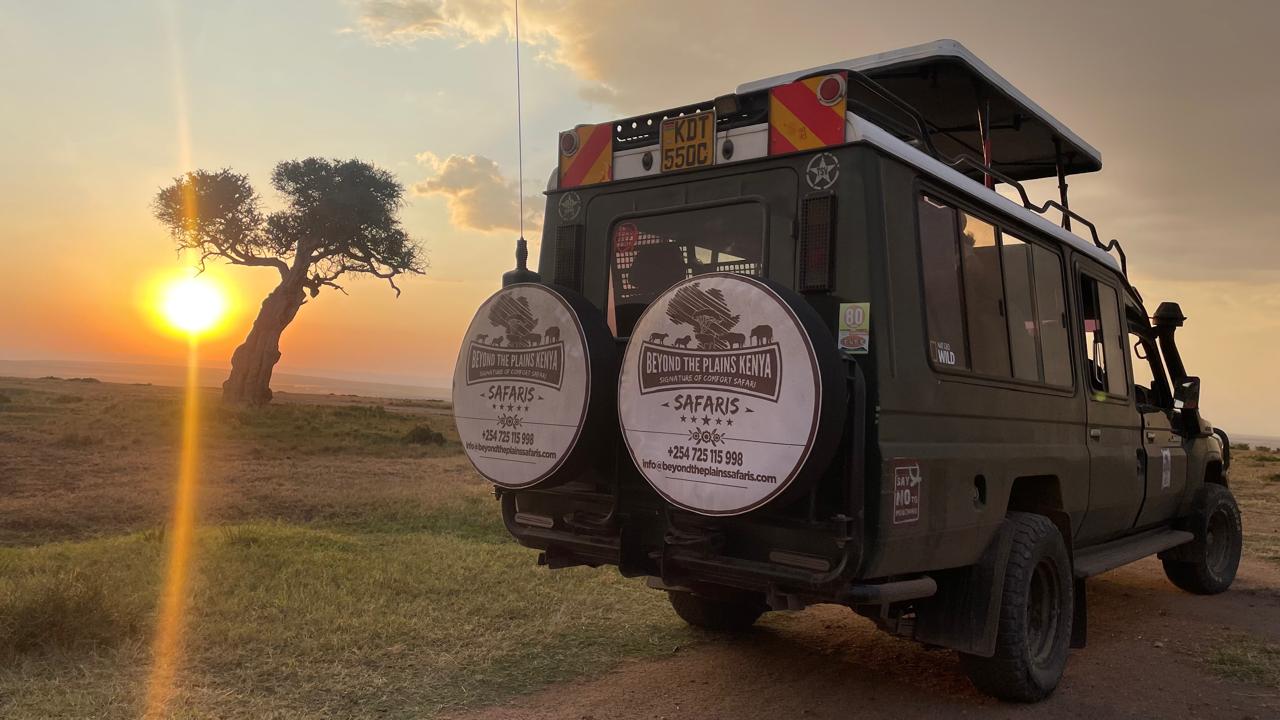
A Kenya safari vehicle is a customized 4x4, most commonly a Toyota Land Cruiser, modified with a pop-up roof and elevated seating for game viewing. Unlike a standard passenger van built for paved roads, a safari vehicle is engineered from the ground up to handle dirt tracks, riverbeds, and uneven bush terrain while still giving every passenger a clear line of sight to wildlife.
First, the chassis and suspension are reinforced to absorb the constant jolting of unpaved park roads. A regular tourist van, built with a low ground clearance and a soft suspension meant for city streets, simply cannot handle the same conditions without risking damage or getting stuck. This structural difference is the single biggest factor separating a true safari vehicle from a repurposed shuttle bus.
Second, the interior is stripped down and rebuilt around visibility rather than passenger volume. Standard vans prioritize seat count, while safari vehicles prioritize window space, headroom, and an unobstructed sightline to the surrounding bush. For example, a converted Land Cruiser might seat only seven to nine people in a vehicle that could technically fit twelve, simply to preserve legroom and viewing angles.
Third, safari vehicles almost always include a roof modification — either a full pop-up hatch or a permanently open top — that a regular van does not have. This single feature does more to define the "safari vehicle" category than any other, because it turns a closed cabin into an open observation deck the moment the vehicle stops near wildlife. [Internal link: "first-time Kenya safari itinerary" → sample itinerary guide]
Finally, safari vehicles are typically driven by trained guides who double as naturalists, not just drivers. That combination of a rugged, purpose-built vehicle and an experienced guide is what separates an organized safari from a casual game park drive-through.
Land Cruiser vs. Standard Minivan: Quick Comparison
| Feature | Custom Safari Land Cruiser | Standard Tourist Van |
|---|---|---|
| Drivetrain | Full-time or switchable 4x4 | Usually 2-wheel drive |
| Ground clearance | High, reinforced suspension | Low, road-oriented suspension |
| Roof | Pop-up hatch or open-air | Fixed, closed roof |
| Typical seating | 6–9 passengers | 12+ passengers |
| Window height | Large, elevated windows | Standard passenger windows |
| Best suited for | Off-road parks (Maasai Mara, Amboseli) | Paved city and highway transfers |
Why Do Safari Vehicles Matter for Your Trip?
The right safari vehicle matters because it directly determines your safety on rough terrain, the quality of your game viewing, and your physical comfort across long days in the bush. A poorly matched vehicle can turn an exciting game drive into a cramped, bumpy ordeal with a limited view of the action.
At the same time, safety is not a minor detail on a Kenyan safari. Parks such as the Maasai Mara include river crossings, steep gullies, and seasonally flooded plains, and a vehicle without proper 4x4 capability and clearance can become stuck or, worse, unsafe to maneuver. [Internal link: "Maasai Mara wildlife you can expect to see" → Mara wildlife/animal guide]
Moreover, game-viewing quality depends heavily on vehicle design. A vehicle with low windows, a fixed roof, and cramped rows makes it harder to photograph animals or even see over other passengers, especially during a crowded sighting like a lion kill or a river crossing. Elevated seating and pop-up roofs solve this problem by giving every passenger a standing, unobstructed vantage point.
Comfort matters just as much as visibility over the course of a full-day drive. Game drives in the Maasai Mara or Amboseli can last four to six hours at a stretch, and a vehicle with proper legroom, ventilation, and shock absorption makes a measurable difference in how enjoyable that time feels. As such, the vehicle is not just transportation — it is the primary "room" you will occupy for a large share of your trip.
Finally, a well-chosen vehicle reflects the overall professionalism of your safari operator. Operators who invest in properly maintained, purpose-built vehicles tend to also invest in trained guides, safety protocols, and a smoother overall itinerary.
What Types of Safari Vehicles Are Used in Kenya?
Kenya's safari industry primarily uses four vehicle types: customized Land Cruisers, extended Land Cruisers, minivans with pop-up roofs, and a mix of open-sided or closed-side configurations. Each type suits a different combination of budget, group size, and terrain.
Customized Land Cruisers
The standard customized Land Cruiser is the workhorse of Kenyan safaris. Built on the Toyota Land Cruiser 70-series or similar chassis, these vehicles are stripped down and rebuilt with tiered seating, large windows, and a pop-up roof hatch. For example, a typical setup seats six to seven guests across three rows, each raised slightly higher than the row in front for better sightlines.
Extended Land Cruisers
Extended Land Cruisers stretch the wheelbase to add one or two additional rows while keeping the same 4x4 drivetrain and off-road capability. Extended Land Cruisers typically seat 6 to 9 passengers, while larger safari minivans can seat up to 12, affecting how much window space each traveler gets. This makes them a popular middle ground for small groups or families who want more space without booking a fully private vehicle.
Minivans With Pop-Up Roofs
Some operators, particularly for larger group tours, use minivans fitted with pop-up roof hatches instead of full 4x4 Land Cruisers. These vehicles can be more budget-friendly and comfortable on smoother roads, but they generally have less ground clearance and off-road capability than a true Land Cruiser.
Open-Sided vs. Closed Vehicles
Open-sided vehicles have no doors or windows on the sides, offering unrestricted photography angles and airflow, while closed vehicles use retractable windows for a similar effect with added weather protection. Both styles typically retain the pop-up roof, so the real difference comes down to side visibility rather than the roof experience itself.
Why Land Cruisers Dominate the Kenyan Safari Market
Toyota Land Cruisers dominate Kenya's safari fleets because of their proven off-road reliability, wide availability of spare parts, and decades-long reputation across East Africa's tourism industry. Many safari operators, including smaller family-run outfits, standardize their entire fleet around the Land Cruiser 70-series precisely because mechanics across Kenya are familiar with its engine and suspension systems.
For example, if a Land Cruiser develops a mechanical issue mid-safari in a remote area like the Mara, there is a strong chance a nearby camp mechanic or a passing operator's driver can help with a temporary fix, since parts and expertise for this specific vehicle are so widespread. This same level of support infrastructure does not exist as consistently for less common 4x4 models, which is part of why the Land Cruiser has become something of an industry default rather than just one option among many.
Plus, the Land Cruiser's high resale value and durability mean operators can justify the upfront cost of a full safari conversion — reinforced suspension, custom seating, and a roof hatch — knowing the vehicle will remain serviceable for many years of rough terrain use. That long operational life ultimately benefits travelers, since a mature, well-maintained fleet tends to be more mechanically reliable than newer, less battle-tested alternatives.
Why Is 4-Wheel Drive Essential for Maasai Mara Game Drives?
4-wheel drive is essential on Kenyan safaris because parks such as the Maasai Mara have unpaved, muddy, and seasonally flooded terrain that standard vehicles cannot traverse. Without power distributed to all four wheels, a vehicle can quickly lose traction in soft mud, loose sand, or steep riverbanks.
For example, during the Great Migration season, the Mara's river crossings and surrounding plains become saturated with water and mud, and only high-clearance 4x4 vehicles can safely approach these areas without getting stuck. [Internal link: "best time to visit the Maasai Mara" → Maasai Mara seasonal travel guide] Tourist arrivals to the Maasai Mara reached roughly 420,000 in 2023 before declining to about 213,000 in 2025 amid rising park fees, a shift that still represents hundreds of thousands of vehicle trips across this terrain each year — Source: Kenya National Bureau of Statistics Economic Survey, 2026.
At the same time, 4x4 capability is not only about avoiding a stuck vehicle — it is also a safety feature. A 4x4 drivetrain gives guides far more control when navigating steep inclines, riverbeds, or uneven ground near wildlife, reducing the risk of a rollover or loss of control. This matters most in the moments when a vehicle needs to reposition quickly and carefully near an animal sighting.
In addition, 4x4 systems allow guides to reach remote areas of the park that two-wheel-drive vehicles simply cannot access. That extended reach often translates directly into better wildlife sightings, since the most memorable moments — a leopard in a riverine thicket, a pride resting off the main track — tend to happen away from the smoothest roads.
Plus, Kenya's rainy seasons (typically March–May and November) intensify these conditions considerably, turning already uneven tracks into slick, rutted paths. A reputable operator will always confirm their fleet is fully 4x4 capable, particularly if your trip falls during or near these wetter months.
How Does a Pop-Up Roof Work on a Safari Vehicle?
A pop-up roof hatch allows passengers to stand up inside the vehicle and view or photograph wildlife at an elevated, unobstructed angle. The roof panel lifts or slides open, and the vehicle's interior includes handrails or a support frame so standing passengers remain stable even on uneven ground.
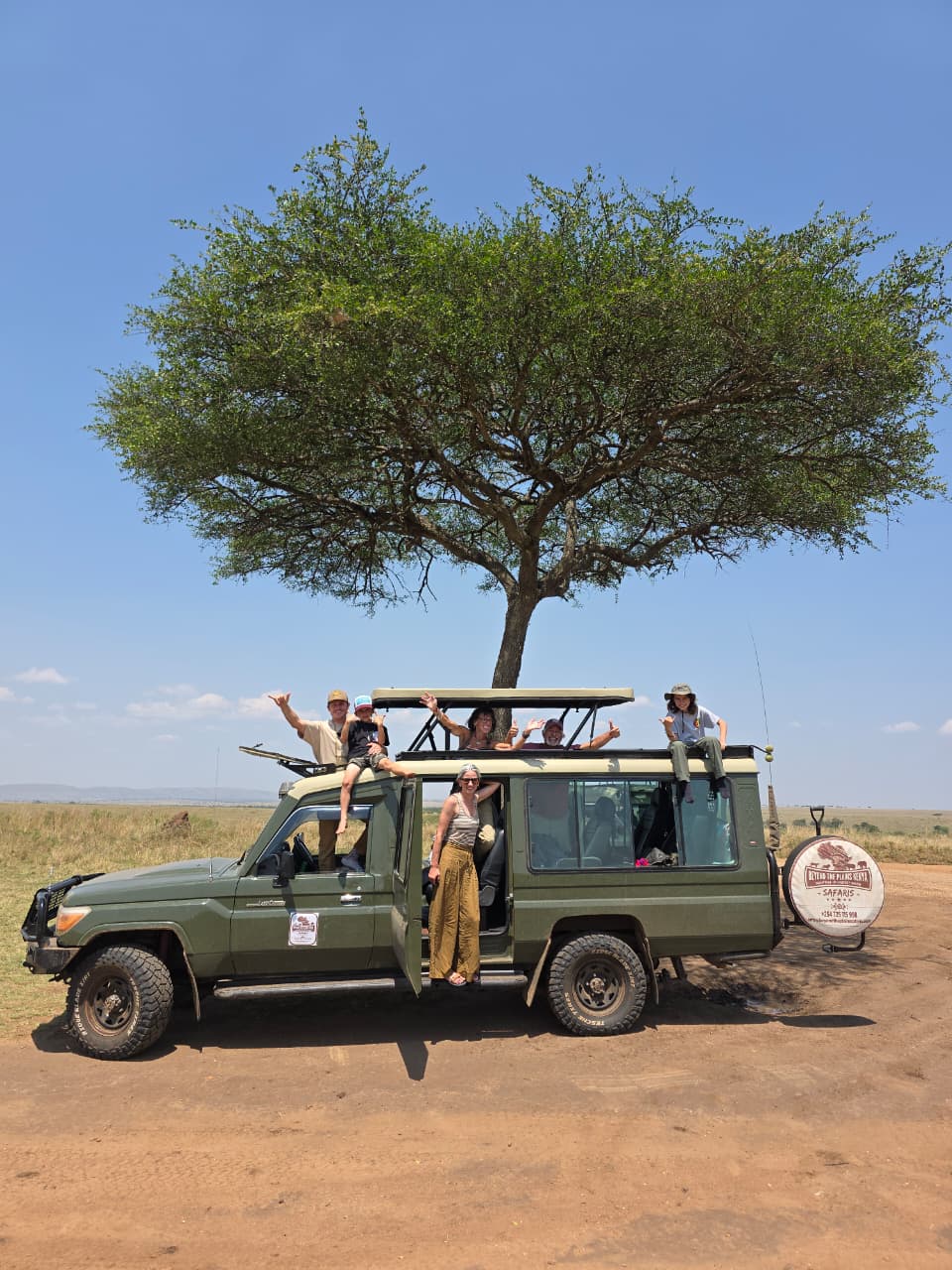
For example, when a vehicle approaches a sighting, the guide typically parks and unlatches the roof, allowing several passengers to stand simultaneously without stepping outside the vehicle. This keeps everyone safely inside the vehicle's frame while still granting eye-level visibility, which matters both for safety around predators and for photo composition.
That being said, pop-up roofs vary in size and design between vehicles. Some cover the entire cabin length, letting every row stand at once, while smaller hatches only accommodate two or three people standing at a time, requiring some rotation among passengers during a sighting.
Is There Really a Bad Seat on a Safari Vehicle?
Well-designed safari vehicles use large windows and raised seating on every row so that no seat has a significantly worse view than another. In a properly built Land Cruiser, each row sits slightly higher than the one in front, which prevents taller passengers or a higher row from blocking the view of those behind them.
For example, in a standard three-row configuration, the back row often has the best combined visibility of the pop-up roof and the widest side windows, while the middle row benefits from being closest to the guide's commentary and the front spotting angle. Seating position affects visibility, but well-designed safari vehicles minimize this difference by giving every row equal window access, which is the entire premise behind treating every seat as a window seat.
That said, a genuinely bad seat can still exist in a poorly maintained or overcrowded vehicle. If an operator packs a minivan built for photography with too many passengers, some seats inevitably end up farther from a window or blocked by the roof support structure. This is exactly why vehicle type and group size both deserve attention before you book.
How Many People Fit in a Standard Safari Land Cruiser?
A standard safari Land Cruiser seats between six and nine passengers, depending on whether it is a standard or extended wheelbase model. Standard Land Cruisers typically hold six to seven guests across two or three rows, while extended versions add a fourth row to accommodate up to nine.
For example, a family of six traveling together could comfortably fill a standard Land Cruiser on a private booking, giving every member a window seat and full access to the pop-up roof. By contrast, joining a shared group tour in a larger minivan means sharing window space and roof access with strangers, which can meaningfully change the pace and intimacy of each sighting.
As such, group size is one of the most overlooked factors in safari planning. Two travelers booking a private Land Cruiser will typically get a dramatically different experience — more space, more flexibility, closer guide interaction — than six strangers sharing a twelve-seat minivan.
Tools and Practical Examples: Reading a Safari Vehicle Layout
Understanding a vehicle's seat map before you travel can remove a lot of pre-trip anxiety about comfort and visibility. Most reputable Kenya safari operators, including Beyond the Plains Safaris, can share a vehicle diagram or photo gallery of their actual fleet on request, showing row count, roof hatch coverage, and window height.
For example, a typical layout diagram will show the guide's seat up front next to the front passenger seat, followed by two or three rows of elevated guest seating, with the pop-up roof spanning the rear two rows. Reviewing this kind of diagram in advance lets you request a specific seat, such as an aisle-adjacent seat for easier roof access during sightings.
In addition to fleet photos, ask your operator directly about a few practical details:
- Roof hatch coverage — does it span the entire cabin or only part of it?
- Row height difference — is each row visibly elevated above the one in front?
- Window type — retractable glass, mesh screens, or fully open sides?
- Group size on your specific date — private vehicle or shared minivan?
- Photography space — is there a beanbag or window ledge for camera stability?
Most operators are happy to provide this information before booking, and a hesitant or vague answer is itself a useful signal about how transparent that operator is likely to be on the ground.
For example, a traveler planning a dedicated photography safari might specifically request beanbag mounts along the window ledges, extra battery charging access, and a guaranteed private vehicle rather than a shared one. Operators who specialize in photographic safaris will typically have this equipment ready without needing to source it last minute, which is another useful question to raise before booking.
In addition, it helps to ask how the operator handles seat rotation on multi-day trips, since some itineraries use the same vehicle and seats for several consecutive days while others rotate travelers through different positions each morning. Knowing this in advance lets you plan around it, whether that means requesting a fixed seat for a family member with mobility needs or simply setting expectations that everyone will get a turn near the roof hatch over the course of the trip.
Are Open-Sided Safari Vehicles Safer or Better for Photography?
Open-sided safari vehicles generally offer better photography angles, while closed vehicles with retractable windows offer more protection from dust, weather, and insects without sacrificing much visibility. Neither style is inherently "safer" in terms of wildlife proximity, since both maintain a safe distance protocol enforced by trained guides.
For example, a photographer chasing unobstructed shots of a cheetah on the move will usually prefer an open-sided vehicle, since there is no window frame or glass reflection interrupting the shot. On the other hand, families traveling with young children, or travelers visiting during a dusty dry season, often prefer closed vehicles for the added comfort of retractable windows.
safari photography tips for beginners" → photography guide
That being said, both vehicle styles rely on the same underlying safety principle: guides keep a respectful distance from wildlife and never allow passengers to exit the vehicle near predators. The open or closed side design changes the viewing experience, not the fundamental safety protocol.
What Should You Ask Your Tour Operator About Vehicle Type Before Booking?
Asking a tour operator about vehicle type and seating configuration before booking helps travelers set realistic expectations for comfort and game-viewing quality. This single conversation, held before you pay a deposit, prevents most of the disappointment that comes from mismatched expectations on arrival.
At minimum, ask whether the vehicle is a dedicated 4x4 Land Cruiser or a converted minivan, since this determines both off-road capability and typical group size. Follow up by asking how many passengers will share the vehicle on your specific dates, since a "small group" tour can sometimes mean anywhere from four to eight strangers depending on the operator.
Next, confirm the roof hatch coverage and whether every passenger gets standing access during sightings, or whether the group rotates in shifts. This detail matters enormously for photography-focused travelers, who may want to negotiate a private vehicle instead of a shared one.
Finally, ask about vehicle age and maintenance history. A well-maintained fleet with recently serviced suspension and tires can significantly reduce the physical toll of long game drives on rough terrain. Operators who proudly share maintenance details are typically the ones investing seriously in guest comfort and safety.
How Does Vehicle Choice Affect Your Overall Safari Experience?
Vehicle choice affects your overall safari experience by shaping your comfort, your photography results, and how close you feel to the wildlife around you throughout each drive. A well-matched Land Cruiser with a private booking and full roof access tends to produce a noticeably more immersive experience than a shared minivan with limited window space.
For example, two travelers who upgrade from a shared 12-seat minivan to a private 6-seat Land Cruiser often report a completely different pace to their game drives — more time lingering at sightings, fewer compromises on seating, and far more flexibility to follow a guide's instinct toward a promising trail. That flexibility, more than any single vehicle feature, is often what separates a good safari from an unforgettable one.
What to Do Next: Choosing the Right Vehicle for Your Safari
Once you understand the basic vehicle types, the next step is matching a vehicle to your specific group size, budget, and priorities. Start by deciding whether photography, family comfort, or budget is your top priority, since each points toward a different vehicle type.
If photography is your priority, request an open-sided or full-length pop-up roof Land Cruiser and consider a private booking to avoid rotating roof access with other travelers. If traveling with family or a larger group, an extended Land Cruiser or a well-maintained minivan with retractable windows can offer a comfortable, cost-effective middle ground.
Before finalizing your booking, request photos or a seating diagram of the actual vehicle you will use, not just a stock image from the operator's marketing materials. This small step confirms that the vehicle matches what was promised and gives you a chance to ask about any seat you're specifically hoping to secure.
Finally, communicate any physical considerations — mobility limitations, a preference for aisle access, or specific photography equipment — directly with your operator ahead of time. Most operators can accommodate reasonable seating requests when they know about them in advance, rather than trying to adjust on the morning of your first game drive.
Conclusion
Choosing the right safari vehicle is not a minor logistical detail — it shapes your safety, your comfort, and the quality of nearly every wildlife encounter on your trip. From the 4x4 drivetrain that keeps you moving safely across the Mara's toughest terrain, to the pop-up roof that turns every stop into a front-row view, the vehicle is the stage on which your entire safari plays out.
As you finalize your Kenya safari plans, take the time to ask your operator about vehicle type, seating, and group size well before departure. With the right vehicle beneath you, every seat truly does become a window seat, and every game drive becomes a chance to see Kenya's wildlife exactly as it deserves to be seen.










Comments (0)
Leave a Comment
No comments yet. Be the first to comment!