
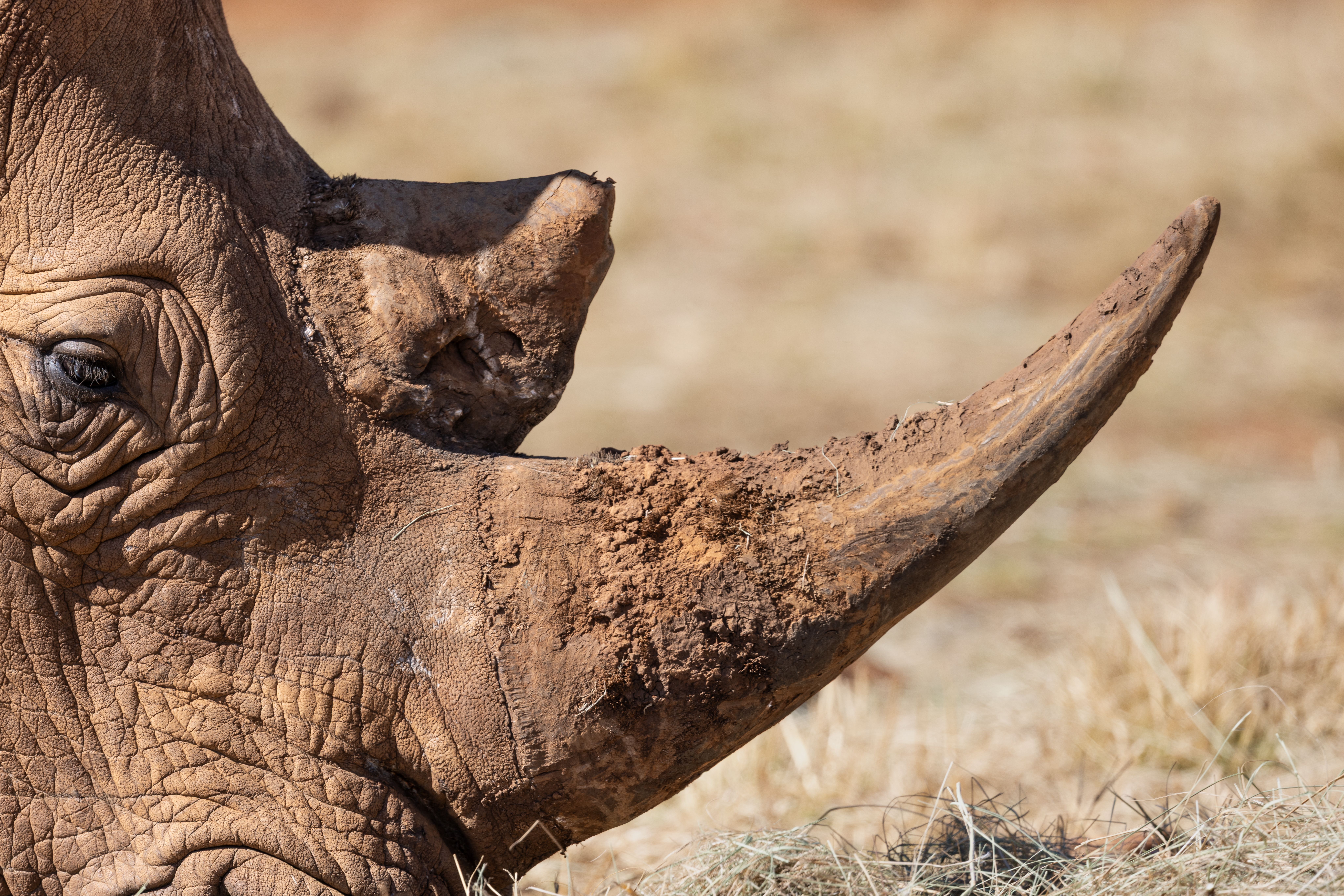
You already know Kenya is one of the best places on earth to see the Big Five, and you've probably heard the rhino is the hardest of them to find. What most safari guides won't tell you is that one conservancy north of Mount Kenya turned 15 rhinos into more than 280 — and that your visit can be part of how it keeps happening. In this guide, we explain how Lewa Wildlife Conservancy helped save Kenya's rhinos and exactly how to plan an ethical rhino safari there, from fees and flights to lodges and the best time to go.
Key Takeaways
- Lewa Wildlife Conservancy is a private, non-profit conservancy in northern Kenya that began in 1983 as a rhino sanctuary and is now part of the Mount Kenya UNESCO World Heritage Site.
- Lewa's rhino population has grown from 15 animals at founding to more than 280 black and white rhinos across the Lewa-Borana Landscape.
- Rhino protection at Lewa relies on trained rangers, a tracker-dog unit, a joint operations command centre, and partnerships with neighbouring communities, with zero rhinos poached since 2019.
- Translocations from Lewa have moved more than 70 rhinos to other conservancies, including Sera and Loisaba, to grow Kenya's national population.
- Visitors reach Lewa by a scheduled flight of under an hour from Nairobi's Wilson Airport or a four-to-five-hour drive, and pay a daily conservancy fee that funds conservation.
- The best months for a rhino safari at Lewa are the dry seasons from late June to October and January to February.
- An overnight stay beats a day trip, because Lewa's behind-the-scenes conservation activities are reserved for guests staying on Lewa and Borana.
What Is Lewa Wildlife Conservancy and Where Is It Located?
Lewa Wildlife Conservancy is a private, non-profit wildlife conservancy of about 62,000 acres in northern Kenya, founded in 1983 as a black rhino sanctuary and now part of the Mount Kenya UNESCO World Heritage Site. It sits on the northern foothills of Mount Kenya, straddling Meru and Isiolo counties, between the farming town of Timau and the dry rangelands that roll north toward Samburu. For example, from a game-drive vehicle on Lewa's plains you can see snow on Mount Kenya to the south and the arid Il Ngwesi hills to the north in the same frame.
To begin with, Lewa did not start as a wildlife park. The Craig family managed the land as a cattle ranch for more than half a century, and in 1983 the Craigs and Anna Merz, who funded the effort, set up the fenced and guarded Ngare Sergoi Rhino Sanctuary on the ranch's western end. About a decade later the sanctuary grew to cover the whole ranch, and in 1994 the neighbouring Ngare Ndare Forest Reserve was brought inside the fence. The conservancy was formally registered in 1995, and UNESCO inscribed Lewa and Ngare Ndare as an extension of the Mount Kenya World Heritage Site in 2013.
In addition, Lewa works as one connected landscape with its western neighbour. Lewa and Borana Conservancy merged their land into 93,000 acres of contiguous rhino range, and that landscape now holds 14% of Kenya's entire rhino population. In practice, this means a rhino tracked on Lewa in the morning may be browsing on Borana by evening, with no fence in between.
How Is a Private Conservancy Different From a National Park?
A private conservancy is land managed for wildlife by a private or community trust under its own visitor rules, rather than by the Kenya Wildlife Service or a county government. That distinction shapes everything about your safari. For example, Lewa permits guided walking safaris, night drives, horseback riding and off-road tracking — activities that are banned or tightly restricted inside the Maasai Mara National Reserve.
That being said, conservancies are not lawless. They operate within national wildlife law, and Lewa's rangers work alongside the Kenya Wildlife Service and Kenya Police. If you want the full side-by-side breakdown, our guide to Kenya conservancy safaris vs national reserves compares sightings, vehicle density and rules in detail. You can also see where Lewa ranks among peers in our list of the best private conservancies in Kenya.
Lewa Wildlife Conservancy at a Glance
| Fact | Detail |
|---|---|
| Founded | 1983 (Ngare Sergoi Rhino Sanctuary); registered as a conservancy in 1995 |
| Size | ~62,000 acres (Lewa); ~93,000 acres with Borana |
| Status | Private non-profit; part of Mount Kenya UNESCO World Heritage Site since 2013 |
| Rhinos | 280+ black and white rhinos on the Lewa-Borana Landscape |
| Share of Kenya's rhinos | 14% |
| Rhino poaching | Zero since 2019 |
| Grevy's zebra | ~350, the world's largest single population |
| Altitude | 1,400–2,000 m (4,500–6,500 ft) |
| Access | <1 hr flight from Wilson Airport; ~4–5 hr drive |
| Best time | Late June–October; January–February |
| Lodges on Lewa | Five, plus five more properties on Borana |
Why Does Lewa Matter for Rhino Conservation in Kenya?
Lewa matters because it was East Africa's first private rhino sanctuary and has grown its population from 15 rhinos to more than 280, making it one of the main engines of Kenya's black rhino recovery. Lewa reports that its rhino population has risen from an initial 15 animals to over 280 today, with zero rhino poaching since 2019 and more than 70 rhinos translocated to other conservancies. In other words, Lewa does not just protect rhinos; it exports them to restart populations elsewhere.
First, consider how close Kenya came to losing the species. Kenya held an estimated 20,000 black rhinos in the 1960s, yet poaching cut that number to fewer than 300 within about two decades. Peer-reviewed work in the journal Pachyderm puts the low point at roughly 370 individuals by 1989, around the time the Kenya Wildlife Service was formed. A sanctuary founded in 1983 with a handful of animals was, quite literally, a lifeboat.
Second, the recovery since then is measurable. Kenya Wildlife Service Director General Professor Erustus Kanga has said the country's black rhino population reached 1,147 by the end of 2025, with no rhino poaching recorded in 2025. National figures in Kenya's Economic Survey show the bigger trend: total rhino numbers rose from 1,603 in 2020 to 2,100 in 2024. Lewa-Borana alone holds about one in seven of those animals.
Moreover, Kenya's black rhinos carry outsized global weight. According to KWS, Kenya's black rhinos represent almost 78 percent of the world's eastern black rhino population. As such, every calf born on Lewa is a meaningful share of an entire subspecies.
How Many Rhinos Live in Lewa Wildlife Conservancy Today?
The Lewa-Borana Landscape is home to more than 280 rhinos, according to Lewa Wildlife Conservancy's 2026 figures. The last published species split came in early 2025. At that point the landscape held 273 rhinos — 130 black and 143 white — Source: Lewa Wildlife Conservancy, 2025.
Notably, that milestone arrived in a record breeding year. The same Lewa report describes 33 calves born in a single year, and those births followed the translocation of 16 rhinos: 12 black rhinos to Loisaba Conservancy and 4 white rhinos to Sera Conservancy. For a rhino lover, that is the clearest possible signal: Lewa gave away 16 animals and still grew.
What Is the Difference Between Black and White Rhinos at Lewa?
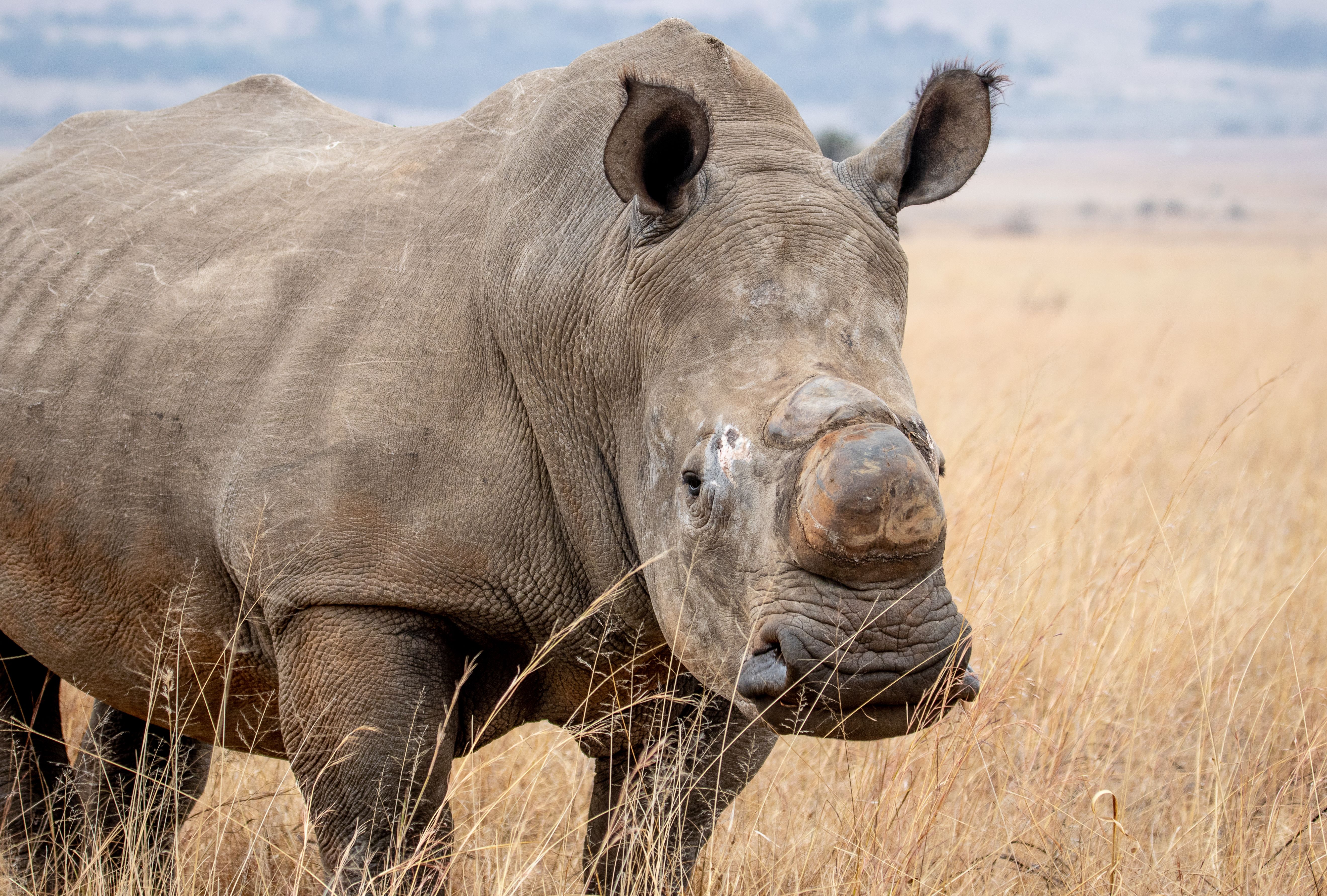
Black and white rhinos are two separate species that differ in diet, lip shape, temperament and social behaviour — not in colour. Lewa protects both, so knowing the difference turns a sighting into a lesson. For example, if you see a rhino grazing in open grassland with a calf trotting ahead of it, you are almost certainly watching a white rhino.
| Feature | Black rhino | White rhino |
|---|---|---|
| Diet | Browser (leaves, twigs, shrubs) | Grazer (short grass) |
| Lip | Pointed, hooked upper lip | Wide, square lip |
| Habitat at Lewa | Thickets, acacia scrub, forest edge | Open plains and grassland |
| Temperament | Shy, solitary, more unpredictable | Calmer, often in small groups |
| Calf position | Usually walks behind mother | Usually walks ahead of mother |
| Status | Critically Endangered (eastern subspecies) | Near Threatened (southern white) |
In practice, black rhinos are the harder find. They hide in dense bush and spook easily, which is why guided tracking with rangers makes such a difference. If you're building a wider rhino itinerary, Lake Nakuru National Park is another reliable Kenyan site for both species.
How Does Lewa Protect Rhinos? Inside the Conservation Model
Lewa protects rhinos through a people-centred security model that combines community intelligence, trained rangers, a tracker-dog unit, real-time monitoring technology and partnerships with national law enforcement. Lewa credits its anti-poaching results to four things: communities that act as the first line of defence, a well-trained and motivated ranger team, close coordination between radio operators, gatekeepers and rangers, and technology that improves intelligence gathering. For example, a tip-off from a neighbouring village can reach the operations room by radio and put a ranger team on the ground within minutes.
How Does Lewa's Anti-Poaching Unit Work?
Lewa's anti-poaching unit is a team of rangers, radio operators and gatekeepers who patrol the landscape, monitor individual rhinos and respond to threats around the clock. Rangers are trained to recognise individual animals by ear notches, horn shape and behaviour, and each sighting is logged. In addition, the team regularly supports local police beyond Lewa's boundary in a region with occasional cattle rustling and banditry.
Furthermore, technology sits at the centre of the operation. Lewa was an early adopter of EarthRanger, a digital platform that pulls patrol routes, animal sightings, radio-collar data and incident reports onto a single live map. Visitors can see this for themselves: guests can tour Lewa's Security Operations Room and the Joint Operations Command Centre (JOCC) to learn how rangers monitor and protect wildlife.
What Does Lewa's Tracker-Dog Unit Do?
Lewa's tracker-dog unit uses specially trained dogs to follow human scent from a crime scene to the people responsible. Lewa describes the dogs as able to follow scents left at crime scenes and lead the security team straight to those involved in illegal activity. For example, if a snare line or broken fence is found at dawn, a dog team can pick up the trail before it goes cold.
Plus, the unit's reach extends beyond rhinos. Save the Rhino International notes that Lewa's canine unit is often called on to help follow up criminal activity in neighbouring communities, and it has funded ranger training and equipment at Lewa since 2010. As a result, the dogs build goodwill with neighbours as well as deterring poachers.
Why Does Lewa Move Rhinos to Other Conservancies?
Lewa translocates rhinos to prevent overcrowding on its own land and to seed new or restored populations across Kenya. When a sanctuary approaches its ecological carrying capacity, breeding slows and rhinos fight over territory. Moving animals out keeps Lewa's population productive while expanding the national range.
For example, Lewa helped found the first community-run black rhino sanctuary at Sera in Samburu, and it contributed animals to a new population at Loisaba. In January 2024, 21 black rhinos were moved to Loisaba from Ol Pejeta, Lewa and Nairobi National Park after years of planning by KWS, conservancies and international partners. This work supports Kenya's national plan, which aims to grow the black rhino population toward 2,000 by 2037 — Source: Capital FM, 2026.
How Does Lewa Support Neighbouring Communities?
Lewa invests in education, healthcare, water and livelihoods for neighbouring communities because it treats local people as the first line of rhino defence. The logic is simple: when a conservancy funds a school bursary or a clinic, neighbours gain a direct stake in the wildlife surviving. For example, Lewa supports 28 schools and four clinics, and guests can visit both as part of a behind-the-scenes programme.
Beyond that, Lewa runs water projects, a demonstration farm for sustainable agriculture, and a women's micro-credit programme. Its 2025 annual report marks 30 years of community-centred conservation. To understand how safari revenue reaches communities more broadly, read our guide on the impact of safaris on local communities and conservation.
How Do You Plan a Rhino Safari at Lewa?
Planning a rhino safari at Lewa involves four decisions: how you will get there, when you will travel, where you will stay, and how many nights you need. Most travellers fly in, stay two or three nights, and combine Lewa with Samburu or the Maasai Mara. For example, a classic shape is three nights in the Mara for big cats, followed by two nights at Lewa for rhino tracking on foot. For broader trip context, start with our Kenya safari planning guide.
How Do You Get to Lewa Wildlife Conservancy From Nairobi?
You can reach Lewa from Nairobi by a scheduled flight of under an hour from Wilson Airport to Lewa Downs Airstrip, or by a four-to-five-hour drive via Nanyuki. Lewa notes that Safarilink and AirKenya run daily direct flights from Wilson, and that Safarilink donates US$5 to Lewa for every passenger flying in or out of the conservancy. In other words, simply choosing your airline can add to conservation funding.
By road, the route runs north through Thika, Karatina, Naro Moru, Nanyuki and Timau to the Meru–Isiolo junction, then a few kilometres toward Isiolo to Lewa's main gate. One rule matters here. Not every vehicle is allowed inside the conservancy, so road travellers may need their lodge to collect them at the Lewa gate.
Based on our own operations, flights take about 45–60 minutes, though some routings stop at other airstrips first and stretch to 90 minutes. Luggage is limited to 15 kg per person in soft-sided bags on these light aircraft, so pack accordingly. If you prefer to fly the whole circuit, our fly-in Kenya safaris combine Lewa with other parks without returning to Nairobi.
How Much Does It Cost to Visit Lewa Wildlife Conservancy?
Lewa charges a daily conservancy fee per person on top of accommodation, and that fee is lower per day for overnight guests than for day visitors. Lewa does not publish a public rate card on its visitor pages, so the figures below come from operators and should be confirmed at booking. One operator lists non-resident rates of US$198 for a day trip and US$126 per night for overnight guests, and KES 8,074 (day) or KES 2,800 (overnight) for Kenyan and East African residents. Another lodge operator lists a US$165 adult conservancy fee, with children aged 5–15 at US$83 and under-5s free.
| Visitor type | Day visit (reported) | Overnight, per night (reported) |
|---|---|---|
| Non-resident adult | ~US$198 | ~US$126–165 |
| Kenyan / East African resident | ~KES 8,074 | ~KES 2,800 |
| Child 5–15 | — | ~US$83 (one operator) |
| Child under 5 | Free | Free |
Rates vary by lodge and season — Sources: Inside Africa Destinations, 2025; African Spice Safaris, 2026. Always confirm the current fee with your lodge or operator.
For a full trip, the conservancy fee is only one line. Our own 3-day Lewa fly-in safari pricing shows the range: US$1,100–3,200 per person depending on season and group size, including return flights, two nights full board, a private Land Cruiser, a guided bush walk and conservancy fees — Source: Beyond the Plains Safaris, 2026. Optional extras we price separately include horse riding from US$85, camel treks from US$55, a Ngare Ndare Forest visit from US$55 and an Il Ngwesi community visit from US$40. To compare against other parks, see our Kenya safari cost guide.
When Is the Best Time to See Rhinos at Lewa?
The best time to see rhinos at Lewa is during the dry seasons, from late June to October and from January to February, when vegetation thins and animals gather near water. Rhinos are resident year-round, so sightings stay reliable in every month. However, thinner bush in the dry months makes black rhinos far easier to spot in their favoured thickets.
| Months | Season | What to expect at Lewa |
|---|---|---|
| January–February | Short dry season | Excellent visibility, warm days, fewer guests than peak |
| March–May | Long rains | Green landscapes, lower rates; some lodges close, roads muddy |
| June–October | Main dry season | Peak viewing and peak demand; book 6–9 months ahead |
| November | Short rains | Lush scenery; some lodges close for maintenance |
| December | Festive peak | Good viewing, high demand around holidays |
Meanwhile, the altitude shapes the weather. Lewa sits between 1,400 and 2,000 metres, with hot, dry days and cool nights, so pack a warm layer for early drives. Several sources also report that some lodges close in April and November. For a month-by-month view of the whole country, read the best time to go on safari in Kenya.
Where Should You Stay for a Rhino Safari at Lewa?
You should stay at one of Lewa's five lodges or on neighbouring Borana, because overnight guests get the best rhino access and exclusive conservation activities. Lewa lists five lodges — Elewana Kifaru House, Elewana Lewa Safari Camp, Sirikoi Lodge, Lewa House and Lewa Wilderness — and notes that Borana offers five more properties. Low lodge density is the point: with so few beds across 62,000 acres, you rarely share a rhino with more than one other vehicle.
- Elewana Kifaru House — five thatched cottages; intimate luxury and fine dining.
- Elewana Lewa Safari Camp — classic tented camp with shared game drives; a strong mid-to-upper option.
- Sirikoi Lodge — a small family-owned lodge with four luxury tents, a cottage and a private house along the spring-fed Sirikoi stream.
- Lewa House — thatched main house with separate cottages and views to the Northern Frontier.
- Lewa Wilderness — family-run homestead known for walking, horse riding, flying and fly camping.
Guide quality is another reason to stay on the conservancy. Elewana reports that all its Lewa guides hold Bronze or Silver certification from the Kenya Professional Safari Guides Association. For a ranked comparison of high-end camps here and elsewhere, see our luxury safari lodges ranked by conservancy, and for the wider region, our Laikipia conservancies safari guide.
Can You Visit Lewa Wildlife Conservancy on a Day Trip?
Yes, you can visit Lewa as a day visitor, but you pay a higher daily conservancy fee and miss Lewa's behind-the-scenes conservation activities. Lewa states that its behind-the-scenes experiences are exclusive to guests staying at lodges on Lewa and Borana. That means a day visitor cannot meet the tracker dogs or tour the operations room.
On top of that, rhinos are most active at dawn and dusk, which a day trip from Nairobi largely misses. By staying at least two nights, you can fit in a dawn drive, a walking safari and a night drive. In our experience, two nights is the minimum and three nights is the sweet spot.
What Rhino Experiences and Activities Can You Do at Lewa?
Lewa offers rhino-focused game drives, guided walking safaris, horseback and camel rides, night drives and behind-the-scenes conservation visits — a wider menu than any national reserve in Kenya. Each activity gives a different angle on the same story. For example, you might track a black rhino on foot in the morning, then meet the rangers who monitor it that afternoon.
Rhino Game Drives and Tracking
Rhino tracking at Lewa means following fresh spoor, dung middens and browse signs with a guide until you locate an individual animal. Guides often radio rangers for the latest sightings, then position the vehicle downwind. Because off-road driving is allowed, you can approach a white rhino crash at its own pace rather than from a fixed track.
Walking and Horseback Safaris
Walking safaris at Lewa put you on foot with an armed ranger and guide, close to rhinos and plains game. On foot, you notice the details: the shape of a black rhino's browse line, the sound of oxpeckers, a dung midden marking territory. For practical safety tips and costs, read our guide to walking safaris in Kenya.
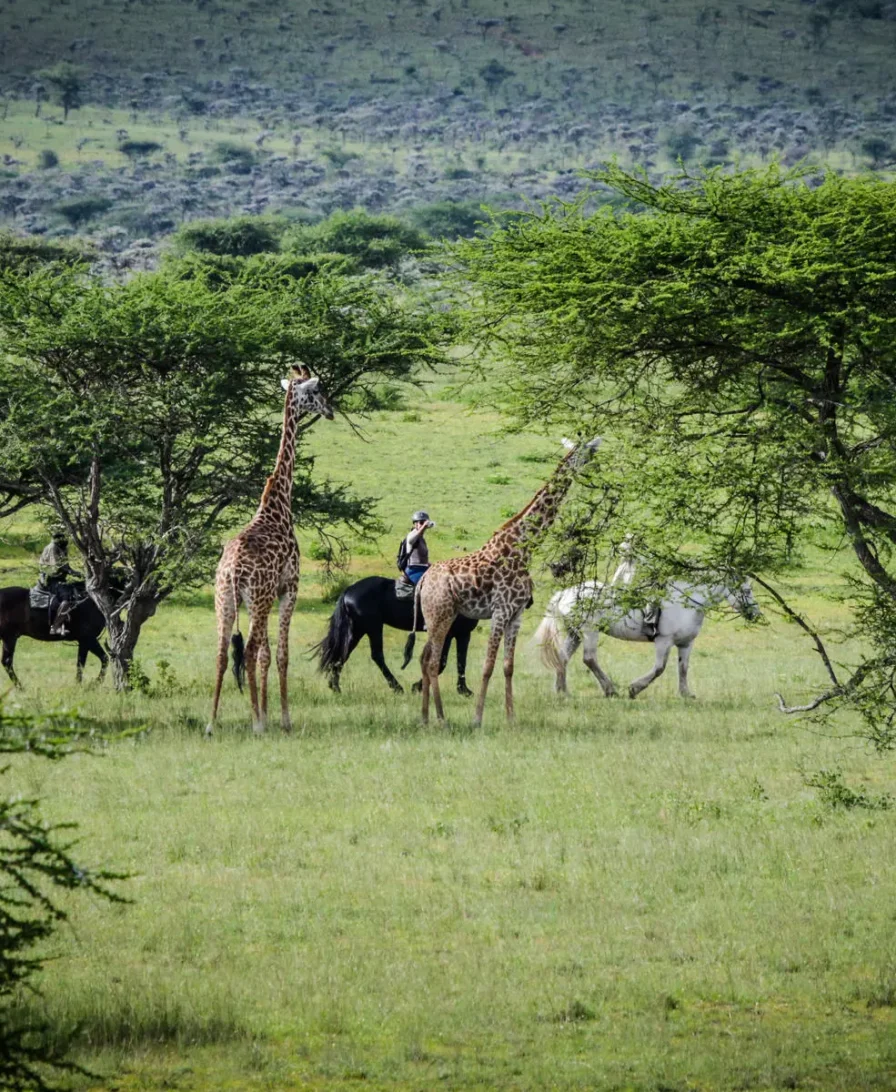
Similarly, horseback and camel safaris let you approach wildlife quietly. Wildlife reads a horse as just another grazing animal, so zebra and giraffe often stay calm. Lewa Wilderness and Borana are known for their riding programmes, with options for experienced and novice riders.
Night Drives
Night drives at Lewa use spotlights to find nocturnal species such as aardvark, genet, civet, bushbaby and striped hyena. They are a conservancy privilege, banned in most Kenyan national parks. To understand where night drives are legal and what you're likely to see, read our guide to night game drives in Kenya.
Behind-the-Scenes Conservation Visits
Lewa's behind-the-scenes programme lets overnight guests see conservation in action, from tracker dogs to clinics. The programme includes school visits, meeting the tracker dogs, security operations, the elephant underpass, conservation education, community health and water and farming projects. These are booked through your lodge and fill on a first-come basis.
For instance, the elephant underpass is a standout. It lets elephants cross beneath the busy Meru–Isiolo highway on their traditional route between Mount Kenya's forests and the northern rangelands. It is a small structure with a big lesson: coexistence is engineered, not assumed.
What Other Wildlife Will You See at Lewa?
Lewa hosts all of the Big Five plus rare northern species such as Grevy's zebra, reticulated giraffe, Beisa oryx, gerenuk and Somali ostrich. Lewa holds approximately 350 Grevy's zebras, the largest single population of the species in the world. That makes it one of the very few places where you can photograph an endangered rhino and an endangered zebra on the same drive.
Moreover, predators are well represented. Lions, leopards, cheetahs and African wild dogs all move through the Lewa-Borana Landscape, along with more than 350 recorded bird species. If you're building a Big Five checklist, our Big Five safari Kenya guide shows how Lewa fits with other parks.
How Should You Behave Around Rhinos? A Responsible-Viewing Checklist
Responsible rhino viewing means keeping your distance, staying quiet and following your guide's instructions at all times. A stressed black rhino can charge, and a disturbed mother may abandon feeding. By following a few simple rules, you protect both the animals and yourself.
- Keep your distance. Let the guide decide how close to approach, especially on foot.
- Stay quiet and still. Lower your voice, avoid sudden movements and never stand up in an open vehicle near a rhino.
- Never share rhino locations online. Turn off photo geotagging; poachers can and do mine social media.
- Leave the drone at home. Drones disturb wildlife and need permits in Kenya — read our guide to drone rules on an African safari.
- Respect ranger instructions. On walks, rangers decide where you go and when you leave.
- Tip fairly. Guides, trackers and rangers are the frontline — see our Kenya safari tipping guide.
Is Lewa or Ol Pejeta Better for Seeing Rhinos?
Neither Lewa nor Ol Pejeta is objectively better for rhinos; Lewa suits travellers who want exclusivity and activity variety, while Ol Pejeta suits those who want the northern white rhinos and easier road access. Ol Pejeta describes itself as home to the largest black rhino population in East Africa, and it also cares for Najin and Fatu, the last two northern white rhinos. Lewa, by contrast, offers lower visitor density and a broader mix of walking, riding and behind-the-scenes conservation access.
| Factor | Lewa Wildlife Conservancy | Ol Pejeta Conservancy |
|---|---|---|
| Rhinos | 280+ black and white (Lewa-Borana) | Largest black rhino population in East Africa; last two northern whites |
| Visitor density | Very low; five lodges | Higher; wider range of lodges and campsites |
| Budget range | Mostly upper mid-range to luxury | Budget to luxury, including self-catering |
| Signature extras | Walking, horses, camels, tracker dogs, JOCC tour | Northern white rhino encounter, chimpanzee sanctuary |
| Access | Flight to Lewa Downs or 4–5 hr drive | Flight to Nanyuki or 3.5–4.5 hr drive |
| Best for | Repeat visitors, honeymooners, photographers | First-timers, families, budget-conscious rhino lovers |
In reality, many rhino-focused travellers visit both, since they are only a couple of hours apart. You can explore Ol Pejeta further in our Ol Pejeta Conservancy rhino guide or see a ready-made Ol Pejeta safari package.
What Tools and Resources Help You Plan a Lewa Rhino Safari?
The most useful planning tools for a Lewa safari are a cost calculator, Lewa's own visitor pages, the airline schedules for Lewa Downs, and Kenya's eTA portal. Using a few of these early prevents the most common mistakes, such as booking a flight that lands after the afternoon drive has left. For example, checking the Safarilink and AirKenya timetables before choosing a lodge can save you a half-day of game viewing.
First, price the trip before you fall in love with a lodge. Our free Kenya safari cost calculator lets you add conservancy fees, flights, lodge tiers and extras line by line. As a free alternative, you can build a rough budget in any spreadsheet using the fee table above.
Second, use primary sources for facts that change. Lewa's Getting Here and Other FAQ page covers flights, vaccinations and what to pack, while its lodges page links directly to each property. For national context, the Kenya Wildlife Service publishes rhino-programme updates.
Third, sort your paperwork early. Every visitor needs an approved Kenya eTA before boarding, so follow our Kenya eTA guide for safari travellers. Lewa describes itself as a low-risk malaria zone, but you should still check with a travel doctor and read our Kenya safari vaccinations and health guide.
Sample Itineraries That Include Lewa
The simplest way to visit Lewa is a three-day fly-in safari from Nairobi, while longer trips pair it with Samburu and the Maasai Mara. Here are three shapes that work well:
- Short and focused (3 days): Fly Wilson–Lewa, two nights, rhino tracking, a bush walk and a night drive. See our 3-day Lewa fly-in safari from Nairobi.
- Northern Kenya circuit (6–7 days): Lewa for rhinos and Grevy's zebra, then Samburu for the "Samburu Special Five." Read our Samburu National Reserve safari guide.
- Rhinos plus big cats (7–9 days): Lewa or Laikipia first, then fly to the Mara for lions and, from July to October, the migration. See our Maasai Mara safari guide and our 6-day Samburu and Masai Mara fly-in safari as a template.
In addition, Lewa works beautifully for special occasions. Its secluded lodges and private guiding make it a favourite for couples — our honeymoon safari Kenya guide covers how to plan one. Photographers should also read our photographer's guide to safaris in Kenya for lens and lighting tips.
How Can Travellers Support Rhino Conservation at Lewa?
Travellers support rhino conservation at Lewa most directly by staying overnight, paying the conservancy fee, joining behind-the-scenes activities and donating or naming a rhino through Lewa's official channels. Your conservancy fee funds rangers, monitoring and community programmes, so a longer stay translates into more protection. For example, choosing Safarilink for your flight adds a US$5 contribution per passenger at no extra effort.
Beyond your trip, there are several ways to give. Lewa accepts donations through entities in the USA, UK and Canada, and runs a Name a Rhino programme. Save the Rhino International also funds ranger training and equipment at Lewa.
Finally, consider the Lewa Safari Marathon. Held every year in late June, it brings runners from around the world onto the conservancy, with proceeds supporting conservation and community projects. The 2026 edition ran on 27 June, organised by Tusk with Lewa.
What Should You Do Next to Book Your Lewa Rhino Safari?
Your next step is to choose your travel dates, decide on two or three nights at Lewa, and secure your lodge before flights and activities. Because Lewa has so few beds, dry-season rooms often sell out six to nine months ahead. By locking in accommodation first, you can then add behind-the-scenes activities, which lodges book on a first-come basis.
Follow this sequence:
- Pick your season. Late June–October or January–February for the best rhino viewing.
- Choose a lodge. Match budget and style — Kifaru House for luxury, Lewa Safari Camp for classic tents, Lewa Wilderness for riding.
- Book flights to Lewa Downs. Align arrival with your lodge's afternoon drive.
- Reserve conservation activities. Ask your lodge to book the tracker-dog and JOCC visits at the same time.
- Add a second destination. Samburu, Ol Pejeta or the Mara round out the trip.
- Pack smart. Soft bags, 15 kg limit, warm layers — use our Kenya safari packing list.
If you'd rather hand the logistics to a Nairobi-based specialist, you can book a free safari consultation with our team. We'll match a Lewa lodge to your budget, align the flights, and pre-book the conservation activities that matter most to you.
Lewa Wildlife Conservancy FAQs
Is Lewa Wildlife Conservancy worth visiting?
Yes, Lewa is worth visiting if you want reliable rhino sightings, low vehicle numbers and activities such as walking and night drives. It costs more than a national park, but the conservancy fee directly funds the protection that makes those sightings possible.
How many black rhinos are at Lewa?
Lewa's last published species split showed 130 black rhinos within a Lewa-Borana total of 273, and the overall landscape count now exceeds 280 — Source: Lewa Wildlife Conservancy, 2025–2026.
Has there been rhino poaching at Lewa recently?
No — Lewa reports zero rhino poaching since 2019. Nationally, KWS reported no rhino poaching in Kenya during 2025.
Who leads Lewa Wildlife Conservancy?
Rob Macaire became Lewa's Chief Executive Officer on 1 June 2026, succeeding Mike Watson after 15 years. The appointment was announced by Lewa's board, chaired by Michael Joseph.
Is Lewa safe for families?
Yes, Lewa is family-friendly, with lodges that run child-specific activities. Lewa says it has welcomed guests from infancy to 99 and that lodges tailor activities to children's ages.
Why is Lewa famous beyond rhinos?
Lewa is internationally known partly because Prince William proposed to Kate Middleton there in 2010. Kenyan media also note the Prince's frequent visits to the conservancy over the years.
Conclusion: Why a Lewa Safari Is Proof That Protection Works
A Lewa safari is one of the few trips where you can see a conservation comeback with your own eyes and pay directly into keeping it going. In just over four decades, a fenced corner of a cattle ranch grew from 15 rhinos to more than 280, sent over 70 animals to start new populations, and has recorded no rhino poaching since 2019. Every rhino you track there is evidence that rangers, communities and visitors can reverse what poachers nearly finished.
So, plan it well. Go in the dry season, stay at least two nights, book the tracker dogs and the operations room, and pair Lewa with Samburu or the Mara for a complete Kenya story. When you finally watch a black rhino step out of the acacia at dawn, you'll know you're not just seeing wildlife — you're seeing proof that protection works.










Comments (0)
Leave a Comment
No comments yet. Be the first to comment!