


You already know Kenya is one of the most sought-after safari destinations on the planet — your clients ask for it by name. But knowing the destination and having a ground partner you can stake your reputation on are two entirely different things. In this guide, you'll learn exactly what separates a trusted Kenya DMC from the rest, the specific criteria experienced travel advisors use to vet ground operators, and how to build a Kenya partnership that delivers for your clients every single time.
Key Takeaways
- A Kenya DMC (Destination Management Company) is a locally based ground operator that manages all in-country logistics on behalf of travel advisors — from game drive coordination to accommodation bookings and client emergency support.
- Trusted Kenya DMCs are registered with KATO (Kenya Association of Tour Operators) and the Kenya Tourism Board — advisors should verify these credentials before entering any trade agreement.
- The right Kenya DMC partnership offers travel advisors net rates, dedicated trade support, and FAM trip access — turning Kenya into a profitable, repeatable revenue line rather than a one-off booking.
- Advisor-focused DMCs provide 24/7 in-destination emergency contacts, ensuring that client issues are resolved on the ground without the advisor needing to intervene across time zones.
- Kenya's major safari circuits — the Maasai Mara, Amboseli, Samburu, and Laikipia — require specialized local knowledge that only an experienced, Kenya-based DMC can reliably deliver.
- Vetting a Kenya DMC requires more than checking a website; advisors should request verifiable client references, inspect vehicle and guide standards, and confirm transparent commission structures before committing.
- A FAM (familiarization) trip offered by a reputable Kenya DMC is the single most effective way for a travel advisor to validate service quality and begin selling Kenya with confidence.
What Is a Kenya DMC and How Does It Differ from a Wholesale Operator?
A Kenya DMC (Destination Management Company) is a locally licensed ground operator based in Kenya that manages all in-country travel logistics — including accommodation, transportation, guides, and client support — on behalf of international travel advisors and tour operators. This distinction matters enormously in practice.
A DMC is not a wholesaler, and it is not an OTA. A wholesale operator aggregates inventory and resells it across markets; an OTA is a consumer-facing booking platform. A DMC, by contrast, is your operational partner on the ground — with its own vehicles, its own vetted guide network, and its own supplier relationships built over years of Kenya-specific operation. When your client lands at Jomo Kenyatta International Airport, it is the DMC's staff member holding the sign, not a contractor sourced from a directory.
For travel advisors, this distinction has direct commercial implications. Working through a DMC Kenya partner means your clients receive a consistently managed, end-to-end experience — while you retain the client relationship, the margin, and the credit.
The DMC model also provides something no wholesale platform can: institutional knowledge of Kenya's reserves, seasonal conditions, lodge availability, and the informal relationships that secure better tent allocations during peak Mara season. That insider access is what your high-value clients are ultimately paying for.
Why Do Travel Advisors Need a Dedicated Kenya DMC Instead of Booking Direct?
Choosing the right Kenya DMC is the most consequential decision in your Africa portfolio — because when a DMC fails, it is your reputation that takes the hit. The risks of using unvetted or under-resourced ground operators are concrete and costly.
Itinerary breakdowns are the most common failure point. A vehicle that doesn't show, a bush walk guide who hasn't been briefed, or a lodge reservation that was never confirmed — these are not minor inconveniences for a client who has flown 15 hours and spent $25,000 on a safari. According to the African Travel and Tourism Association, operational failures by ground handlers represent the leading cause of client complaints in Africa-bound travel — Source: ATTA, 2023.
Communication blackouts during in-trip emergencies are the second major risk. If your DMC lacks a staffed 24/7 emergency line — not just a mobile number that goes to voicemail — your client is stranded and you are fielding panicked calls at 3am across time zones. A trusted Kenya DMC eliminates that scenario entirely.
Conversely, the right DMC partnership becomes a genuine competitive advantage. Advisors who work with a strong Kenya ground handler and operations partner can confidently market premium Kenya safaris, secure repeat bookings, and differentiate their Africa offering from competitors who are simply booking online.
What Credentials Should a Trusted Kenya DMC Hold Before You Partner with Them?
Trusted Kenya DMCs are registered with the Kenya Association of Tour Operators (KATO) and hold active accreditation from the Kenya Tourism Board — these are the two baseline credentials travel advisors should verify before entering a trade partnership. Both registrations are publicly verifiable, and any reputable operator will provide their license numbers without hesitation.
KATO Registration and Kenya Tourism Board Accreditation
KATO membership signals that the DMC operates within the industry's ethical and professional framework. KATO members commit to service standards, financial accountability, and dispute resolution mechanisms — all of which protect you and your clients. Verify our KATO registration and trade credentials directly on our partner page. The Kenya Tourism Board accreditation layer adds a government-level validation of operational legality.
Beyond licensing, years of continuous operation matter. An operator who has been running safaris in Kenya for under three years carries a fundamentally different risk profile than one with a decade of documented client history. Request a portfolio of advisor testimonials — not just consumer reviews, but specific references from other travel advisors or tour operators in your market. Read what travel advisors say about our Kenya DMC services on our partner page.
Guide Certification and Vehicle Standards
A Kenya DMC's guide quality directly determines the client experience on safari — reputable DMCs employ Kenya Professional Safari Guides Association (KPSGA)-certified guides with verified field experience across Kenya's key ecosystems. This is not a minor credential. KPSGA certification requires demonstrated wildlife knowledge, first aid qualification, and assessed field competency. Ask any prospective DMC for their guide roster and certification records.
Vehicle standards are equally non-negotiable. Safari vehicles should be purpose-built 4x4s with pop-top roofs, not converted minibuses. Ask for fleet photographs, maintenance records, and vehicle age. A fleet that cannot safely traverse the Maasai Mara's black cotton soil during the rainy season is a liability, not an asset. View our safari vehicle standards to see what purpose-built game drive vehicles look like.
Responsible Tourism Credentials
Responsible tourism and sustainability standards signal operational maturity. DMCs committed to conservation tend to have stronger lodge partnerships, better community relationships, and more resilient supply chains. Look for membership in the Eco-Tourism Kenya certification program or documented partnerships with conservation organizations such as the Maasai Mara Conservancy Alliance.
What Destinations and Safari Circuits Should a Full-Service Kenya DMC Cover?
The Maasai Mara, Amboseli National Park, Samburu National Reserve, and Laikipia Plateau represent the four primary safari circuits that a full-service Kenya DMC should be able to operate across with in-house expertise and established supplier relationships. Coverage of these circuits is the baseline — not the ceiling.
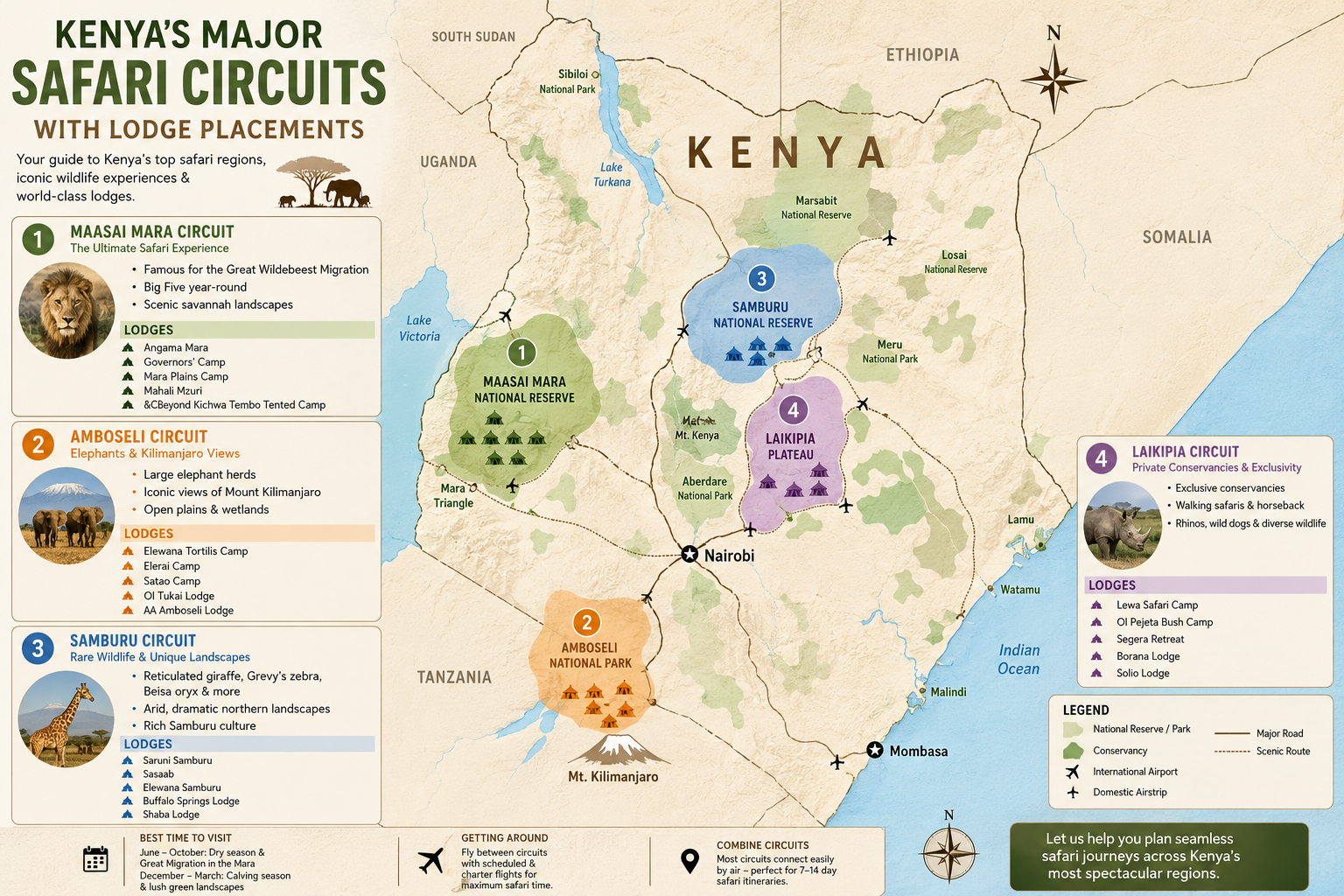
A full-service Kenya safari logistics partner should also cover the following operational scope without outsourcing to third parties:
| Service Category | What to Expect from a Trusted DMC |
|---|---|
| Airport transfers | Branded vehicles, meet-and-greet staff, flight monitoring |
| Lodge & camp bookings | Direct contracts, allocated inventory during peak season |
| Private game drives | Dedicated guide and vehicle per group, not shared departures |
| Hot air balloon coordination | Pre-booked slots, weather contingency planning |
| Nairobi pre-tour services | City hotel bookings, Karen Blixen Museum, Giraffe Centre |
| Coastal extensions | Diani Beach, Watamu, Lamu — direct lodge partnerships |
| Cross-border add-ons | Uganda and Rwanda gorilla trekking add-ons from Kenya — gorilla permits, cross-border transfers |
| Documentation support | Visa facilitation guidance, Yellow Fever certificate requirements |
Understanding Kenya's safari circuits and how they connect is essential for building itineraries that flow logically and minimize unnecessary travel time — a quality that luxury clients notice immediately.
Accommodation sourcing depth matters as much as geographic coverage. A trusted DMC holds direct allocations at top-tier camps — meaning your clients don't lose their tent to a last-minute inventory conflict on a travel agent's website. Browse our Kenya luxury safari lodge partnerships and preferred camps to see the properties we work with directly.
How Do Kenya DMC Commission and Net Rate Structures Work for Travel Advisors?
Travel advisors who partner with a dedicated Kenya DMC gain access to pre-negotiated net rates, exclusive lodge allocations, and a local support infrastructure that allows them to sell high-value Kenya safaris without managing in-country logistics directly. Understanding how this commercial structure works is essential before signing any trade agreement.
Net Rates vs. Commission Models
Net rate structures give advisors a fixed supplier-level price, allowing them to apply their own margin. This is the preferred model for luxury travel advisors who want pricing control and the ability to package Kenya components within a broader multi-country itinerary. Net rates typically represent a 20–30% discount from public rack rates — Source: Kenya Tourism Federation, 2023.
Commission models pay the advisor a percentage of the total booking value after the trip completes. This model suits advisors who prefer not to hold margin risk or who are newer to Africa product. Most trusted Kenya DMCs offer both structures and allow advisors to choose based on their business model. View our full trade commission structure and partnership tiers to understand exactly how the programme works.
FAM Trips and Site Inspection Support
FAM (familiarization) trips are the most direct commercial investment a DMC makes in an advisor relationship. A well-structured Kenya FAM trip allows you to experience the safari product firsthand — the guiding quality, the lodge standards, the transfer efficiency — so you can sell with authority rather than assumption. Submit a Kenya FAM trip request for travel agents via our contact page to enquire about availability. Reputable DMCs subsidize or fully sponsor FAM trips for qualified advisors in key markets.
Dedicated account management is the structural element most advisors undervalue at the start of a DMC relationship. An account manager who knows your client preferences, your preferred lodge tiers, and your quoting turnaround requirements eliminates friction from the sales process. When evaluating a DMC, ask specifically: Who is my named account manager, and what is their response time SLA?
Co-Branded Marketing and Advisor Tools
Browse Kenya safari sample itineraries for travel advisors in our itinerary library. The strongest Kenya DMC partnerships include co-branded marketing collateral — itinerary templates, destination guides, and client-facing proposal documents with the advisor's branding applied. This infrastructure saves advisors significant time and gives their Kenya proposals a professional depth that generalist booking platforms cannot replicate.
What Red Flags Should Travel Advisors Watch for When Evaluating a Kenya DMC?
Red flags in a Kenya DMC evaluation are often subtle — they reveal themselves not in what an operator says, but in what they avoid saying. Advisors who know what to look for can eliminate underperforming operators before a client's trip is at stake.
Watch for these specific warning signs:
- No verifiable physical Kenya office. A legitimate DMC has a registered address in Kenya — not just a website domain and a WhatsApp number. Ask for the office address and verify it on Google Maps and the KATO directory.
- Vague emergency contact protocols. If a DMC cannot tell you exactly who answers their emergency line at 2am on a Sunday — a named person, a direct mobile, a protocol — they do not have a real emergency system.
- Resistance to providing references. Any reputable DMC can provide three to five verifiable travel advisor references within 24 hours. Hesitation or redirection is a significant red flag.
- Non-standardized vehicles. If fleet photographs show inconsistency — different vehicle types, no pop-top roofs, visible age — ask for a written vehicle specification. If they cannot provide one, walk away. Review our full safari vehicle specifications as a benchmark for what purpose-built game drive vehicles should look like.
- Unlicensed guides. Ask specifically for KPSGA certification records for the guides assigned to your client groups. An inability to produce these documents indicates an informal guide network.
- Opaque pricing. Any pricing that changes unexpectedly between quote and invoice — without documented rate sheet — signals poor financial controls or deliberate opacity.
- Lack of sustainable and responsible tourism commitments. DMCs without documented conservation policies are often disconnected from the community relationships that make Kenya safaris meaningful and sustainable.
How Does a Kenya DMC FAM Trip Help Travel Advisors Sell Africa More Confidently?
A FAM trip offered by a reputable Kenya DMC is the single most effective tool for converting an interested travel advisor into a confident Kenya seller. The logic is straightforward: advisors sell what they have experienced, and Kenya's experiential gap — the difference between knowing it intellectually and having felt the Mara at dawn — is vast.
A well-structured Kenya FAM trip should include:
- At least two distinct safari circuit experiences (e.g., Maasai Mara + Amboseli)
- Representative lodge stays across multiple price tiers
- A private game drive with one of the DMC's lead guides
- A debrief session with the DMC's trade desk team
- A post-trip rate sheet, sample itinerary, and co-branded proposal template
Apply for a Kenya FAM trip for travel agents via our contact page. According to ATTA's Africa travel advisor survey, advisors who have completed a FAM trip to Kenya close Kenya safari bookings at three times the rate of advisors who rely on destination knowledge alone — Source: ATTA Advisor Survey, 2022.
The commercial return on a FAM trip is rapid. A single $20,000 Kenya booking generates enough margin to justify the FAM trip investment many times over — and the best Kenya DMC partnerships are built on exactly this foundation.
What Does the Onboarding Process Look Like When Partnering with a Kenya DMC?
Onboarding with a trusted Kenya DMC follows a clear, structured sequence — from first contact to your first client departure. Understanding this process removes uncertainty and helps advisors set realistic expectations for timeline and effort.
Step 1: Initial Inquiry and Discovery Call
The process begins with a discovery call — typically 30 to 45 minutes — where the DMC's trade desk assesses your client profile, volume expectations, preferred destinations, and market positioning. This is also your opportunity to ask the vetting questions outlined in this guide.
Step 2: Trade Agreement and Rate Sheet Access
Upon approval, you receive a formal trade agreement — not just a terms sheet — and access to the DMC's advisor rate sheets. This document governs the commercial relationship, dispute resolution, and cancellation terms. Read it carefully, and ensure it specifies your named account manager. Register for our trade partnership and advisor portal to begin the onboarding process.
Step 3: Test Itinerary and Proposal Build
Before committing your first client, build a test itinerary with your account manager. A trusted DMC will invest time in this stage — proposing lodge options, explaining seasonal trade-offs, and turning around a client-ready proposal within 48 hours. Response speed at this stage is a reliable proxy for how the DMC will perform when your client is in the field.
Step 4: FAM Trip and Client Launch
If you qualify for a FAM trip, schedule it before your first client departure where possible. Your first booking confidence increases dramatically when you can speak from firsthand experience. Submit your Kenya FAM trip enquiry here via our contact form. For advisors who cannot travel immediately, the DMC's co-branded itinerary tools and advisor resources bridge the gap.
How Do Advisors Build Profitable Long-Term Revenue with a Kenya DMC Partner?
Long-term revenue from a Kenya DMC partnership compounds over time — as your client base grows, your repeat booking rate increases, and your Kenya expertise deepens. The advisors who generate the most consistent Africa revenue treat their DMC partnership as a strategic relationship, not a transactional supplier arrangement.
Volume commitments unlock better commercial terms. Most trusted Kenya DMCs offer tiered net rate structures — advisors who send five or more groups per year typically access preferential pricing, priority lodge allocations, and dedicated account management at a senior level. See our full tiered commission and partnership programme for details on how volume bookings unlock better terms.
Repeat client cultivation is the highest-value activity in Kenya safari sales. According to a 2023 Virtuoso Luxe Report, clients who complete one African safari have a 68% likelihood of booking a second Africa trip within three years — Source: Virtuoso Luxe Report, 2023. A trusted Kenya DMC helps advisors capture this repeat business through post-trip reporting, client experience summaries, and proactive next-destination recommendations.
What's Next: How to Begin Your Kenya DMC Partnership Today
Starting your Kenya DMC partnership is a structured, low-risk process when approached correctly. Here are your immediate next steps:
- Request a trade pack from a KATO-registered Kenya DMC that includes their license documentation, rate sheets, and advisor reference contacts.
- Schedule a discovery call to assess operational capability, communication standards, and commercial terms before signing any agreement. Register on our advisor partner portal to get started.
- Build a test itinerary for a hypothetical client — evaluate the DMC's response time, itinerary depth, and lodge knowledge.
- Apply for a FAM trip if you are new to Kenya. Submit your Kenya FAM trip application here. Experience the product before you sell it.
- Verify credentials independently — confirm KATO registration, Kenya Tourism Board accreditation, and guide certifications before your first client departs.
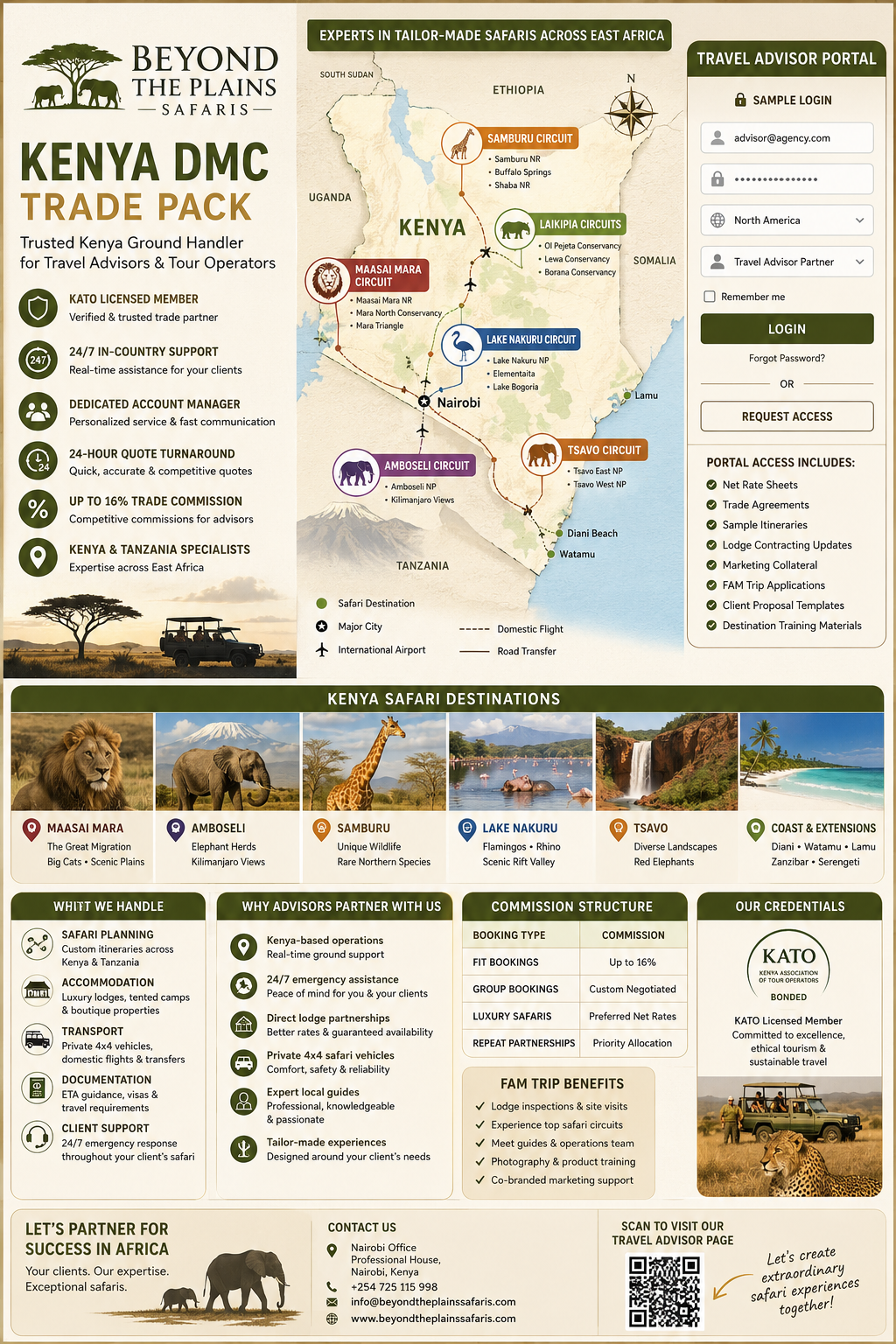
The entire process from first inquiry to first client departure typically takes four to eight weeks — ample time to build confidence before committing client itineraries to the partnership.
Conclusion: Kenya Deserves a Place in Your Portfolio — and the Right DMC Makes It Profitable
Kenya is not just a destination. It is a recurring revenue opportunity for advisors who position it correctly and execute it through the right ground partner. The Maasai Mara wildebeest migration, Amboseli's elephant landscapes against Kilimanjaro, Samburu's rare Northern species — these are the experiences that turn first-time safari clients into lifelong Africa travelers.
But Kenya's potential as a portfolio pillar depends entirely on the operational infrastructure behind your offering. A trusted Kenya DMC — credentialed, transparent, advisor-focused, and locally embedded — is the difference between a destination you can confidently sell and one you have to hope for the best with.
The advisors who dominate their market's Africa category are not necessarily the ones who know Kenya best. They are the ones who found the right ground partner early and built a repeatable system around that relationship.
Start your Kenya DMC vetting process today. The partnership that's right for your business is out there — and this guide has given you everything you need to find it.
Written by John Dante, Director & Operations Manager, Beyond the Plains Safaris — a Kenya-based Destination Management Company specializing in bespoke safari logistics and trade partnerships for international travel advisors and tour operators.











Comments (0)
Leave a Comment
No comments yet. Be the first to comment!