


The Three Kenya Safari Itineraries We Quietly Talk Clients Out Of — and What We Recommend Instead
By John Dante, Owner & Safari Director | Beyond the Plains Safaris | Nairobi, Kenya
Reading time: 10 minutes Category: Kenya Safari Planning | Itinerary Advice | Insider Expertise Published by: Beyond the Plains Safaris — 4.9 ⭐ TripAdvisor · Travelers' Choice 2022–2024 · 2025 Tourism Excellence Awards 1st Runners-Up · KATO Member
We receive hundreds of kenya safari enquiries every year. Most arrive with an itinerary already attached — something put together from a travel blog, a TripAdvisor thread, or a conversation with a friend who went five years ago.
We read every one carefully. And there are three itinerary patterns we see so often, in so many variations, that we now recognise them in the first paragraph of a client's email.
We never dismiss them. We ask questions. We open a conversation. And then, gently, we explain why the version they've arrived with is likely to work against them — and what we'd build instead.
This piece shares those three conversations. Not to criticise the research clients have done — that research is careful and well-intentioned — but because the gap between a good Kenya safari and a transformative one almost always comes down to exactly these decisions.
Understanding why we push back on these itineraries, and what we recommend instead, is the most useful thing we can offer any first-time Kenya safari planner.
Itinerary #1: Five Parks in Seven Days
What the enquiry looks like:
"We have 7 days. We'd love to see the Masai Mara, Amboseli, Lake Nakuru, Samburu, and maybe fit in Naivasha for the boat safari. Is this doable?"
It is technically doable. It is not advisable.
Here is the maths that changes the conversation.
The drive from Nairobi to the Masai Mara National Reserve is 5–6 hours. The drive from the Mara to Amboseli National Park via Nairobi is 8–9 hours. Nairobi to Samburu Game Reserve is 5–6 hours north. If you are visiting all five destinations in seven days by road, you will spend between 22 and 28 hours in a vehicle during a week that is supposed to be spent in the bush.
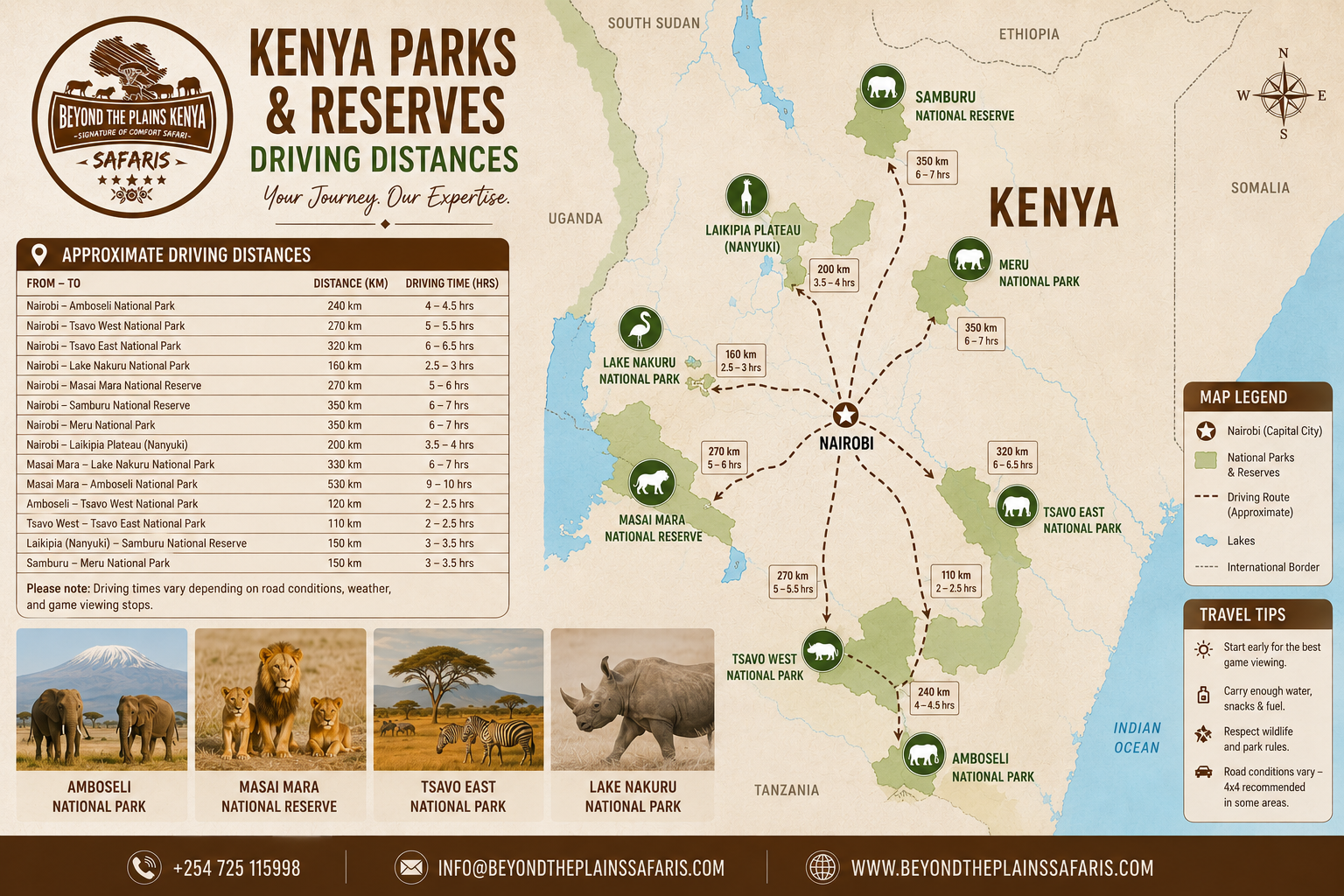
That is three and a half working days of driving. In a safari context, those are lost game drives — the single most valuable unit of a Kenya safari.
But the problem goes deeper than lost time. Every time you move between destinations, your first afternoon is consumed by transfer. Your final morning is compressed by the need to depart. In a two-night stay, you realistically have three game drives — one evening arrival drive, one full-day morning and afternoon, and a brief morning drive on departure day if your schedule allows. That is not enough time to settle into an ecosystem, to learn its rhythms, to experience the second-day knowledge that a guide accumulates about specific animal movements. The best sightings of any stay usually happen on day two or three, once the guide has had a full day to observe patterns, track movements, and anticipate behaviour.
Guests who move every two days rarely reach that depth. They collect parks like stamps and return home with a collection of brief glimpses rather than the immersive encounters they came for.
What we recommend instead:
A three-destination itinerary over seven days, with a minimum of two nights — ideally three — per location. Our most-recommended structure for this duration:
Option A — The Mara and Amboseli circuit (best for Big Five and iconic landscapes)
- 1 night Nairobi (arrival buffer — more on why this matters in Itinerary #3)
- 3 nights Masai Mara National Reserve or a neighbouring private conservancy
- 3 nights Amboseli National Park (elephant herds, views of Kilimanjaro, exceptional open-sky photography)
This structure gives you six to eight game drives across two ecosystems that are completely different in character — the Mara's tall-grass plains and predator density versus Amboseli's open dusty flats and elephant-dominated landscapes. The contrast makes each feel richer.
Option B — The Northern circuit (best for unusual wildlife and fewer crowds)
- 1 night Nairobi
- 3 nights Samburu Game Reserve — home to the Northern Specials: Grevy's zebra, reticulated giraffe, beisa oryx, Somali ostrich, and gerenuk, none of which you will see in the south
- 3 nights Ol Pejeta Conservancy — the largest black rhino sanctuary in East Africa, home to chimpanzees, lion, elephant, and the last two northern white rhinos on earth
This is our recommendation for clients who have already been to the Mara, or who want to see wildlife they cannot find anywhere else.
What our guests say: "Our guide was always active during game drives, well communicated over wireless, expert in off road chase and overall a very good person." — Verified guest, TripAdvisor. This level of guide performance is only possible when the itinerary gives guides time to work.
→ See our Masai Mara safari packages: Masai Mara Safari Tour Package → Plan a northern Kenya circuit: Samburu Game Reserve | Ol Pejeta Conservancy
Itinerary #2: Two Nights in the Mara During Peak Migration Season
This is the most emotionally difficult conversation we have. Because the Great Migration is one of the greatest wildlife spectacles on earth, and clients who have been dreaming about it for years arrive in our inbox with real excitement. We share that excitement. We just need to do the maths together.
What the enquiry looks like:
"We can only travel in August. We've read that's peak migration season in the Masai Mara. We're thinking two nights. Is that enough?"
Here is what two nights in the Masai Mara in August actually costs and yields.
The cost side:
- Masai Mara National Reserve entry fees: $200 per adult per day (July–December peak season rate, plus 18% VAT)
- Two adults, two days: $800 in park fees alone, before accommodation, vehicle, guide, or flights
- Mid-range to upper-mid accommodation in August: $400–$700 per person per night
You are spending significant money to access a park you will see for approximately 48 hours.
The yield side:
- Night 1: Arrive afternoon, one evening game drive (2–3 hours)
- Day 2: One morning drive (3–4 hours), one afternoon drive (3–4 hours)
- Day 3: Brief morning drive before 10 AM departure
Total usable game drive time: approximately 10–12 hours across three drives. On a 3-million-acre reserve.
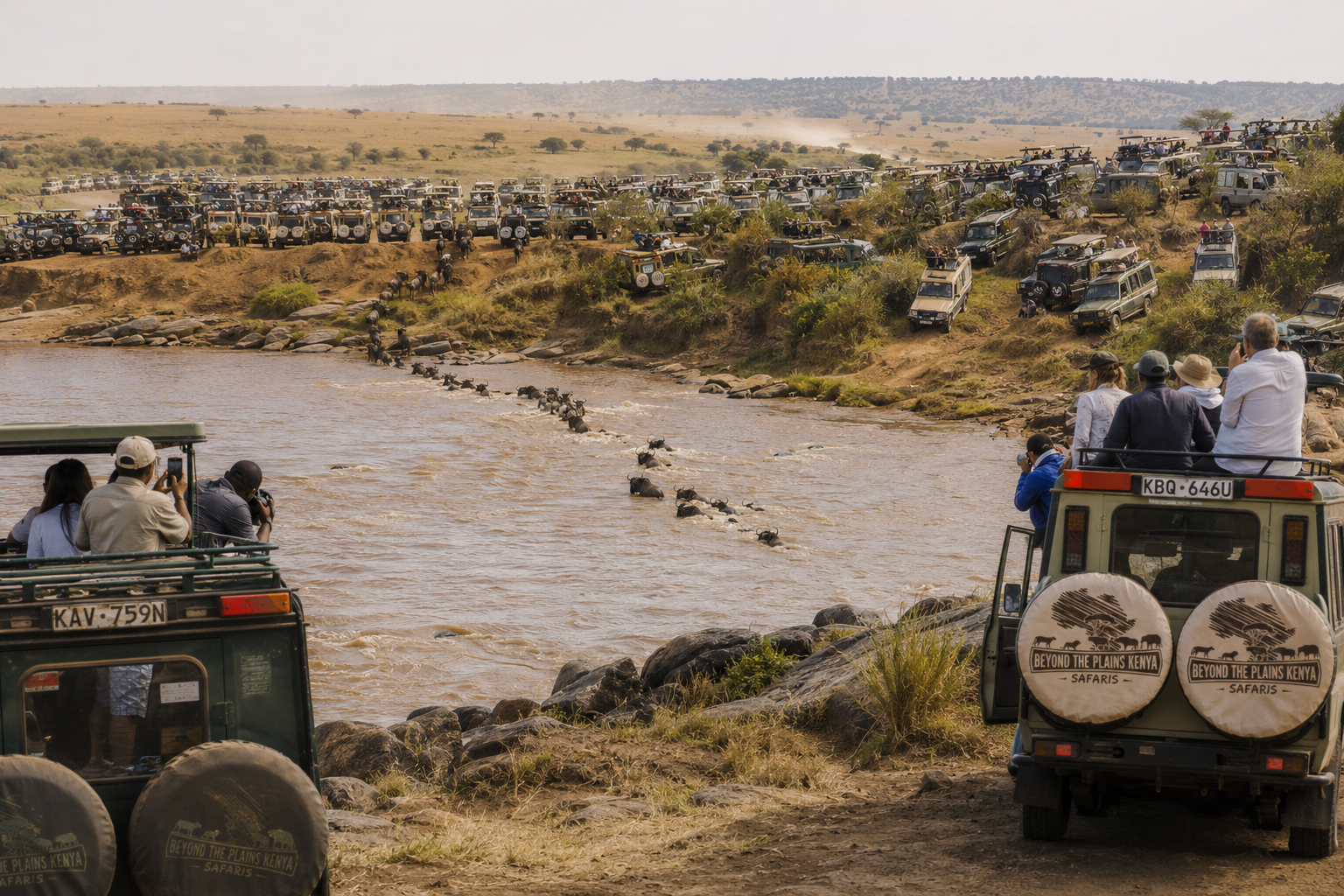
The crowd reality: August is the Mara's peak month. The reserve's main public areas — around the Talek and Sekenani zones — are heavily trafficked. River crossing sightings, which are the migration's defining moment, routinely attract 20–40 vehicles. The experience can feel more like a traffic event than a wildlife encounter.
The river crossing reality: Wildebeest crossings are not scheduled. They happen on the animals' terms. A herd will approach a crossing point, mill around for hours, and then retreat without crossing. Or they cross at 7 AM before most vehicles have arrived. Or they cross at dusk in near-darkness. Spending two days at the Mara and expecting to witness a crossing is like going to Wimbledon for two days expecting to watch the final.
What we recommend instead:
Option A — Stay longer, spend smarter: Three to four nights in the Mara dramatically improves your crossing odds, gives your guide time to track herd movements across multiple days, and reduces the per-drive cost of your park fees. The incremental accommodation cost of one or two additional nights is almost always less than the park fees you've already committed to. If you are paying $800 in park fees for three drives, adding two more nights roughly doubles your drives for a fraction of additional cost.
Option B — Consider the shoulder season advantage: June and early July offer excellent Mara game viewing — the dry season has arrived, predators are highly active, and the first migration herds are building in the northern Serengeti and approaching the Kenyan border. Park fees drop to $100 per adult per day (January–June rate). Accommodation prices are 20–30% lower. Crowds are a fraction of August levels. Our guests who travel in June consistently report more intimate, less crowded encounters than those who go in August.
Late October and early November is another exceptional window — the migration has dispersed, fees remain at peak levels until December, but the crowds are gone and big cat activity is superb as the plains replenish after the dry season.
Option C — A private conservancy instead of the main reserve: The private conservancies bordering the Mara — Naboisho, Olare Motorogi, Mara North — operate under different rules. Vehicle numbers are limited. Off-road driving is permitted. Conservancy fees are separate from park fees but often lower in aggregate when you factor in the quality differential. River crossings are visible from conservancy land. And the experience of watching a crossing with three vehicles instead of forty is something that cannot be overstated.
From a verified Reddit and TripAdvisor reviewer of Beyond the Plains Safaris: "Having a private guide and vehicle is the way I recommend as you can decide what to do and when to do it. The driver has a very good relationship with other drivers and they communicate frequently regarding where to spot the best action on the Masai Mara — we never spent more than 10 minutes before seeing some action."
This is the outcome that proper night allocation and private vehicle access produce. It does not happen on a two-night group tour during peak season.
→ See the Masai Mara in depth: Maasai Mara National Reserve → Combine Mara with Serengeti on a longer circuit: Masai Mara and Serengeti Safari Tour Package → Explore Kenya and Tanzania together: Kenya and Tanzania Safari Packages
Itinerary #3: Driving from the Masai Mara Directly into the Serengeti
This is the itinerary we talk clients out of before they have even fully described it, because the practical obstacle is definitive and not widely known.
What the enquiry looks like:
"We want to follow the migration. We're thinking we'll do the Mara in Kenya, then drive across into the Serengeti in Tanzania to continue the experience. We've seen this mentioned in a few blogs. Can you arrange this?"
The answer is no — and not because of logistics or cost. Because the border crossing that makes this possible is closed.
The Bologonya border crossing — the only land crossing between the Maasai Mara in Kenya and the Serengeti in Tanzania — is currently under indefinite closure. It has been closed for an extended period and there is no confirmed reopening date. Attempting to cross by road at Isebania or Namanga, the alternative Kenya-Tanzania border posts, adds 8–10 hours to the journey and takes you far outside the safari circuit.
Several travel blogs still describe the Mara–Serengeti road crossing as if it were operational. It is not. Clients who plan around those descriptions arrive in Nairobi to find the crossing unavailable, and their itinerary has to be rebuilt from scratch under time pressure.
The compound problem: Even if the border were open, the Mara–Serengeti overland crossing was never seamless. It involved road transfers between airstrips in different countries for immigration clearance, operated only in high season, and required a minimum of two passengers per charter flight segment. The crossing itself — even when operational — was one of the most logistically complex moves in East African safari planning.
What we recommend instead:
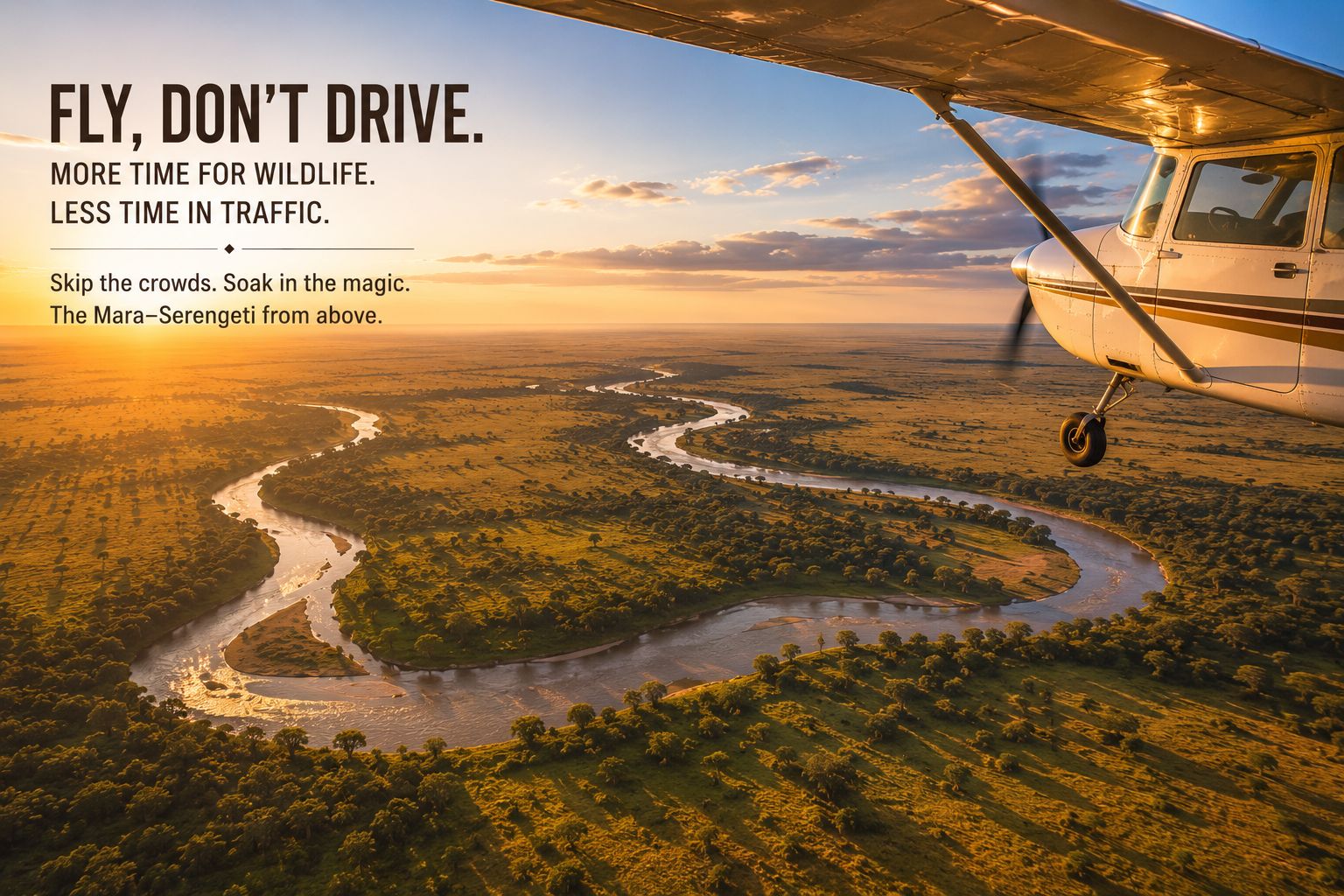
Option A — Fly between the ecosystems (the correct approach): The Masai Mara has multiple airstrips. Kenya's Wilson Airport in Nairobi connects to Kilimanjaro International Airport in Tanzania, from which transfers to the Serengeti are straightforward. A well-structured Kenya–Tanzania safari flies rather than drives between countries, keeps border formalities to a single airport immigration stop, and preserves game drive time on both sides.
A 10-day Kenya and Tanzania itinerary built around flying — typically three to four nights in the Mara or a conservancy, then three to four nights in the Serengeti or Ngorongoro Crater — is the correct structure for guests who want to experience both ecosystems. We build these regularly. The logistics, when planned properly, are completely seamless.
→ See our Kenya and Tanzania combined packages: Kenya and Tanzania Safari Packages → Explore our Tanzania destinations: Serengeti National Park | Ngorongoro Crater | Tarangire National Park
Option B — Stay entirely in Kenya and go deeper: If Tanzania is not in the budget or the timeframe, the Mara–Serengeti combination is not the only way to follow wildlife across a landscape. Kenya's northern circuit offers an entirely different ecosystem, different species, and a genuinely different experience. The Laikipia plateau, accessible via Ol Pejeta Conservancy, provides big-five viewing in a landscape that feels nothing like the Mara — open moorland, forested slopes, wildlife at population densities that rival the south.
Tsavo East National Park and Tsavo West together form the largest protected area in Kenya — bigger than the Masai Mara and Serengeti combined. Tsavo East's red elephants and Tsavo West's Mzima Springs provide wildlife encounters found nowhere else.
A Kenya-only itinerary built across genuinely distinct ecosystems delivers variety, depth, and value that a rushed Mara–Serengeti road crossing could never match.
From our TripAdvisor listing: "It's difficult to put in words the wonderful experience of safari at Masai Mara, Ol Pejeta, Nakuru and Amboseli. And the serene boat ride at Naivasha. If you are looking for a safari company that combines impeccable organisation, incredible responsiveness, highly individualised planning, and the absolute best ground experience — look no further than Beyond the Plains."
The Three Questions We Actually Ask First
Every itinerary we build begins with three questions. They are not about destinations. They are about you.
1. What does your body need? Safari wakes you at 5 AM every morning. International flights — especially from North America or Europe — arrive in Nairobi exhausted. We almost always recommend at least one buffer night in Nairobi before departing for the first park. It costs less than a park night and prevents guests from spending their first two game drives recovering from jet lag. It also gives us time to brief you properly: conditions in specific parks that week, what your guide has heard on the radio network, any last-minute routing adjustments based on real-time wildlife intel.
2. What kind of pace restores you? Some guests want to cover ground, collect destinations, move quickly. We can build that itinerary — but we build it honestly, with realistic driving times and genuine minimum nights per destination, not aspirational ones. Other guests want to arrive somewhere, unpack properly, learn a single landscape deeply, and leave knowing it. That guest needs a completely different structure, and we are not going to put them on the five-parks circuit.
3. What is the one thing you would not forgive yourself for missing? This question sounds dramatic. It produces the most useful information in the planning process. If the answer is "a river crossing," we talk about what that requires in terms of nights, timing, and conservancy access. If the answer is "seeing a cheetah hunt," we talk about which ecosystems maximise that probability. If the answer is "understanding what I am actually looking at," we talk about private vehicles, guide selection, and drive structure. The answer to this question often completely overturns the initial itinerary a client has drafted.
Why We Tell You This Before You Book
We are a Nairobi-based operator. We are not a booking platform that earns commission regardless of itinerary quality. Our business runs on repeat clients, referrals, and reviews — all of which depend on guests returning with experiences that exceeded their expectations.
Talking a client out of a five-park, seven-day circuit is sometimes a shorter conversation than we would like it to be. Some clients have already committed to that structure emotionally. Some return to us having done it, and tell us about the long drives between parks and the feeling of having arrived somewhere just in time to leave.
We prefer to have the conversation earlier.
Beyond the Plains Safaris is a KATO member, recognised as 1st Runners-Up for Best Tour Operator in Kenya at the 2025 Tourism Excellence Awards. We carry a 4.9 rating on TripAdvisor across multiple years, Travelers' Choice recognition from 2022 through 2024, and a 5.0 rating on SafariBookings. We work across Kenya and Tanzania, across budget levels from mid-range to luxury, and across group types from solo travellers to large family safaris.
What we do not do is tell clients their itinerary is fine when it isn't.
Plan Your Kenya Safari the Right Way
If you have an itinerary you would like us to review honestly — or if you would prefer to start from scratch with a blank page and a conversation — we are here.
- Schedule a Free Planning Consultation
- Get a Free Safari Quote
- Browse All Kenya Safari Tours
- Kenya and Tanzania Combined Safaris
- East Africa Safaris Overview
Frequently Asked Questions
How many parks should I visit on a 7-day Kenya safari? We recommend a maximum of three destinations on a 7-day safari, with a minimum of two nights — ideally three — per location. Visiting more than three parks in seven days means spending a disproportionate amount of time in transit and insufficient time in each ecosystem to experience it properly. The depth of a two-park safari almost always exceeds the breadth of a five-park one.
Is two nights in the Masai Mara enough? For a basic introduction, two nights provides three game drives. For a meaningful experience — especially during migration season — we recommend a minimum of three nights and ideally four. The additional nights cost less than the park fees you have already committed to, and roughly double your chances of witnessing a river crossing during the Great Migration.
Can you drive from the Masai Mara to the Serengeti? No. The Bologonya border crossing between the Maasai Mara and the Serengeti is currently closed indefinitely. Kenya–Tanzania safari combinations should be planned around domestic flights from Wilson Airport in Nairobi connecting to Kilimanjaro International, with road transfers into the Serengeti circuit from there.
What is the best time to visit Kenya on safari? Kenya offers excellent wildlife viewing year-round. The dry seasons — January to March and June to October — offer the most reliable game viewing due to shorter vegetation and animals concentrating around water sources. Peak migration in the Masai Mara runs July to October, with August the most crowded and expensive month. June and early July offer excellent conditions with significantly lower park fees and fewer vehicles.
What is the difference between a private and a shared Kenya safari vehicle? On a private vehicle, your guide calibrates every decision — pace, focus area, how long you spend at a sighting — to your group alone. Shared vehicles carry mixed groups with different interests, experience levels, and priorities, which limits the guide's ability to adapt. We strongly recommend private vehicles for guests who want expert-level field guidance. Every Beyond the Plains safari uses private Toyota Land Cruisers with named guides who are personally matched to the terrain and guest profile.
Is Lake Nakuru still worth visiting? Lake Nakuru National Park remains a viable safari destination for rhino, Rothschild's giraffe, lion, and leopard. However, its famous flamingo population fluctuates significantly with water levels — periods of heavy rainfall can reduce or temporarily displace the flamingo concentrations the park is known for. We always check current conditions before recommending it and adjust itineraries accordingly.
More from the Beyond the Plains Safari Blog
- 10-Day Private Kenya and Tanzania Safari Review
- What Our Guides Do in the First 15 Minutes of Every Game Drive
- Masai Mara National Reserve — Complete Visitor Guide
- Amboseli National Park — Elephants, Kilimanjaro, and the Open Plains
- Ol Pejeta Conservancy — Rhinos, Wild Dogs, and the Last Northern Whites
- Kenya and Tanzania Safari Packages
- Kenya Destination Overview
- Tanzania Destinations Overview
Beyond the Plains Safaris is headquartered in Nairobi, Kenya. We are members of KATO (Kenya Association of Tour Operators), ASTA, the East Africa Wildlife Society, AMREF, and Nature Kenya, and are registered with Kenya's Tourism Regulatory Authority. All our safaris operate with private Toyota Land Cruisers and named, expert field guides.
4.9 ⭐ TripAdvisor | 5.0 ⭐ SafariBookings | 4.7 ⭐ Google | Travelers' Choice 2022, 2023, 2024 | 2025 Tourism Excellence Awards — 1st Runners-Up Best Tour Operator in Kenya | Featured in Yahoo Finance, Associated Press, MarketWatch, and 800+ media outlets globally










Comments (0)
Leave a Comment
No comments yet. Be the first to comment!