

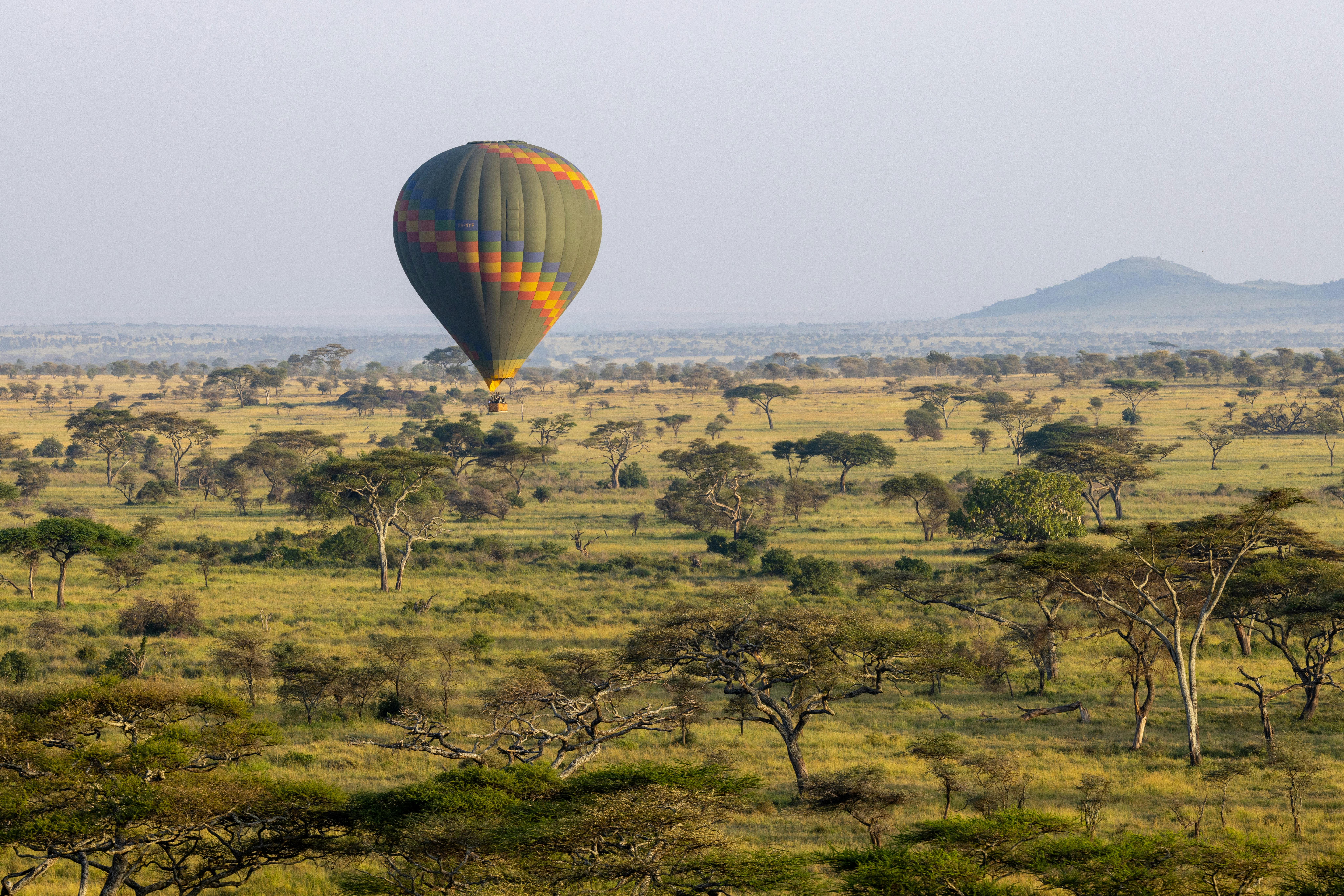
Hot Air Balloon Safari in the Maasai Mara: Is It Worth the Cost? (2026 Honest Review)
You've already planned your Kenya safari, chosen your camps, and mapped out your game drives — and then you spotted the balloon safari on your itinerary at $500 per person and paused. Is this a genuine once-in-a-lifetime experience, or an expensive tourist add-on you can comfortably skip? What most balloon safari articles won't tell you is that the answer genuinely depends on when you're going, what you're hoping to see, and what kind of traveler you are. In this honest 2026 review, you'll get the real cost breakdown, an unfiltered account of what the experience is actually like, and a straight verdict on whether it's worth your money for your specific trip.
Key Takeaways
- A hot air balloon safari in the Maasai Mara involves a 1 to 1.5-hour dawn flight over the Mara ecosystem, followed by a champagne bush breakfast on landing, with the total experience lasting approximately 4 to 5 hours from pre-dawn departure to return to camp.
- The cost in 2026 ranges from $450 to $550 per adult depending on operator and season, making it one of the most expensive safari add-ons — but also one of the most frequently cited highlights of an East Africa trip.
- Migration season (July to October) is the optimal time for a balloon safari, when wildebeest herds and Mara River crossing sites are visible from the air; green season flights offer beautiful landscapes but significantly lower wildlife density below.
- Balloon safaris operate subject to weather conditions and may be cancelled at short notice; most operators offer a rescheduling option or full refund when flights cannot safely proceed.
- The experience is most worth the cost for honeymooners, milestone travelers, and wildlife photographers; budget-focused travelers visiting outside migration season may find the cost difficult to justify.
- Children under 7 are typically not permitted on Maasai Mara balloon safaris, and passengers with serious back, knee, or mobility conditions should consult with the operator before booking due to basket boarding and landing requirements.
- Advance booking of 3 to 6 months is strongly recommended during July and August peak season, as balloon capacity is limited and flights sell out well before departure dates.
What Is a Hot Air Balloon Safari in the Maasai Mara and What Does It Include?
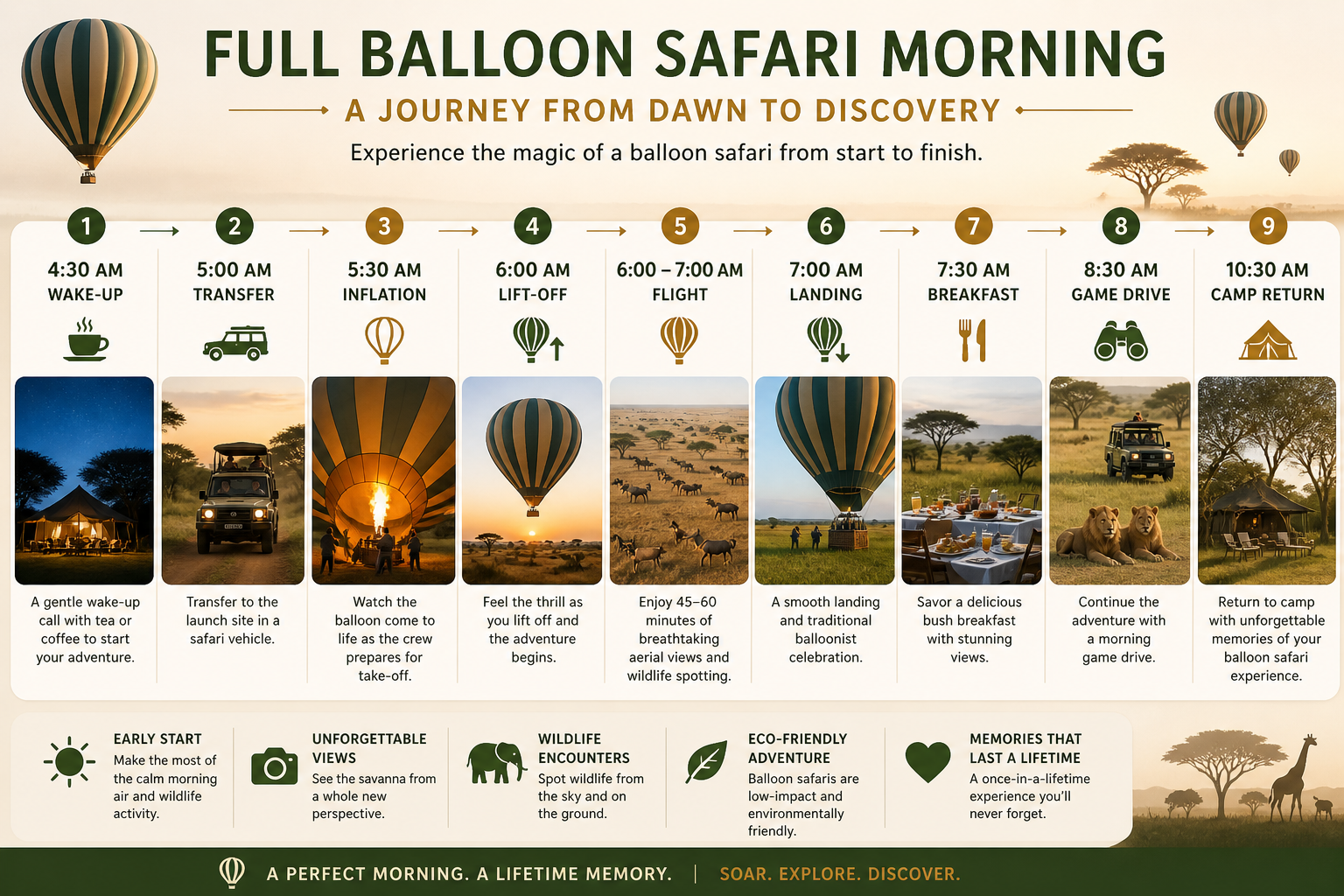
A hot air balloon safari in the Maasai Mara consists of a 1 to 1.5-hour dawn flight over the Mara ecosystem, followed by a champagne bush breakfast served in the field on landing, with the full experience typically lasting 4 to 5 hours from pre-dawn departure to return to camp. It is one of the most distinctive safari activities available in Kenya — and arguably the only way to see the Mara at a scale that a game drive vehicle simply cannot offer.
Here is what the full experience looks like, from the moment your alarm goes off:
The pre-dawn transfer. You are collected from your camp at approximately 4:30 AM, while the Mara is still completely dark. The drive to the launch site takes between 15 and 45 minutes depending on your camp's location. This is an important logistical note that we will return to in the booking section: not every camp is equally well-positioned for the balloon launch.
Inflation and lift-off. At the launch site, the crew inflates the balloon using high-powered gas burners. The process takes 20 to 30 minutes and is worth watching — the scale of the envelope as it rises above you is impressive on its own. Passengers typically number between 12 and 16 per balloon, standing in a large rectangular basket divided into compartments. You board while the balloon is still tethered on its side, then the basket rights itself as inflation completes.
The flight itself. The balloon reaches varying altitudes during the 60 to 90 minutes aloft — from just above the treeline to several hundred feet — depending on wind conditions and what the pilot chooses to do. There is no engine. The only sounds are the occasional burst of the burner and the wind.
The champagne breakfast. After landing — more on what that actually feels like shortly — the crew sets up a full bush breakfast on folding tables in the field. This includes eggs, sausages, fruit, pastries, juice, and the signature champagne toast. You receive a flight certificate at breakfast.
The game drive back. Most operators include a game drive in an open vehicle on the return to camp. This is a genuine bonus — you are already in the Mara, the morning light is perfect, and the Big Five sightings on this drive are frequently excellent.
The two primary operators are Governors' Balloon Safaris — the longest-running operator, associated with Governors' Camp — and Balloon Safaris Ltd, which serves a broader range of camps and lodges across the ecosystem. Both are reputable and hold Civil Aviation Authority of Kenya certification.
Why a Maasai Mara Balloon Safari Is Unlike Any Other Safari Experience
A hot air balloon safari offers a perspective on the Mara ecosystem that is genuinely impossible to replicate from a game drive vehicle — and that distinction is the entire basis for its value. From the ground, your view is always framed by the horizon and interrupted by vegetation, vehicles, and the limits of your vehicle's clearance. From the balloon, the Mara opens up completely.
The scale becomes real. The Maasai Mara National Reserve covers approximately 1,510 square kilometres, and the wider Mara-Serengeti ecosystem is one of the largest unfenced wildlife areas on the planet — Source: Kenya Wildlife Service, 2024. From altitude, you see what that actually means: plains that stretch without interruption, the silver thread of the Mara River bending through acacia woodland, the patchwork of conservancy land beyond the reserve boundary. It is, for most travelers, the first time the ecosystem makes visual sense.
During migration season, it becomes extraordinary. When the wildebeest herds are present — typically July through October — the view from the balloon is described by nearly every returning traveler as the single image they carry home from Kenya. Columns of animals stretching to the horizon, gathering at river crossing points, moving as a slow dark tide across the grass. This is unreachable by vehicle and unframeable from the ground.
The silence matters. There is something specific about a hot air balloon flight that is difficult to communicate in advance: it is profoundly quiet. The burner fires periodically, but between burns, the only sound is wind. After days of game drives with engine noise and radio chatter, the silence at altitude over the Mara is genuinely affecting. Many passengers describe it as the most peaceful moment of their entire trip.
For these reasons, the balloon safari is not a routine add-on. It is — for most travelers — a once-in-a-safari-lifetime experience that changes how they understand what they have been driving through.
How Much Does a Maasai Mara Hot Air Balloon Safari Cost in 2026 — and What Are You Actually Paying For?
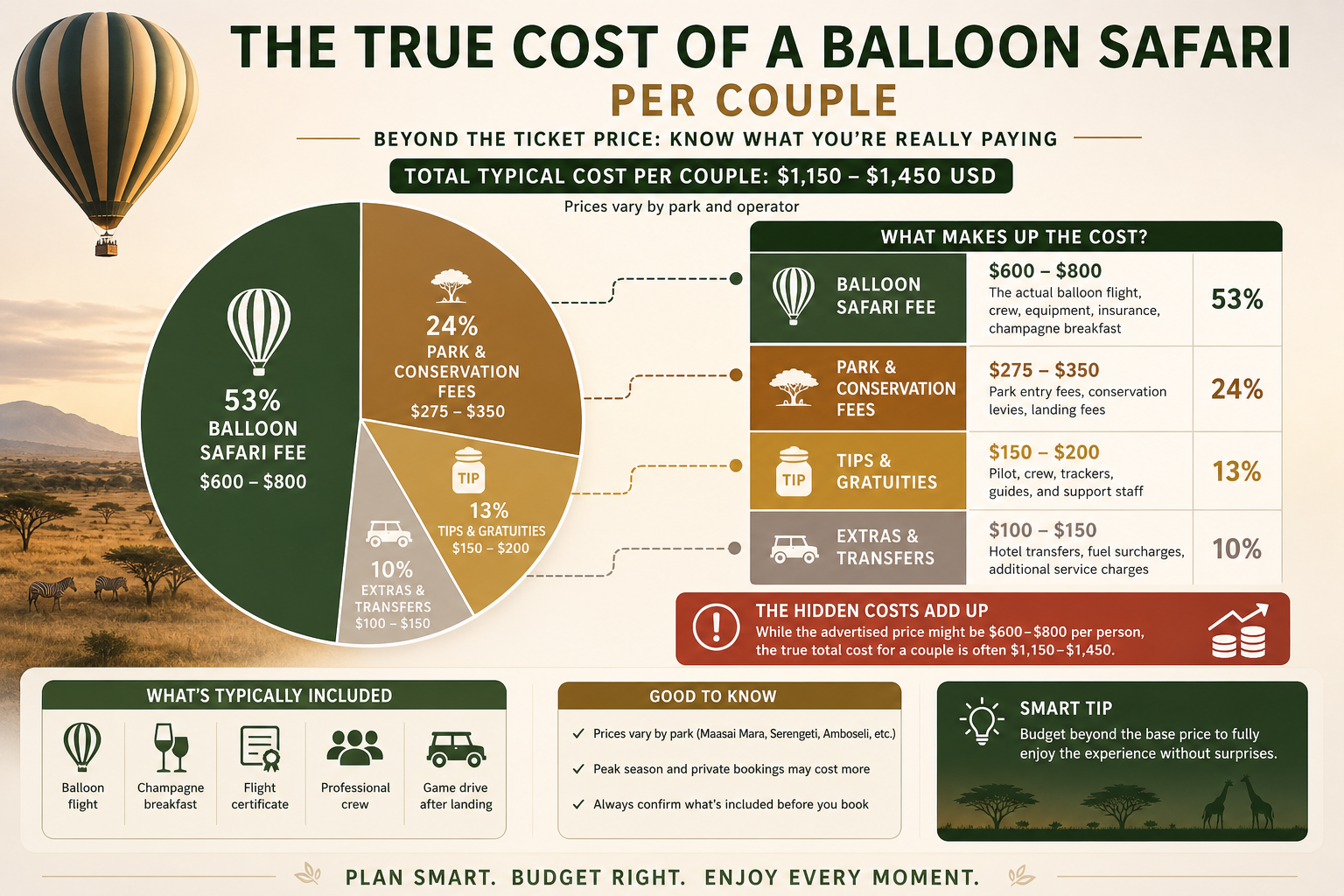
The cost of a hot air balloon safari in Kenya's Maasai Mara in 2026 ranges from $450 to $550 per adult depending on the operator and season, making it one of the highest-priced optional add-ons available within a Kenya safari itinerary. Understanding exactly what is and is not included in that price is essential before committing.
What Is Included in the Price
The standard rate covers:
- The balloon flight itself (1 to 1.5 hours)
- The champagne bush breakfast on landing
- A flight certificate
- Ground crew support and safety equipment
- The game drive vehicle return to camp (included by most — confirm with your operator)
What Is NOT Included
Several costs sit outside the headline price and should be factored into your total:
- Park fees for the return game drive, if it takes place inside the Maasai Mara National Reserve. These range from $70 to $100 per person per day — Source: Kenya Wildlife Service, 2024. If you are staying in a conservancy rather than the national reserve, this may not apply.
- Tips for the pilot and ground crew. This is customary. A guideline is $20–$30 per person for the pilot and $10–$15 per person for the crew.
- Your morning transfer, if your camp is not partnered with the balloon operator.
Total Real Cost Per Couple
| Item | Cost Per Person | Cost Per Couple |
|---|---|---|
| Balloon flight (mid-range) | $500 | $1,000 |
| Park fees (if applicable) | $80 | $160 |
| Tips (pilot + crew) | $35 | $70 |
| Total | $615 | $1,230 |
How Does This Compare to Other Safari Add-Ons?
For context, a private fly-in charter between Nairobi and the Mara runs $300–$500 per person one way. A private full-day game drive in a luxury vehicle costs $150–$250. The balloon sits at the top of the optional-experience price range — but unlike most add-ons, it is not replicable by any cheaper alternative. You cannot approximate the balloon experience; you either do it or you don't.
On the question of value relative to prior years: prices have increased approximately 15–20% since 2022, consistent with broader safari cost inflation driven by fuel costs, operator overhead, and post-pandemic demand. The 2026 rates are high but reflect genuine operational costs, not speculative markup.
When Is the Best Time of Year for a Balloon Safari in the Maasai Mara?
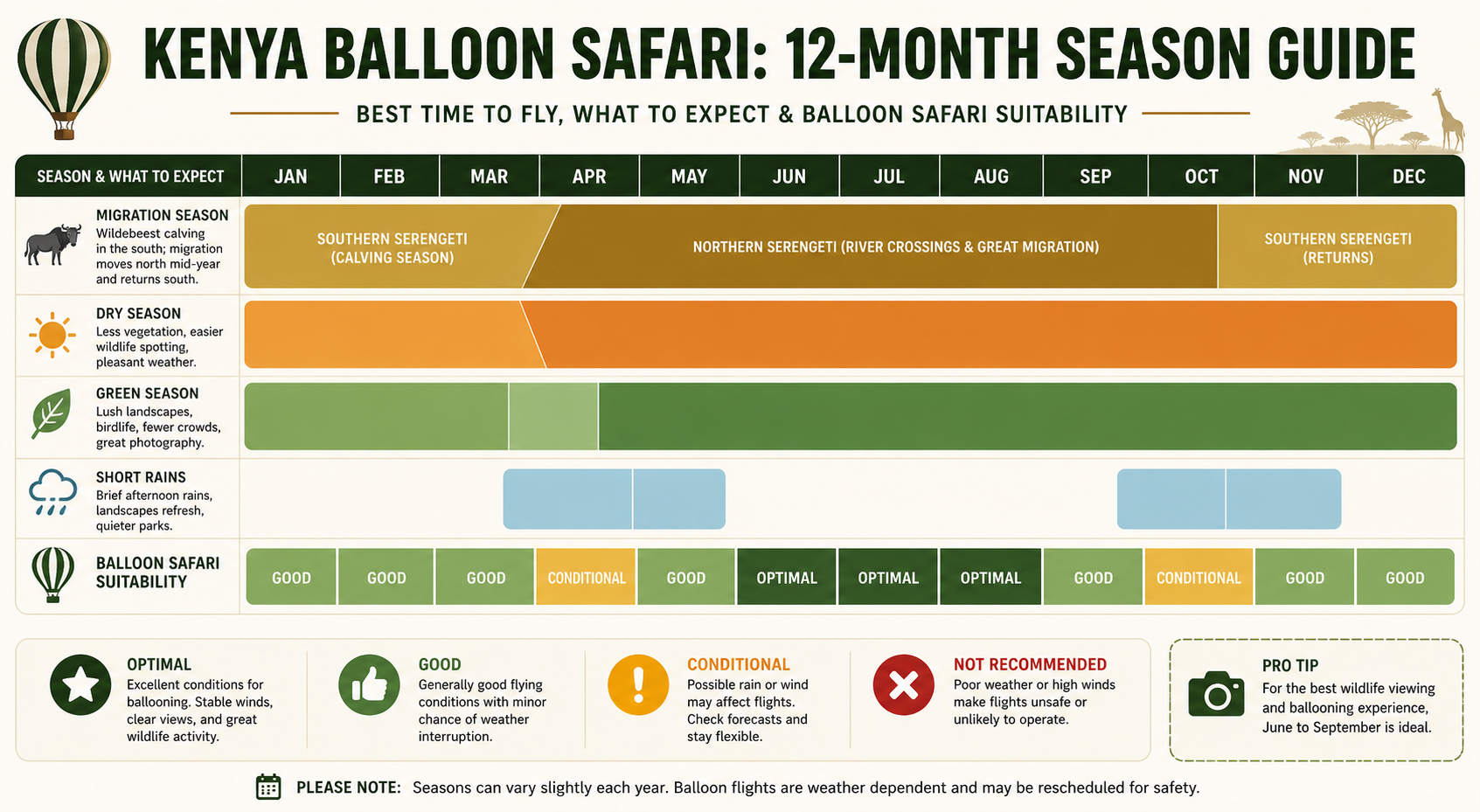
The best time for a balloon safari in the Maasai Mara is during Kenya's Great Migration season, from July to October, when wildebeest herds and Mara River crossing sites are visible from altitude. However, the Mara is an excellent balloon destination year-round, with meaningful differences by season that should inform your decision.
Migration Season: July to October (Optimal)
This is the period when the balloon safari delivers its most iconic imagery. Wildebeest numbers in the Mara during peak migration can exceed 1.5 million animals — Source: Mara Conservancy, 2023. From the air, you can track columns moving across the plains and locate river crossing congregations that may take hours to find by vehicle. July and August are peak demand months; book 3 to 6 months in advance.
Dry Season: January to March (Excellent)
The short dry season offers clear skies, excellent visibility, and concentrated predator activity around permanent water sources. Wildlife density is high and the landscape's golden-grass aesthetic is particularly photogenic from altitude. This is an underrated window for the balloon — fewer crowds than migration season, good weather reliability, and lower accommodation costs at many camps. Book 4 to 8 weeks in advance.
Green Season: April to June (Conditional)
The long rains bring lush, intensely green landscapes that are genuinely beautiful from a balloon. However, wildlife is dispersed across the ecosystem rather than concentrated, making sightings from altitude less predictable. More critically, green season carries the highest weather cancellation risk. Wind and visibility conditions are most variable in these months, and the probability of a cancelled flight is meaningfully higher than in dry season. If you choose the green season, ensure your operator has a clear refund or rebooking policy before you pay.
November to December (Moderate)
The short rains create variable conditions. Wildlife is good — the resident Mara population is always present — but weather reliability is intermediate between dry season and the long rains. A serviceable option if this is your only travel window.
What Does a Maasai Mara Balloon Safari Actually Feel Like? (An Honest Account)
The experience of a Maasai Mara balloon safari begins well before lift-off — and that pre-dawn start is something worth preparing for honestly.
4:30 AM: The Wake-Up
Your alarm goes off in complete darkness. The Mara is cold at this hour — overnight temperatures regularly drop to 12–15°C (54–59°F), and in July and August, it can feel colder in the open air. Your camp staff will have prepared hot tea or coffee, but the transition from a warm bed to a cold Land Cruiser is bracing. This is not a complaint — the early hour is part of what makes the dawn flight special — but if you are not a morning person, know that the wake-up is non-negotiable.
The Inflation: Better Than Expected
Most passengers arrive at the launch site still half-asleep, and the inflation process wakes them up. Watching a balloon the size of a house rise from the ground in firelight is genuinely spectacular. The crew works quickly and efficiently, and the spectacle of the envelope filling is one of the better visual moments of the entire experience — worth photographing.
Lift-Off: The Moment of Silence
The basket tilts upright, the tether releases, and the ground simply falls away. There is no acceleration, no noise, no sensation of speed. The Mara opens below you as the light changes from deep blue to orange to gold. For most passengers, this is the singular moment of the trip — the one they describe to everyone they know for years afterward.
Wildlife Sightings from the Air: An Honest Caveat
Here is the honest part that promotional content skips. The balloon does not hover over specific animals the way a game drive vehicle can position for a close-up encounter. You are moving with the wind, at altitudes that vary from 50 to 500+ feet, and wildlife sightings depend on what is below your flight path and at what altitude you happen to be flying when you pass over it. On some flights — particularly during migration — the sightings are extraordinary: herds of wildebeest, giraffe silhouettes at eye level, elephant families at the waterhole. On others, particularly in low-density seasons or at higher altitude for extended periods, the wildlife below may be limited to scattered impala and the occasional zebra.
Do not book the balloon expecting a game drive in the sky. Book it expecting something categorically different: a panoramic, atmospheric, silent perspective on one of the world's great wildebeest migrations — and accept that the specific animal encounters are genuinely variable.
The Landing: Bumpier Than Advertised
Balloon landings in the Mara are frequently what operators describe as "dynamic." The basket can tip significantly on touchdown — sometimes dragging briefly across the grass before the crew secures it. This is normal, not dangerous, but it can be startling. Passengers with lower back issues should be aware: the impact is abrupt, and you brace yourself by gripping the basket handles.
The Champagne Breakfast: Atmospheric and Simple
The bush breakfast is genuinely lovely — not because the food is exceptional (it is a solid buffet, not a fine dining experience), but because you are eating eggs and toast in the middle of the Mara with morning light across the grass and your balloon deflating in the background. The champagne toast is a mimosa-grade pour, not a vintage Champagne experience. It is atmospheric, communal, and a nice moment of shared celebration with the other passengers. Most flights include 12–16 people, so this is a group experience, not a private one.
Is a Hot Air Balloon Safari in the Maasai Mara Safe?
Hot air balloon safaris in the Maasai Mara operate under Civil Aviation Authority of Kenya oversight and maintain strong safety records, with both primary operators — Governors' Balloon Safaris and Balloon Safaris Ltd — holding consistent certification and conducting pre-flight safety briefings for all passengers.
Regulatory Oversight
Both main operators are licensed and regularly inspected by the Civil Aviation Authority of Kenya (KCAA). Pilots hold commercial balloon pilot licences and undergo recurrent training. Weather is assessed before every flight, and no flight proceeds if conditions are outside established safety parameters. According to available operator records, balloon flights in the Maasai Mara have operated with an excellent safety record over several decades of commercial operation.
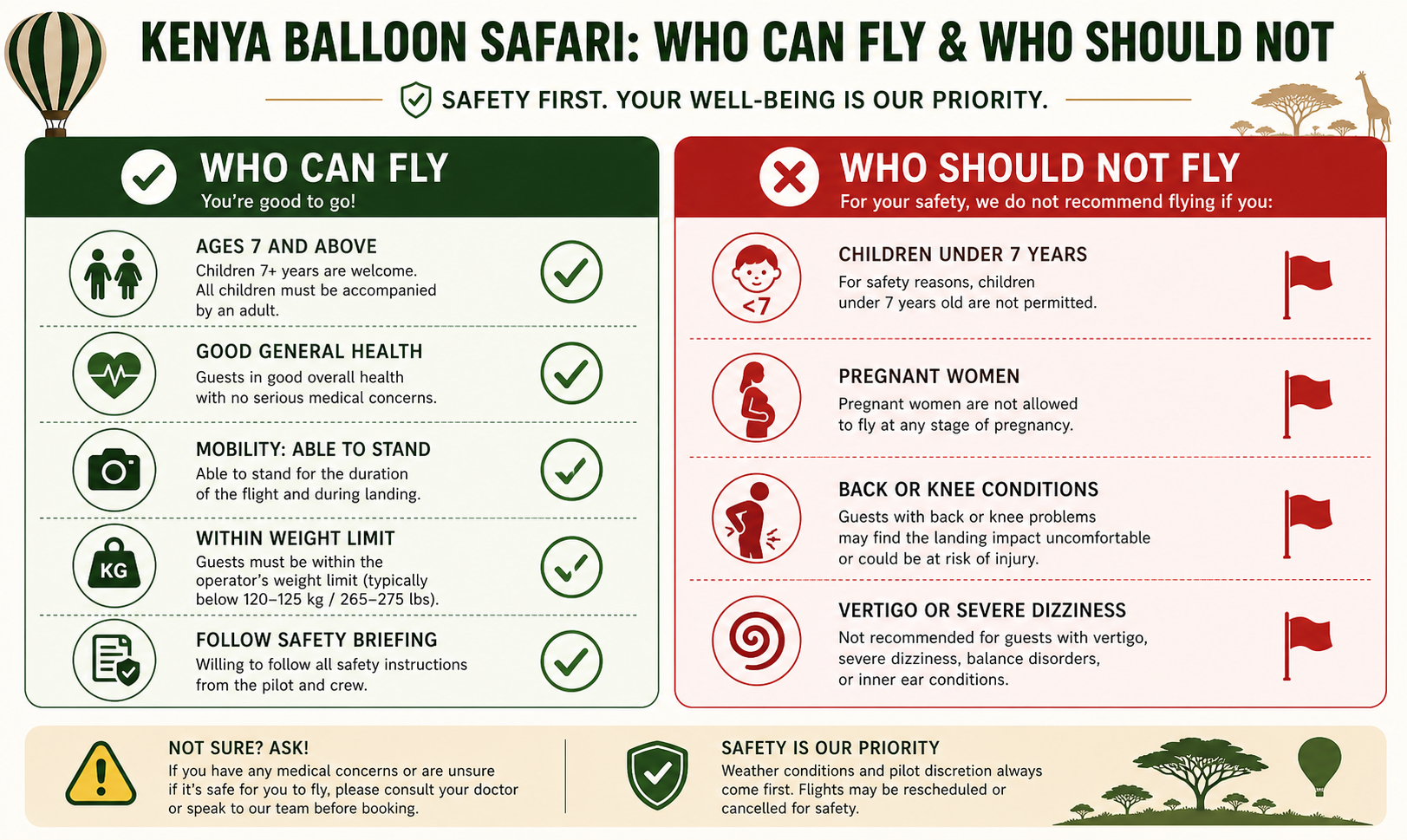
Who Should Not Fly
Be honest with yourself about the following restrictions before booking:
- Children under 7 years are not permitted on most Maasai Mara balloon safaris.
- Pregnant passengers are strongly advised against flying.
- Passengers with serious back, knee, or hip conditions should consult with their doctor and the operator before booking. Boarding requires stepping over a high basket rim, and landings involve abrupt impact.
- Passengers with severe vertigo or a strong fear of heights should reconsider — there are no seat belts and no enclosed structure at altitude.
- Weight and height restrictions may apply; confirm with your operator at the time of booking.
What Happens If the Flight Is Cancelled?
Maasai Mara balloon safaris are subject to cancellation based on wind speed, visibility, and weather conditions, with most operators offering a full refund or rebooking option when flights cannot safely proceed. Cancellations at short notice — sometimes as late as the morning of your flight — are not uncommon, particularly in the green season. Your operator should clearly communicate the refund and rebooking policy at the time of booking. Ensure this is in writing.
How Do You Book a Maasai Mara Balloon Safari and Which Operator Should You Choose?
Booking a Maasai Mara balloon safari is best done through your ground safari operator, who can confirm logistics, coordinate with the balloon company, and handle payment in the context of your wider itinerary. Attempting to book direct as an international traveler is possible but adds unnecessary complexity.
Governors' Balloon Safaris vs. Balloon Safaris Ltd
| Feature | Governors' Balloon Safaris | Balloon Safaris Ltd |
|---|---|---|
| Launch sites | Governors' Camp area, Musiara Marsh | Multiple sites across the reserve and conservancies |
| Capacity | 12–16 per balloon | 12–16 per balloon |
| Availability | Best suited to Governors' Camp guests | Accessible from more camps |
| Booking channel | Via Governors' directly or through your operator | Via your safari operator |
| Price range | $500–$550 | $450–$530 |
| Reputation | Longest-running; strong safety record | Widely used; consistently reviewed positively |
Both operators are reliable. The right choice is typically determined by which one is logistically connected to your accommodation — your camp or lodge will have a preferred or partner operator, and using that relationship ensures the morning transfer, timing, and return game drive are coordinated correctly.
How Far in Advance Should You Book?
- July and August: Book 3 to 6 months in advance. These months are fully booked for balloon slots well before the season opens.
- September to October: 6 to 8 weeks is typically sufficient, but earlier is always better.
- January to March and November: 2 to 4 weeks is usually adequate.
- April to June: Availability is less constrained, but confirm the weather policy before payment.
Payment and Cancellation
Most operators require full payment in advance, not a deposit. Cancellation policies vary — some operators offer full refunds up to 48 hours before flight; others have stricter terms. Ensure your travel insurance covers non-refundable activity bookings if cancellation for weather or personal reasons is a concern.
Can You Do a Balloon Safari with Children or Physical Limitations?
Children under the age of 7 are not permitted on most Maasai Mara balloon safaris, and the experience carries specific physical requirements that travelers with health conditions should review carefully before booking.
For children aged 7 to 12, participation is at the operator's discretion and subject to parental consent. The basket ride is not frightening for most children at this age, but the early wake-up, the physical boarding process, and the duration of the morning (4 to 5 hours total) should be considered.
For travelers with physical limitations, the key constraints are:
- Boarding: Passengers must step over a waist-height basket rim. This requires some flexibility and lower body strength.
- Landing: The basket can tip or drag on touchdown. Passengers with lower back, spine, or knee vulnerabilities should discuss this with the operator and their doctor.
- Standing duration: The entire flight is conducted standing in the basket compartment. There is no seating. The flight lasts 60 to 90 minutes.
If you have any doubt, contact the operator directly before booking. They have seen every situation and will give you an honest assessment.
What Should You Bring on a Maasai Mara Balloon Safari?
Packing for the balloon safari requires balancing weight restrictions with practical needs. Most operators impose a small personal bag limit of 1–2 kg in the basket, which rules out your full camera backpack.
Bring:
- A light fleece or warm layer (4:30 AM in the Mara is cold, especially July–August)
- A windproof outer layer — wind chill at altitude is real
- Your camera or smartphone — charged the night before
- A small lens cloth (condensation from temperature changes can affect glass)
- Sunscreen and a hat for the breakfast period (you will be in open sun post-landing)
- Your ID or passport copy if your operator requires it
Leave behind:
- Your heavy camera bag and multiple lens kit (weight restrictions apply)
- Valuable jewellery (the landing can be rough)
- Large water bottles (the crew provides drinks at breakfast)
For a full packing list, see our guide on what to pack for a Kenya safari.
How Does a Balloon Safari Compare to a Standard Game Drive for Wildlife Viewing?
A balloon safari and a game drive serve fundamentally different purposes — they are not substitutes for each other but complementary experiences that each reveal a different dimension of the Maasai Mara ecosystem.
A game drive allows close, extended encounters with wildlife. Your driver can reposition, follow an animal, wait for a predator to make a move, and get within metres of a lion. The vehicle is quiet, low to the ground, and nimble in terms of where it can go within the reserve. For actual wildlife interaction — the kind that fills a photographer's memory card with frame-worthy shots — the game drive is superior.
A balloon safari offers scale, silence, and perspective. You see the ecosystem as a whole, understand the geography, and experience the Mara in a way that removes the human infrastructure of roads, camps, and vehicles from the frame. For migration season aerial views, for the silence, and for the emotional impact of dawn light over endless plains, the balloon is unmatched.
The honest answer: if you can only choose one, choose the game drive. Game drives are the core of a Maasai Mara safari and should not be sacrificed for the balloon. If budget allows both, the balloon complements the game drives beautifully — preferably on day two or three of your Mara stay, after you have already had ground-level encounters.
What Happens If the Balloon Safari Is Cancelled Due to Weather?
Weather cancellations are a genuine possibility on any balloon safari, and understanding the cancellation process in advance will save you significant stress on the morning it happens.
The decision to cancel is made by the pilot, typically within 60 to 90 minutes of your scheduled wake-up call. You will receive notification via your camp. Common cancellation triggers include:
- Wind speed above safe operating limits (typically 15 knots sustained)
- Low cloud or mist reducing visibility below safe parameters
- Rainfall at the launch site or along the projected flight path
Most operators will offer one of the following on cancellation:
- Rebooking on the next available morning — the most common resolution if you have additional nights in the Mara
- A full refund — standard if you cannot rebook due to camp checkout
- A partial refund or credit toward a future booking — less common but offered by some operators
The critical advice: confirm the cancellation policy in writing before you pay, and ensure your travel insurance covers activity cancellations. If you have only one night in the Mara, weather risk is a meaningful factor — particularly in shoulder season. Kenya safari honeymoon guide
Is the Maasai Mara Balloon Safari Worth the Money — or Should You Skip It?
The Maasai Mara balloon safari is worth the money for the right traveler on the right trip — and not worth it for others. Here is the honest breakdown.
Absolutely Do It If:
- You are traveling during migration season (July–October). The aerial view of wildebeest herds is unreplicable by any other means and represents the apex of what the balloon can deliver. If you are already spending $500+ per person per night on your camp, the balloon is a proportionate addition.
- This is a honeymoon, anniversary, or milestone trip. The champagne breakfast in the bush, the certificate, the shared sunrise over the Mara — this is the kind of experience that becomes a story you tell for decades.
- You are a photographer who wants aerial Mara shots. The balloon offers light and angles that are categorically unavailable from the ground. For the first 20 minutes after lift-off, the quality of the light — low, golden, raking across the grass — is extraordinary for photography.
- This is a once-in-a-decade trip. If you are unlikely to return to the Maasai Mara in the foreseeable future, the balloon is a non-negotiable addition to the experience.
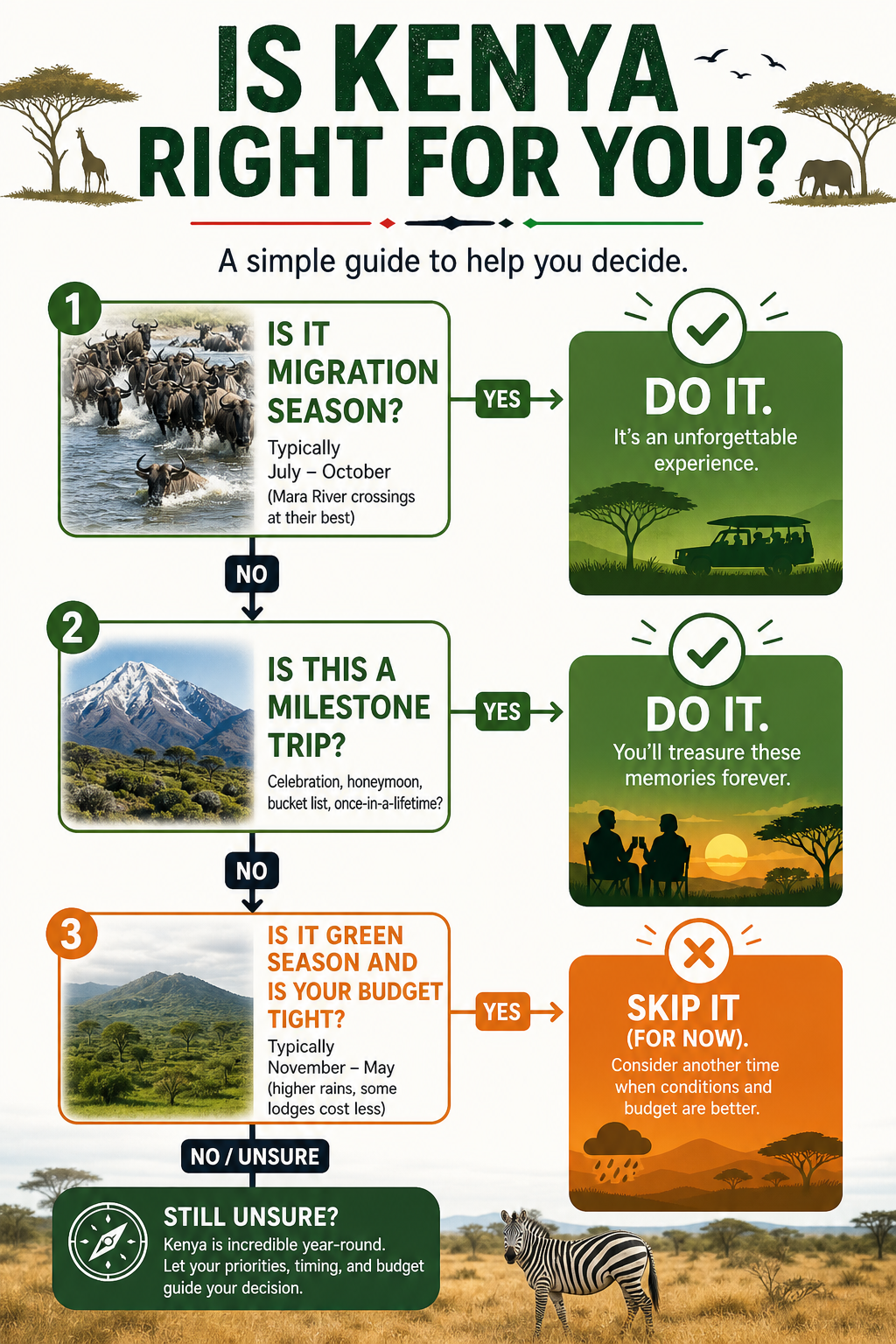
Consider Skipping If:
- You are visiting in the green season (April–June) on a tight budget. Wildlife density from the air is significantly lower, weather cancellation risk is higher, and the cost-per-memorable-image ratio shifts unfavorably.
- You have significant physical limitations that make the boarding or landing process uncomfortable or unsafe.
- You are traveling with children under 7. The balloon is simply not available to them, and the 4:30 AM departure is hard on young families.
- You would need to sacrifice a game drive day to afford it. The balloon should supplement your safari, not replace core game drive time.
The overall verdict from years of accompanying clients through this experience: for migration season travelers, the balloon safari earns its cost without question. Outside migration season, the decision is more nuanced — and the honest answer is that the experience is still beautiful, but you should go in with calibrated expectations rather than peak-season assumptions.
What to Do Next: How to Add a Balloon Safari to Your Kenya Itinerary
Adding a balloon safari to your Kenya itinerary requires a few logistical steps that are easy to overlook if you wait until you arrive.
Step 1: Tell your safari operator before your itinerary is finalized. The balloon launch is from specific sites within or near the Maasai Mara — and your camp placement affects the transfer time to that site. If you are staying at a camp more than 45 minutes from the launch site, the 4:30 AM wake-up becomes a 3:30 AM wake-up, which changes the experience significantly. Your operator can recommend camps with proximity to the launch.
Step 2: Book through your operator, not directly. As noted above, your ground operator handles coordination between the balloon company, your camp, and the return game drive vehicle. This eliminates the fragmented logistics of managing it yourself.
Step 3: Schedule the balloon for day 2 or 3 of your Mara stay. Your first Mara morning is best spent on an early game drive — you want ground-level encounters before you see the ecosystem from above. The balloon makes more sense once you have spatial context from the vehicle.
Step 4: Pack accordingly the night before. Charge all devices. Layer your clothing in advance. Keep your camera accessible, not buried in your bag.
Step 5: Confirm the weather policy in writing. This takes 30 seconds and saves considerable stress if conditions force a cancellation.
For help incorporating the balloon into a multi-park Kenya itinerary, see our 9-day Kenya safari itinerary] covering Amboseli, the Maasai Mara, Lake Nakuru, and Ol Pejeta.
Conclusion: The Morning That Changes How You See Africa
A hot air balloon safari in the Maasai Mara is not for every traveler on every trip — and the honest version of this review acknowledges that. The cost is high, the wake-up is brutal, the wildlife sightings are variable, and the champagne is a pour, not a vintage. These things are all true.
What is also true is this: the moment the balloon clears the treeline and the Mara opens below you in the first light of a July morning, with a column of wildebeest moving across the grass in the distance and absolute silence above you — that moment is categorically unlike anything else in safari travel. It does not replace the game drive. It does not guarantee a lion sighting. But it gives you something no vehicle can: a sense of the full scale and silence of one of the last great wildebeest migrations on Earth.
For the right traveler at the right time of year, $500 is not a lot of money for that.
If you are ready to add the balloon to your Kenya safari, speak to our team at Beyond the Plains Safaris for a custom itinerary and Kenya safari package quote. We have coordinated hundreds of balloon bookings across both operators and can advise on camp placement, seasonal timing, and logistics to make the experience as seamless as possible.
Written by Maurine Nyabuto Senior Safari Specialist, Beyond the Plains Safaris. Maurine has over a decade of experience designing bespoke Kenya and Tanzania safari itineraries and has personally accompanied clients on balloon safaris across multiple seasons of the Great Migration.
Reviewed by the Beyond the Plains Safaris Editorial Team
Disclaimer: This article was initially drafted using AI assistance. However, the content has undergone thorough revisions, editing, and fact-checking by human editors and subject matter experts to ensure accuracy. All pricing figures reflect available 2026 operator rates and are subject to change; confirm current pricing with your safari operator or directly with Governors' Balloon Safaris or Balloon Safaris Ltd at the time of booking.










Comments (0)
Leave a Comment
No comments yet. Be the first to comment!