

How Much Does a Kenya Safari Cost Per Day? The Complete Budget, Mid-Range & Luxury Breakdown
You've seen the headlines — "Kenya safari from $99 a day!" — and you've also seen the luxury camp brochures quoting $1,800 per night. Both are technically true, and that's exactly the problem. In this guide, you'll get a no-nonsense, tier-by-tier breakdown of exactly what a Kenya safari costs per day — what's included at each price point, which hidden costs most travellers miss, and how to match your budget to the safari experience you actually want.
Key Takeaways
- A Kenya safari costs between $100 and $2,000+ per person per day, depending on accommodation tier, travel season, and whether park fees and meals are included.
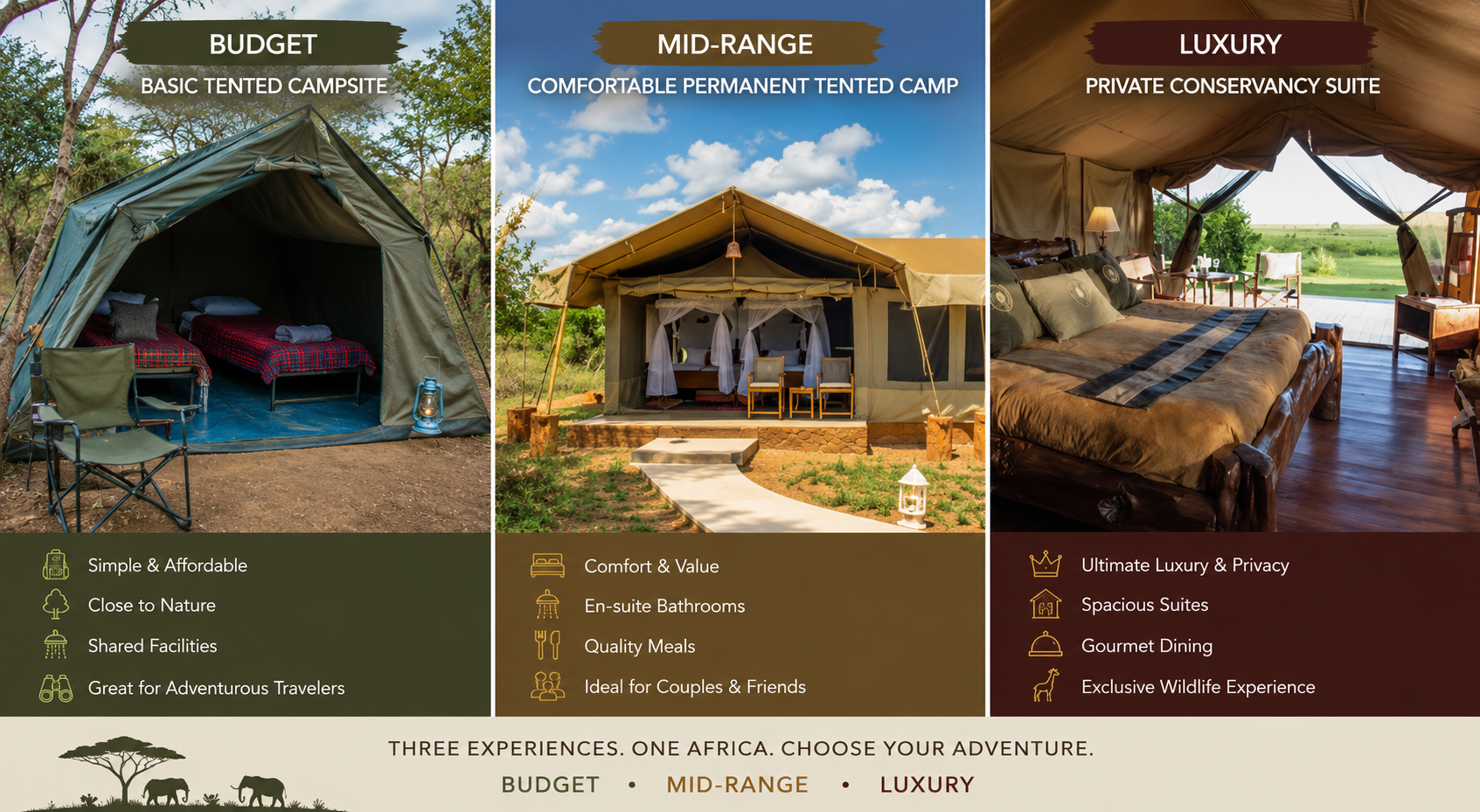
- Budget safaris ($100–$250/day) typically involve public campsites or basic lodges, shared game drives, and self-catering or simple meal plans — ideal for backpackers and cost-conscious travellers.
- Mid-range safaris ($250–$600/day) offer permanent tented camps or comfortable lodges, professional guides, twice-daily game drives, and full board — the most popular tier for first-time visitors.
- Luxury safaris ($600–$2,000+/day) deliver private conservancy access, exclusive camps, personalised guiding, and premium inclusions such as bush meals, spa services, and helicopter transfers.
- Hidden costs — including international flights, domestic transfers, visa fees, gratuities, and travel insurance — can add $500–$1,500+ to the total trip budget and are frequently overlooked in online price estimates.
- The Masai Mara commands the highest daily rates in Kenya; budget-conscious travellers can access outstanding wildlife in Amboseli, Tsavo, or Lake Nakuru at significantly lower cost.
- Travelling during Kenya's green season (April–June) can reduce daily accommodation costs by 20–40% while still offering rewarding game viewing and fewer crowds.
What Is a Kenya Safari Daily Rate — and What Does It Actually Include?
A Kenya safari daily rate is the per-person, per-night cost that covers your safari experience — but what it includes varies significantly depending on how the package is structured. This single point causes more budget surprises than any other aspect of safari planning.
Most quoted daily rates include: accommodation for the night, all meals (full board), morning and afternoon game drives, a professional safari guide, and park or conservancy fees. At mid-range and luxury tiers, laundry, Wi-Fi, and house drinks are often bundled in. What is almost never included in the daily rate: your international flights, domestic flights or road transfers to the safari region, your Kenya e-visa, travel insurance, and tips for guides and camp staff.
The all-inclusive vs. à la carte distinction matters enormously. A $150/day rate that excludes park fees, meals, and transfers is not cheaper than a $280/day package that includes all three. Always ask operators to confirm exactly what the daily rate covers before comparing quotes side by side. Before you even get to pricing, make sure you understand what to expect on your first African safari — knowing the basics sets the right foundation for every budget decision that follows.
A Kenya safari costs between $100 and $2,000 or more per person per day, with budget options starting at shared camping tours and luxury options including private conservancy camps with exclusive guiding.
Why Do Kenya Safari Costs Vary So Dramatically?
Kenya safari costs vary dramatically because five distinct factors can each double or halve your daily spend — and they interact with each other in ways that aren't always obvious from a brochure.
First, the safari region. The Masai Mara, Kenya's most celebrated park, commands a premium due to its unmatched wildlife density and the annual Great Migration. Amboseli sits comfortably in the mid-range. Tsavo and Lake Nakuru offer considerably more affordable entry points. The same standard of accommodation consistently costs more inside or adjacent to the Mara than in Tsavo — often by a factor of two or three. Explore our full Masai Mara safari guide to understand exactly what drives the Mara's premium pricing.
Second, travel season. Peak season commands premiums of 30–50% above low-season rates at most properties. The Great Wildebeest Migration, which sees over 1.5 million animals move between Tanzania and Kenya's Masai Mara, is the primary demand driver during the July–October window — Source: Kenya Wildlife Service.
Third, accommodation type. Public campsite pitches in national parks can cost as little as $30 per person per night. A mid-range permanent tented camp runs $180–$400 per person all-inclusive. A luxury private conservancy camp starts at $600 and can comfortably exceed $2,000 per person per night at the top end.
Fourth, group size. Shared group tours of 6–12 people spread vehicle and guide costs across more guests, lowering your per-person daily rate. A private vehicle and guide — standard at the luxury tier — adds $150–$400 per day to the cost but transforms the quality and flexibility of your game viewing entirely.
Fifth, operator margins. Booking directly with a Kenya-based operator typically saves 10–20% compared to booking through an international wholesaler. A reputable Kenya-based operator also provides on-the-ground support, vetted accommodation, and crisis response that international booking platforms simply cannot match.
How Much Does a Budget Kenya Safari Cost Per Day?
A budget Kenya safari costs between $100 and $250 per person per day, and at this price point you are trading exclusivity and comfort for access to Kenya's extraordinary wildlife. The trade-off is real — but for cost-conscious travellers, it remains absolutely worthwhile.
What the Budget Tier ($100–$250/Day) Delivers
At the lower end of the budget tier ($100–$150/day), expect public or semi-private campsites inside national parks, self-catering or basic meal options, shared game drives in vehicles carrying 6–8 passengers, and a qualified guide. Parks consistently accessible at this budget include Tsavo East, Tsavo West, Amboseli, and Lake Nakuru — all of which offer exceptional wildlife viewing year-round. Read our detailed Tsavo National Park safari review to see exactly what this budget unlocks in Kenya's largest protected wilderness.
At the upper budget range ($180–$250/day), you unlock basic lodges and simple tented camps with private bathrooms, more consistent twice-daily game drives, and meals included. Group sizes remain larger (6–10 people), and the Masai Mara remains out of reach for most without compromising significantly on other elements. For practical strategies to maximise your experience without overspending, our guide on budget safari in Kenya tips covers everything you need to know.
Budget Safari Sample Daily Cost Breakdown
| Cost Item | Estimated Daily Cost (Per Person) |
|---|---|
| Accommodation (public campsite or basic lodge) | $30–$80 |
| Park entrance fees (if not included) | $30–$70 |
| Shared game drives | $30–$60 |
| Meals (self-catering or basic meal plan) | $15–$40 |
| Total Daily Estimate | $105–$250 |
For a 7-day budget safari in Tsavo and Amboseli, expect a total land cost of $700–$1,750 per person, before international flights and visa fees.
What Do You Get on a Mid-Range Kenya Safari for $250–$600 Per Day?
A mid-range Kenya safari costs between $250 and $600 per person per day all-inclusive, and this tier represents the sweet spot for most first-time safari travellers — delivering a genuinely immersive, comfortable experience without the ultra-premium price of private conservancies.
Accommodation and Inclusions at the Mid-Range Tier
Mid-range safari accommodation typically means permanent tented camps or comfortable lodges with en-suite bathrooms, hot water, and electricity. Meals are full board — breakfast, lunch, and dinner included. Twice-daily game drives in a private or small-group vehicle (4–6 passengers) with an experienced, licensed guide are standard. Many mid-range properties now include house drinks and laundry in the daily rate.
Representative mid-range properties include Keekorok Lodge in the Masai Mara (from approximately $350pp/night), Ol Tukai Lodge in Amboseli (from approximately $280pp/night), and Voi Safari Lodge in Tsavo East (from approximately $200pp/night). Each offers reliable quality, professional guiding, and genuinely memorable game viewing. For a deeper look at one of Kenya's most iconic mid-range destinations, our Amboseli National Park safari guide covers the full experience — including what makes it exceptional value against the Mara.
Mid-Range Safari Sample Daily Cost Breakdown
| Cost Item | Estimated Daily Cost (Per Person) |
|---|---|
| Accommodation (permanent tented camp or lodge) | $150–$350 |
| Park/conservancy fees (often included) | $0–$70 |
| Twice-daily game drives (included) | $0 |
| Full board meals (included) | $0 |
| House drinks | $0–$20 |
| Total Daily Estimate (all-in) | $250–$600 |
For a 7-day mid-range safari covering the Masai Mara and Amboseli, expect a total land cost of $1,750–$4,200 per person. Our 5-day Masai Mara itinerary shows exactly how to structure this tier for maximum value and wildlife density.
Is a Luxury Kenya Safari Worth $600–$2,000+ Per Day?
A luxury Kenya safari costs between $600 and $2,000+ per person per night, and at this tier the price reflects not just comfort but an entirely different category of experience — one defined by exclusivity, personalisation, and access to Kenya's most pristine wildlife habitats.
What Genuinely Justifies the Luxury Premium
Private conservancies are the defining feature of luxury safari in Kenya. Properties situated on private land adjacent to — but not inside — the crowded Masai Mara National Reserve give guests the same wildlife and often superior big-cat sightings, with a fraction of the vehicle traffic. Off-road driving, night game drives, and bush walks are permitted in conservancies and prohibited inside the national park itself. Our guide on private conservancy vs national park safari breaks down exactly when the conservancy premium is worth paying — and when it isn't.
Private guides and dedicated vehicles mean your game drive schedule is entirely your own. You stay at a sighting as long as you choose. The guide-to-guest ratio is often 1:2 or 1:4, compared to 1:8 at the budget tier.
Ultra-luxury inclusions at the highest price points add: helicopter transfers between camps, private bush breakfasts and sundowners at scenic locations, in-tent spa treatments, complimentary premium bar, conservation fees that directly fund anti-poaching efforts, and personalised pre-trip planning with a dedicated camp manager.
Luxury Safari Sample Daily Cost Breakdown
| Cost Item | Estimated Daily Cost (Per Person) |
|---|---|
| Accommodation (luxury tented camp, private conservancy) | $500–$1,800 |
| Conservancy fees (usually included) | $0 |
| Private guide and vehicle (usually included) | $0 |
| All meals, premium bar, and laundry (included) | $0 |
| Helicopter transfers (if applicable) | $200–$600 per flight |
| Total Daily Estimate (all-in, excl. helicopter) | $600–$2,000+ |
Masai Mara National Reserve commands the highest safari accommodation rates in Kenya, with mid-range camps starting at approximately $350 per person per night and luxury private conservancy camps exceeding $1,500 per person per night.
What Hidden Costs Should You Budget for on a Kenya Safari?
Hidden costs on a Kenya safari are the line items that don't appear in any operator's quoted daily rate but can collectively add $500 to $1,500 or more to your total trip spend. Knowing them in advance is the difference between a comfortable trip and an uncomfortable credit card bill.
The Kenya Safari Hidden Cost Checklist
International flights are the biggest hidden cost — and the most variable. Return flights from London to Nairobi average $700–$1,400 per person; from New York, $900–$1,600. Budget for this separately from your daily safari rate, and book as early as possible for the best fares.
Domestic flights or road transfers from Nairobi to your safari region are frequently not included in operator quotes. A return flight from Nairobi Wilson Airport to the Masai Mara costs approximately $250–$450 per person. Road transfers take 5–7 hours and cost $80–$150 per person one way.
Kenya e-visa is currently $50 USD per person for most nationalities, applied for online at least 72 hours before arrival. Check our Kenya visa requirements for tourists guide for the latest application process and country-specific requirements, as these can change.
Travel insurance is non-negotiable on a safari. Medical evacuation from a remote national park can cost $30,000–$100,000 without coverage. Budget $80–$200 per person for a comprehensive policy covering emergency evacuation. Our travel insurance for safari guide outlines exactly what your policy must cover before you depart.
Yellow fever vaccination is required if travelling from or through a yellow fever endemic country, and is widely recommended for East Africa travel regardless. Cost varies by country and clinic — confirm current requirements with your nearest travel health clinic before departure.
Tips and gratuities are a genuine cultural expectation in Kenya's safari industry. Budget $15–$20 per day for your guide and $5–$10 per day for camp staff, distributed via a communal staff tip box. On a 7-day safari, this adds approximately $140–$210 in guide tips alone.
Hidden costs on a Kenya safari — including the e-visa fee, yellow fever vaccination, tips for guides and camp staff ($15–$20 per day recommended), and travel insurance — frequently add $500 to $1,500 to a traveller's total trip budget.
Additional costs to factor in: personal drinks beyond the included package, curio shopping, laundry at budget properties, and optional activities such as hot air balloon safaris over the Mara ($450–$500 per person). Our Kenya safari packing list also helps you avoid arriving underprepared — which can mean expensive last-minute purchases in Nairobi.
Which Kenya Safari Destination Offers the Best Value for Your Budget?
Kenya's safari regions vary widely in cost, wildlife density, and crowd levels — and matching your budget to the right destination is one of the most impactful planning decisions you'll make.
| Destination | Best For | Accommodation Range (pp/night) | Crowd Level |
|---|---|---|---|
| Masai Mara | Big cats, Great Migration, overall wildlife density | $280–$2,000+ | High (peak season) |
| Amboseli | Elephants, Kilimanjaro views, photography | $180–$800 | Moderate |
| Tsavo East & West | Red elephants, landscapes, budget safaris | $80–$400 | Low–Moderate |
| Samburu | Rare northern species (Grevy's zebra, gerenuk) | $250–$1,200 | Low |
| Lake Nakuru | Flamingos, rhinos, birdlife | $80–$300 | Moderate |
| Laikipia Plateau | Private conservancies, walking safaris | $350–$1,500+ | Very Low |
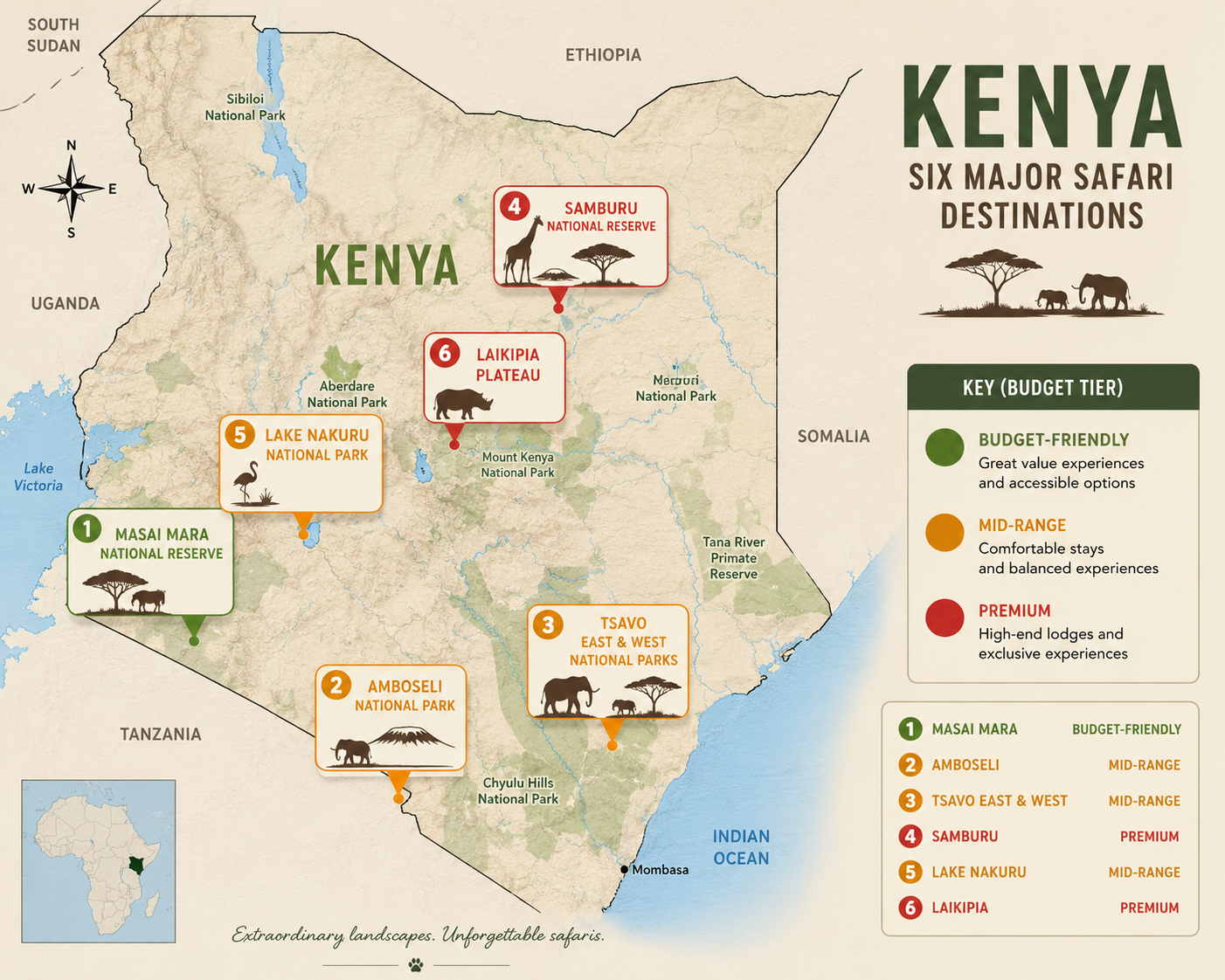
The Masai Mara delivers Kenya's most celebrated safari experience but carries the country's highest price tag. Budget travellers who cannot reach the Mara should consider Amboseli — which offers world-class elephant viewing with Mount Kilimanjaro as a backdrop — at 30–40% lower cost than the Mara.
Tsavo remains Kenya's most underrated budget-friendly destination. Covering nearly 22,000 km² — the largest protected area in Kenya — Tsavo East and West together offer exceptional wildlife at per-night accommodation rates starting as low as $80 per person. It is consistently one of the best-value destinations on the continent for independent and budget travellers.
How Does Travel Season Affect Kenya Safari Costs?
Kenya's travel season has a direct and significant impact on daily safari costs, with peak season rates running 30–50% higher than low-season equivalents at the same property — a difference that can represent hundreds of dollars per person per night.
Peak season (July–October and January–February) coincides with the Great Migration in the Mara and dry-season game viewing across the country. Wildlife concentrates around water sources, making sightings more predictable and frequent. Demand is highest during these windows, accommodation books out 6–12 months in advance, and prices reflect it consistently year after year.
Shoulder season (November and March–April) offers a balance of lower rates — typically 10–25% below peak — and good game viewing. Short rains in November are brief and rarely disruptive to game drives. March into April marks the beginning of the long rains, but some properties offer exceptional value for travellers comfortable with occasional afternoon showers.
Green season (May–June) is when Kenya's landscape is at its most lush and accommodation prices are at their annual low. Travelling during the green season can reduce daily accommodation costs by 20–40% at most properties. Wildlife doesn't disappear in the rains — predators are active year-round, newborn prey animals attract exceptional predator activity, and birdlife reaches its annual peak during this period.
Kenya's peak safari season, driven by the Great Migration, commands the highest accommodation prices of the year; travelling during the green season can reduce daily costs by 20–40% while still delivering rewarding wildlife encounters. For a full month-by-month breakdown, our guide on the best time to visit Kenya for safari covers what to expect from every season across every major park.
Sample Kenya Safari Itineraries with Real Per-Day Cost Estimates
The most useful way to understand Kenya safari pricing is through complete itinerary examples — with honest, all-in figures rather than teaser rates that exclude half the actual spend.
7-Day Budget Safari: Tsavo East + Amboseli
Daily rate: $120–$180/person | Total land cost: ~$840–$1,260/person
- Days 1–3: Tsavo East (public campsite, shared game drives, self-catering)
- Days 4–7: Amboseli (basic lodge, shared drives, Kilimanjaro views)
- Includes: accommodation, park fees, shared game drives, most meals
- Excludes: Nairobi–Tsavo road transfer (~$80pp), visa fee, tips (~$105), international flights
Total estimated trip cost (excluding international flights): $1,075–$1,495 per person
7-Day Mid-Range Safari: Masai Mara + Amboseli
Daily rate: $320–$480/person | Total land cost: ~$2,240–$3,360/person
- Days 1–4: Masai Mara (mid-range tented camp, twice-daily drives, full board)
- Days 5–7: Amboseli (comfortable lodge, professional guide, full board)
- Includes: accommodation, park fees, twice-daily drives, full board, house drinks
- Excludes: domestic flights (~$400pp return), visa fee, tips (~$175), international flights
Total estimated trip cost (excluding international flights): $2,865–$3,985 per person
7-Day Luxury Safari: Masai Mara Private Conservancy + Laikipia
Daily rate: $900–$1,500/person | Total land cost: ~$6,300–$10,500/person
- Days 1–4: Private Masai Mara conservancy (luxury tented camp, private guide, night drives, off-road)
- Days 5–7: Laikipia Plateau (exclusive camp, walking safaris, community visits)
- Includes: all accommodation, conservancy fees, private guide and vehicle, all meals and premium bar, laundry, bush activities
- Excludes: helicopter transfers (~$400pp), visa fee, tips (~$350), international flights
Total estimated trip cost (excluding international flights): $7,100–$11,300 per person
For a side-by-side look at how Kenya's costs compare to its neighbouring destination, our Kenya safari vs Tanzania safari cost guide helps you decide which country better fits your budget and travel priorities.
How to Choose the Right Kenya Safari Budget: Your Next Steps
Choosing your Kenya safari budget is not about finding the cheapest option — it's about identifying which trade-offs you're genuinely comfortable making and which elements of the experience are non-negotiable for you.
Start by defining your priorities. If wildlife exclusivity and off-road access matter most, the luxury conservancy tier is the one to stretch for. If you simply want to see elephants in front of Kilimanjaro and stay within a sensible budget, Amboseli at mid-range delivers that beautifully. If you're a solo traveller or couple who values flexibility over comfort, a budget group tour through Tsavo is a legitimate and deeply rewarding choice.
Then build your total budget — not just your daily rate. Use the hidden costs checklist above, add your international flights, and work backwards to determine what daily rate your total budget can actually support. The gap between a quoted daily rate and a true all-in trip cost is where most safari budgets break down.
Finally, contact a Kenya-based operator directly. A reputable specialist — not a global booking platform — can match your priorities and budget to the right properties, secure better rates, and provide on-the-ground support that no algorithm can replicate. The conversation costs nothing; the clarity it provides is invaluable.
Frequently Asked Questions About Kenya Safari Costs
1: How Much Does a Kenya Safari Cost Per Day on Average?
A Kenya safari costs between $100 and $2,000+ per person per day, depending on your accommodation tier, the safari region you choose, the time of year you travel, and what your daily rate actually includes. That wide range is not a dodge — it reflects three genuinely distinct safari experiences that share the same landscape but deliver very different levels of comfort, exclusivity, and access.
At the budget tier ($100–$250/day), you are typically sharing a game drive vehicle with 6–10 other travellers, staying at a public campsite or basic lodge, and self-catering or eating simple set meals. Parks like Tsavo East, Tsavo West, and Lake Nakuru are comfortably accessible at this price point. At the mid-range tier ($250–$600/day), you move into permanent tented camps or comfortable lodges with full board, twice-daily game drives in a smaller vehicle, and a professional licensed guide. At the luxury tier ($600–$2,000+/day), you access private conservancies with off-road driving, night game drives, a private guide and vehicle, and inclusions such as bush meals, premium bar, and laundry.
The single most important thing to understand before comparing quotes is what the daily rate actually covers. A $150/day rate excluding park fees, meals, and transfers is frequently more expensive in reality than a $280/day all-inclusive package. Always ask your operator for a full inclusions list before making a decision. For a complete tier-by-tier breakdown with sample cost tables, read our full guide on how much a Kenya safari costs per day.
2: What Is and Is Not Included in a Kenya Safari Daily Rate?
The daily rate for a Kenya safari typically includes accommodation, meals, twice-daily game drives, and a professional guide — but it almost never includes international flights, domestic transfers, visa fees, or gratuities. This distinction is the number-one source of budget surprises for first-time safari planners, and understanding it upfront can save you from a significant and avoidable financial shock.
What is almost always included in a quoted daily rate at mid-range and luxury tier: your tent or lodge room, full board (breakfast, lunch, and dinner), morning and afternoon game drives, a licensed professional guide, park or conservancy entry fees, and in many cases, house drinks and laundry. What is almost never included: your return flights from your home country to Nairobi, domestic flights or road transfers from Nairobi to the safari region, your Kenya e-visa (currently $50 USD for most nationalities), travel insurance, yellow fever vaccination costs, and tips for your guide ($15–$20 per day) and camp staff ($5–$10 per day).
At the budget tier, the exclusions list grows longer. Park entry fees, meals, and ground transfers are frequently quoted separately, meaning a $120/day headline rate can climb to $180–$210/day once all genuine daily costs are added. Optional activities — such as a hot air balloon safari over the Masai Mara, which typically costs $450–$500 per person — are excluded at every tier. To make sure you arrive fully prepared and avoid last-minute unexpected spend, review our Kenya safari packing list and our complete breakdown of Kenya visa requirements for tourists well before your departure date.
3: Which Kenya Safari Destination Offers the Best Value for Money?
The best-value Kenya safari destination depends entirely on your budget tier — the Masai Mara delivers the most iconic experience but commands the country's highest prices, while Amboseli, Tsavo, and Lake Nakuru offer outstanding wildlife at significantly lower daily rates. Knowing which park aligns with your budget before you start comparing accommodation quotes saves considerable time and prevents the frustration of falling in love with a property you cannot afford.
The Masai Mara is Kenya's flagship safari destination and justifiably commands a premium. Mid-range camps start at approximately $280–$350 per person per night all-inclusive; luxury private conservancy camps exceed $1,500 per person per night. The wildlife density, big-cat sightings, and access to the Great Migration corridor make it worth the premium for many travellers — but it is not the only option. Our Masai Mara safari guide covers exactly what the Mara delivers at each price point.
Amboseli National Park is Kenya's best mid-range value proposition. With accommodation from approximately $180 per person per night and one of the world's most photogenic backdrops — large elephant herds moving beneath the snow-capped peak of Mount Kilimanjaro — Amboseli consistently ranks as the top recommendation for first-time visitors on a mid-range budget. Read our full Amboseli National Park safari guide for a complete park-by-park breakdown. Tsavo East and West together form Kenya's largest protected ecosystem at nearly 22,000 km², with accommodation starting as low as $80 per person per night — making it the country's most accessible entry point for budget safari travellers. Our Tsavo National Park safari review goes deep on what this underrated destination delivers. Samburu appeals to travellers seeking rare northern Kenya species — Grevy's zebra, reticulated giraffe, Somali ostrich, and gerenuk — at mid-range to mid-luxury prices. Lake Nakuru pairs well with any circuit as a budget-friendly addition, particularly for birdwatchers and rhino enthusiasts.
4: What Are the Hidden Costs of a Kenya Safari That Most People Miss?
Hidden costs on a Kenya safari — including the Kenya e-visa, yellow fever vaccination, guide and camp staff gratuities, domestic transfers, and travel insurance — frequently add between $500 and $1,500 to a traveller's total trip budget beyond the quoted daily rate. These are not optional extras; they are genuine, unavoidable costs of the trip that operators have no obligation to include in their headline pricing.
International flights are the largest single hidden cost and must be budgeted entirely separately from your safari daily rate. Return flights from London to Nairobi typically range from $700 to $1,400 per person; from New York, $900 to $1,600 per person. Book as early as possible, particularly if travelling during peak season.
Domestic transfers from Nairobi to your safari destination are frequently omitted from operator quotes. A scheduled return flight from Nairobi Wilson Airport to a Masai Mara airstrip typically costs $250–$450 per person. Road transfers cover the same journey in 5–7 hours at $80–$150 per person one way. The Kenya e-visa currently costs $50 USD per person for most nationalities and must be applied for online before arrival — confirm current requirements and the application process via our Kenya visa requirements for tourists guide. Travel insurance covering emergency medical evacuation is genuinely non-negotiable on a safari — evacuation from a remote national park without insurance can cost $30,000 or more. Budget $80–$200 per person for comprehensive coverage. Our travel insurance for safari guide details exactly what your policy must include. Guide and camp staff gratuities are a genuine cultural expectation. Budget $15–$20 per day for your guide and $5–$10 per day for camp staff. On a 7-day safari, that is $140–$210 in guide gratuities alone — a meaningful line item that almost no online safari budget article includes.
5: When Is the Cheapest and Best Time to Go on a Kenya Safari?
The cheapest time to go on a Kenya safari is during the green season from April to June, when daily accommodation rates at most properties drop by 20–40% compared to peak season pricing — while still delivering excellent wildlife encounters, lush landscapes, and far fewer crowds. Understanding how Kenya's seasons interact with pricing is one of the highest-leverage decisions a budget-conscious safari planner can make.
Peak season (July–October and January–February) delivers the most celebrated conditions: the Great Wildebeest Migration river crossings in the Masai Mara during July–October, dry-season wildlife concentrations at waterholes, and the clearest photographic light. Accommodation books out 6–12 months in advance at premium properties, and prices are at their annual high — often 30–50% above green season rates at the same camp or lodge.
Shoulder season (November and March–April) strikes a balance. Rates drop 10–25% below peak, game viewing remains strong, and the short rains in November are typically brief enough not to disrupt morning game drives. For travellers with some flexibility, shoulder season frequently represents the best ratio of experience quality to cost. Green season (May–June) is when Kenya's bush is at its most vibrant and verdant. Predators remain highly active — with newborn prey animals providing exceptional hunting activity — and Kenya's extraordinary birdlife reaches its annual peak. The dramatic, cloud-filled skies create remarkable photography conditions. Properties that remain open during green season offer their lowest rates of the year, and the bush is notably quieter and more intimate than at peak. For a complete month-by-month breakdown of what each season delivers across every major Kenyan park — and how timing affects both your daily rate and your wildlife experience — read our full guide on the best time to visit Kenya for safari.
Conclusion
A Kenya safari costs between $100 and $2,000+ per person per day — and every point on that range delivers a genuinely different experience. The daily rate is just the starting point; what matters is understanding exactly what it covers, what it doesn't, and whether it aligns with what you actually want from your time in the bush.
Budget tier safaris make Kenya accessible to cost-conscious travellers willing to share vehicles and stay in simpler accommodation. Mid-range tier delivers the balanced, immersive experience that most first-time safari visitors remember for a lifetime. Luxury tier removes every logistical friction and places you inside Kenya's most exclusive, biodiverse private landscapes.
Kenya is not a destination to rush. Whatever your budget, plan deliberately, account for hidden costs honestly, and give yourself at least 5–7 days in the wild. The wildlife — and the silence — will do the rest. Speak with our team at Beyond The Plains Safaris for a no-obligation itinerary and honest cost breakdown tailored to your budget and travel style.
Written by John Dante, Director & Operations Manager, Beyond The Plains Safaris — John has over 15 years of on-the-ground experience planning and operating safaris across Kenya's major wildlife destinations, from the Masai Mara to Samburu and Laikipia.
Reviewed by The Editorial Team, Beyond The Plains Safaris — reviewed for factual accuracy, current pricing, and regional destination expertise.
Disclaimer: This article was initially drafted using AI assistance. However, the content has undergone thorough revisions, editing, and fact-checking by human editors and subject matter experts to ensure accuracy. Safari prices cited are indicative market-rate ranges and should be confirmed with your operator, as costs vary by season, property, and availability.










Comments (0)
Leave a Comment
No comments yet. Be the first to comment!