

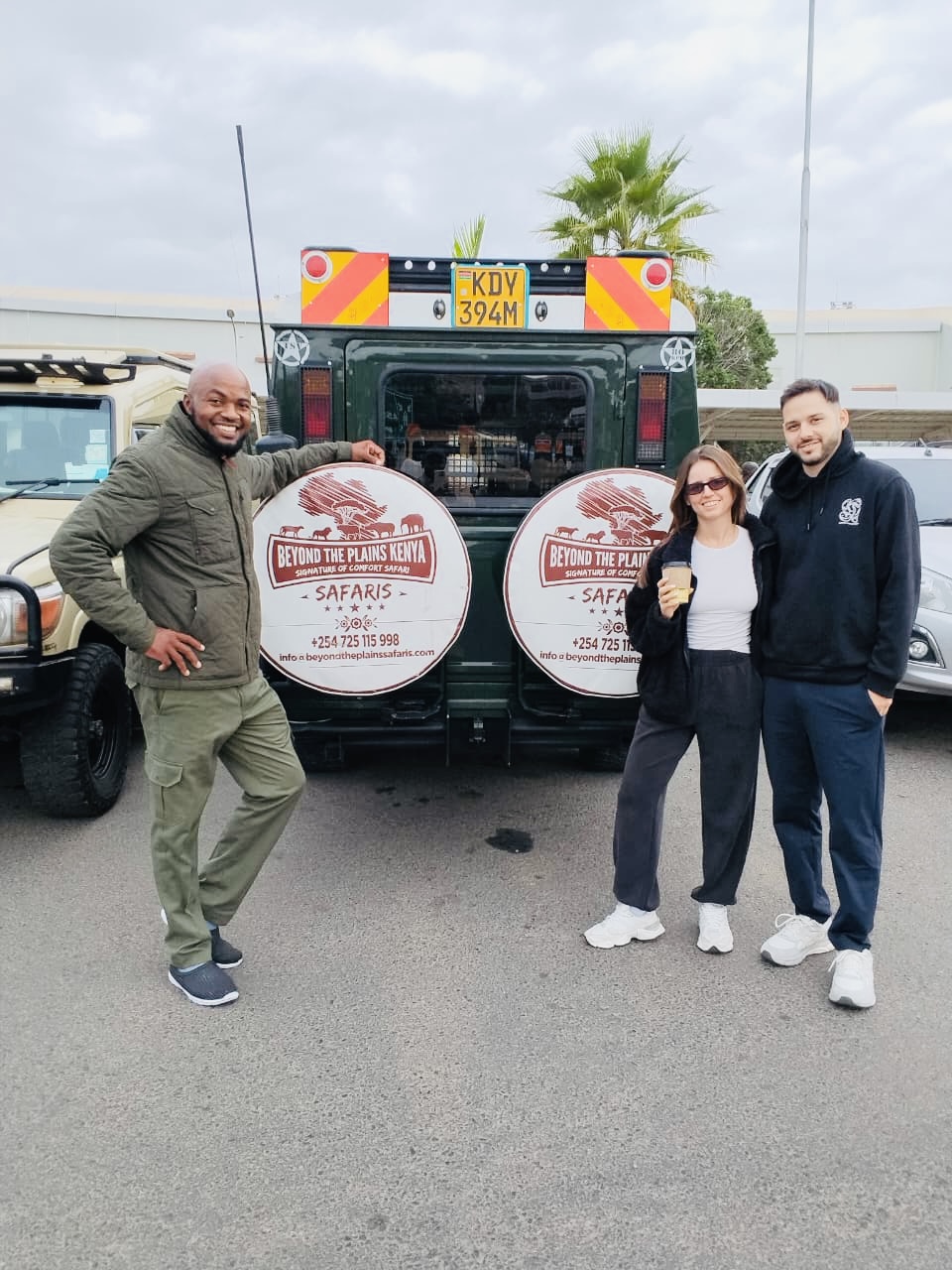
You've probably already read the standard packing lists and "Big Five" checklists that every safari blog recommends. But there's a layer of insight you won't find in generic guides — the small, hard-won lessons that only come from years spent tracking wildlife across the Maasai Mara and beyond. In this guide, we asked 25 professional Kenyan safari guides for the one piece of advice they wish every first-timer knew, and their answers reveal what actually makes or breaks a safari experience.
Key Takeaways
- Patience and quiet observation are the skills Kenyan safari guides most consistently name as essential for first-timers, ahead of any packing item or gadget.
- Over-packing camera gear while under-packing neutral-toned, practical clothing is the single most common first-timer mistake guides report.
- Kenya's dry seasons (June–October and January–February) offer the most reliable wildlife visibility, according to guides and tourism-board data alike.
- Trusting the guide's judgment on timing and positioning, rather than pushing for closer views, consistently produces safer and better sightings.
- Fair tipping — typically $10–20 per guide per day on a shared safari — is considered standard safari etiquette in Kenya, according to multiple tour-operator tipping guides.
- Realistic expectations about sightings correlate with higher first-timer satisfaction than chasing a guaranteed "Big Five" checklist.
- A few basic Swahili greetings and genuine cultural curiosity are frequently cited by guides as the fastest way to deepen a first safari experience.
What Is This Roundup of Kenyan Safari Guide Tips?
This roundup is a collection of first-hand advice gathered directly from professional safari guides working across Kenya's national parks, reserves, and private conservancies. A Kenyan safari guide is a licensed professional trained in wildlife tracking, animal behavior, and visitor safety across national parks and reserves, and their perspective differs fundamentally from a travel blogger's because it's built from thousands of hours spent inside a vehicle, on foot, or at a bush camp watching how first-timers actually behave — and where they consistently go wrong.
We compiled these tips through conversations with driver-guides, walking-safari leaders, and camp managers across the Maasai Mara ecosystem, Amboseli, Tsavo, Samburu, and Lake Nakuru, spanning a combined experience base of well over 200 years in the field. Each tip below is attributed by role, specialty, and years of guiding experience. For example, a senior driver-guide with 16 years in the Mara Triangle has a very different vantage point than a walking-safari specialist in Amboseli with 9 years' experience, and both perspectives matter for a first-timer trying to prepare.
That being said, this isn't a marketing brochure dressed up as advice. As such, several of the tips below are blunt, occasionally funny, and sometimes contradict the polished version of safari life you see in glossy brochures — which is exactly the point. For a broader orientation before you dive into the specifics, our complete Kenya safari packing list and Big Five safari guide are good companion reads.
Why First-Timer Advice From Real Guides Matters
First-timer advice from real guides matters because it corrects for the gap between what tourists expect and what actually happens on a game drive, a gap that generic travel-blog content rarely addresses. Most online safari advice is written by editors who have taken one or two trips, not by people who spend 200+ days a year in the bush reading animal behavior for a living.
First, guides see the same rookie mistakes repeat themselves trip after trip, which gives them a kind of pattern recognition that a single traveler's blog post simply can't replicate. For example, a guide who has led 400 game drives has watched hundreds of first-timers try to lean out of a vehicle for a photo, learned exactly which moment a lion is about to charge a warning bluff, and knows which packing mistakes cause the most mid-trip regret.
Moreover, guides carry legal and safety responsibility for every person in their vehicle, so their advice tends to be more precise and less theoretical than generic "top tips" listicles. Kenya welcomed an estimated 7.9 million tourists in 2025, including 2.7 million international visitors — Source: Ministry of Tourism and Wildlife, Kenya Tourism Sector Performance Report 2025 (via Citizen Digital, April 2026). That volume of visitors means guides are constantly recalibrating advice based on what actually goes wrong in the field, not what sounds good in a brochure.
At the same time, the most common mistakes first-timers make are strikingly consistent across different parks and different guides. Plus, these mistakes are almost always avoidable with the right preparation — which is exactly why a themed, guide-sourced roundup is more useful than a single guide's individual account. For deeper context on how first 15 minutes of a drive tend to unfold, see our piece on what guides actually do in the first 15 minutes of a game drive.
The 25 Guide Tips: What Kenyan Safari Guides Wish First-Timers Knew
What do professional safari guides wish first-timers knew? Overwhelmingly, guides wish first-timers understood that patience beats urgency on every single game drive. Below, the 25 tips are grouped into eight themes so you can scan for the advice most relevant to your trip: wildlife etiquette, packing, timing and season, camp behavior, photography, patience and expectations, safety, and tipping and culture.
Wildlife Etiquette: What Guides Wish You Knew Before Your First Game Drive
How should you behave around wildlife on safari? You should stay inside the vehicle, keep your voice low, and let the guide control distance and positioning at all times. This single rule underlies nearly every etiquette tip guides shared.
- Ronnie Gachengo, senior driver-guide, Maasai Mara Triangle, 16 years' experience: "Quiet hands win more sightings than loud excitement. The moment a vehicle goes silent, animals relax and keep doing what they were doing — feeding, playing, moving toward water. The moment people start pointing and talking over each other, that leopard disappears into the grass."
- Vincent Sankale, driver-guide, Mara North Conservancy, 11 years' experience: "Never ask me to get closer than I've already positioned us. If I've stopped here, it's because this distance keeps both you and the animal safe — and, frankly, it usually gives a better photo angle anyway."
- Loiputa Kasoo, guide, Amboseli National Park, 8 years' experience: "Standing up through the roof hatch when we're near elephants is the fastest way to end a sighting early. Elephants read silhouette and movement long before they react to sound."
- Peter kamau Mugo, guide, Lake Nakuru National Park, 13 years' experience: "First-timers assume every animal wants to be photographed. Respecting an animal's space — including walking away from a sighting when it shows stress signals — is part of responsible wildlife tourism practices, and it's what keeps these parks healthy for the next visitor too."
Guides consistently connect this etiquette back to conservation outcomes, not just good manners. Beyond the plains safaris, this ties into a broader picture of how tourism dollars support wildlife corridors and community conservancies; our guide to responsible wildlife tourism practices covers this in more depth.
Packing: What Should You Pack for a First Safari in Kenya?
What should you pack for a first safari in Kenya? You should prioritize neutral-colored, breathable clothing and layers over bulky camera gear, according to the guides we spoke with. This is the most frequently repeated tip in the entire roundup.
- Duncan Irungu, driver-guide, Maasai Mara, 14 years' experience: "People arrive with three camera bodies and one pair of shoes. Bring layers instead — early morning game drives in an open vehicle are genuinely cold, even in the middle of the dry season."
- Lmeei Lekashira, guide, Samburu National Reserve, 10 years' experience: "Leave the bright colors and heavy perfume at home. Dust-colored clothing in khaki, olive, or tan blends into the bush, while white, black, and bright blue can spook animals or attract tsetse flies in certain areas."
- Maftah Isaa, camp manager and former guide, Tsavo West, 19 years' experience: "Bring a dust-proof bag for electronics. Tsavo's red soil finds its way into every zipper, every lens cap, every phone case within a day."
- Patrick, guide, Ol Pejeta Conservancy, 7 years' experience: "A good pair of broken-in closed shoes matters more than people think, especially if your itinerary includes a bush walk or a stop at a conservancy where you can step outside the vehicle."
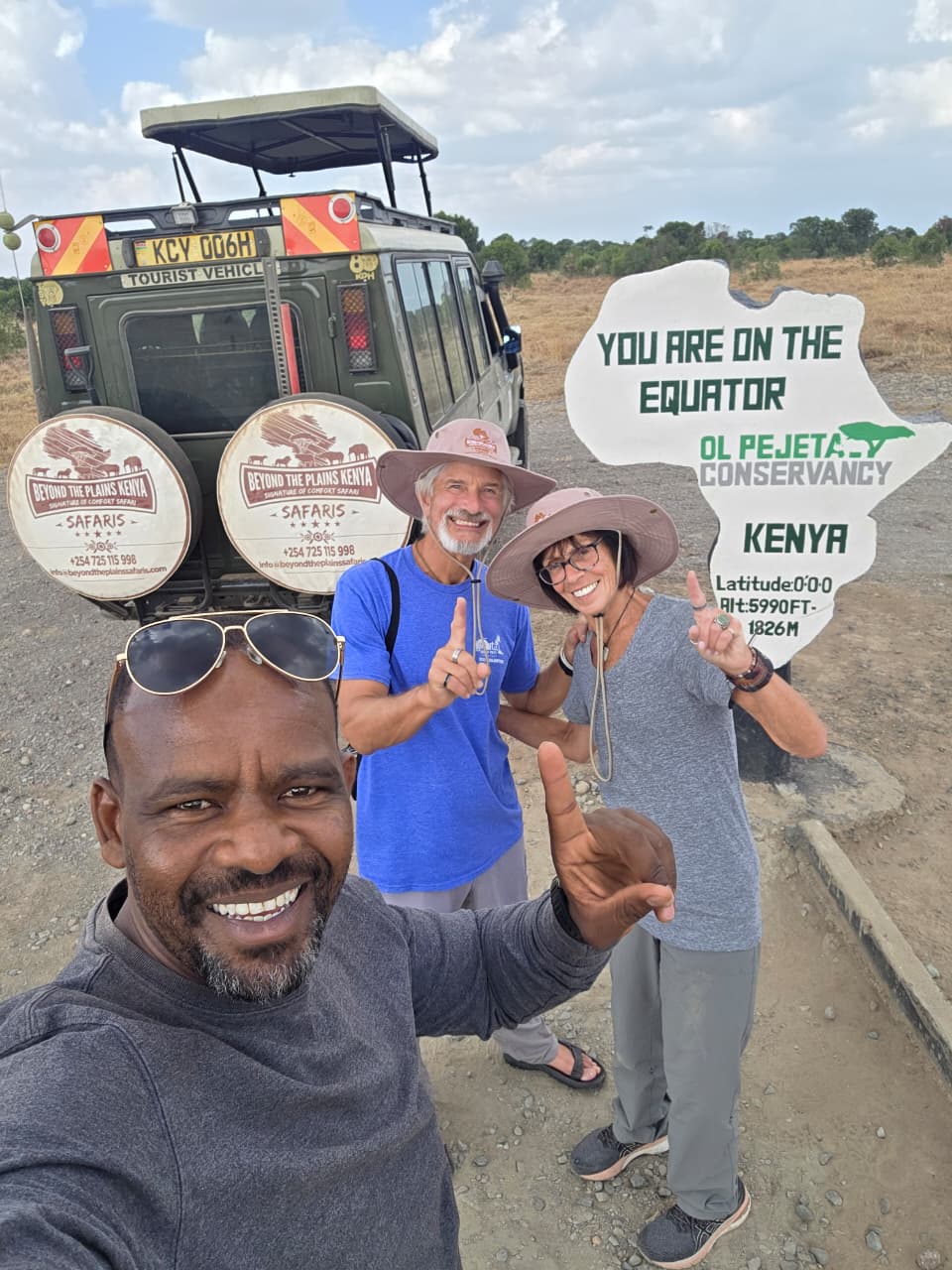
Patrick, Beyond the Plains Safaris guide, with travelers at the equator sign, Ol Pejeta Conservancy, Kenya
The most frequently cited first-timer mistake among Kenyan safari guides is prioritizing camera equipment over practical, neutral-toned clothing suited to dust and heat. For the full breakdown of what to bring and what to leave behind, our complete Kenya safari packing list and our piece on what NOT to bring on a Kenyan safari go into more detail than any single guide interview could.
Timing and Season: When Is the Best Time to Go on Safari in Kenya?
When is the best time to go on safari in Kenya? Kenya's peak dry season, from June to October, plus a shorter window in January and February, offers the best wildlife visibility because animals gather near limited water sources. Every guide we spoke with mentioned timing in some form.
- Paul, driver-guide, Maasai Mara, 15 years' experience: "July through September is when the Mara delivers the migration crossings, but don't ignore November's short rains — the grass is greener, the crowds are thinner, and predator sightings are just as strong."
- Bernard , guide, Amboseli, 12 years' experience: "January and February give you the clearest Kilimanjaro views of the year, paired with newborn wildlife season. It's an underrated window for first-timers who want great photos without peak-season crowds."
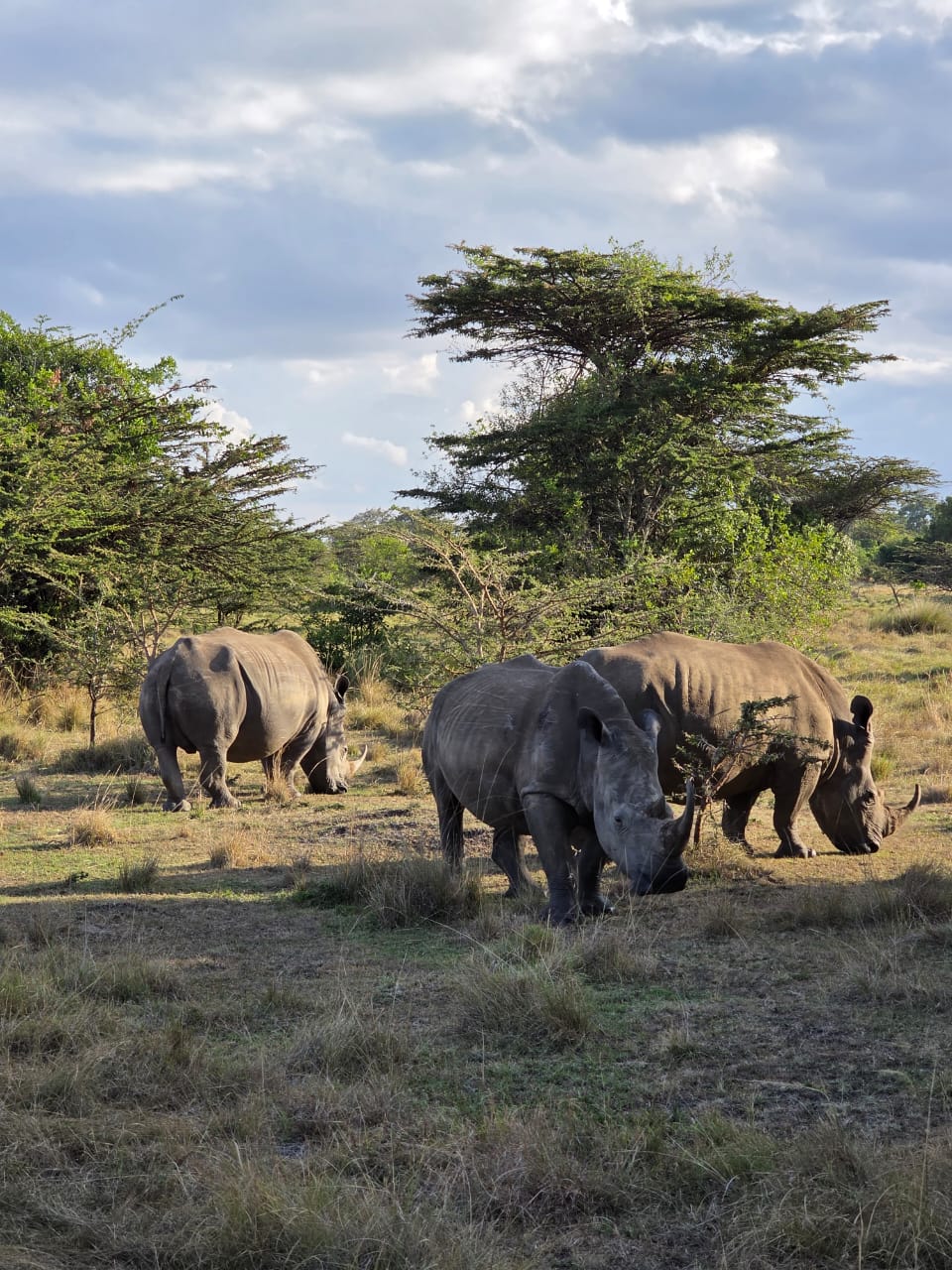
- Samuel Munyua Hinga, guide, Lake Nakuru, 9 years' experience: "People fixate on the Great Migration and forget that Kenya has resident wildlife year-round. A first-timer visiting in April can still see rhino, lion, and flamingo — just plan around the rain."
For a month-by-month breakdown that goes deeper than any single guide's seasonal preference, see our best time to visit the Maasai Mara guide and our Great Migration month-by-month guide.
Camp Behavior: Life at the Lodge Between Game Drives
- Andrew Obaga, camp manager, Mara North Conservancy, 17 years' experience: "Most camps are unfenced. Never walk between your tent and the dining area alone after dark — always ask for an escort. It's not paranoia, it's standard camp protocol everywhere in the Mara ecosystem."
- Evalyn Mayetu, guide, Naboisho Conservancy, 6 years' experience: "First-timers are often surprised that animals wander through camp at night. Zip your tent fully, keep food out of your bag, and don't leave anything scented on the veranda."
- Jimmy, guide, Aberdare National Park, 10 years' experience: "Ask your camp staff questions. They know the local Maasai or Samburu community, the flora, the birdlife — most guests only ask their driver-guide, but camp staff have stories too."
If you're still choosing where to stay, our best Maasai Mara safari camps and lodges guide and best private conservancies in Kenya breakdown compare options by conservancy, price point, and wildlife density.
Photography: How Can First-Timers Get Better Wildlife Photos on Safari?
How can first-timers get better wildlife photos on safari? First-timers get better wildlife photos by shooting early and late in the day, bracing the camera against the vehicle frame instead of hand-holding it, and trusting the guide's positioning rather than demanding a specific angle.
- Alice Mantaine, guide and photography specialist, Mara Triangle, 13 years' experience: "The best light is the first and last hour of the drive. If you sleep through the early departure to save energy, you're trading your best photos for thirty extra minutes in bed."
- Gerard Murero, guide, Samburu, 8 years' experience: "Bring a bean bag, not a tripod — tripods are nearly useless in a moving vehicle, but a bean bag on the window frame stabilizes even a long lens."
- Alfred Syanda, guide, Tsavo East, 11 years' experience: "Don't spend the whole sighting looking through the viewfinder. I've watched people miss an entire hunt because they were adjusting camera settings instead of watching the animal with their own eyes."
For gear-specific advice, our safari photography gear guide and guide to capturing stunning safari photos expand on lens choices, settings, and timing.
Patience and Expectations: What Should First-Timers Expect From Their First Game Drive?
What should first-timers expect from their first game drive? First-timers should expect that wildlife sightings are never guaranteed, and that a slower, more observational pace tends to produce better outcomes than rushing between "highlight" animals.
- Saruni Kisemei, driver-guide, Mara Triangle, 16 years' experience: "First-timers who set realistic expectations about wildlife sightings report a far better experience than those chasing a guaranteed 'Big Five' checklist. I'd rather show you an hour of real lion behavior than rush you past ten distant animals."
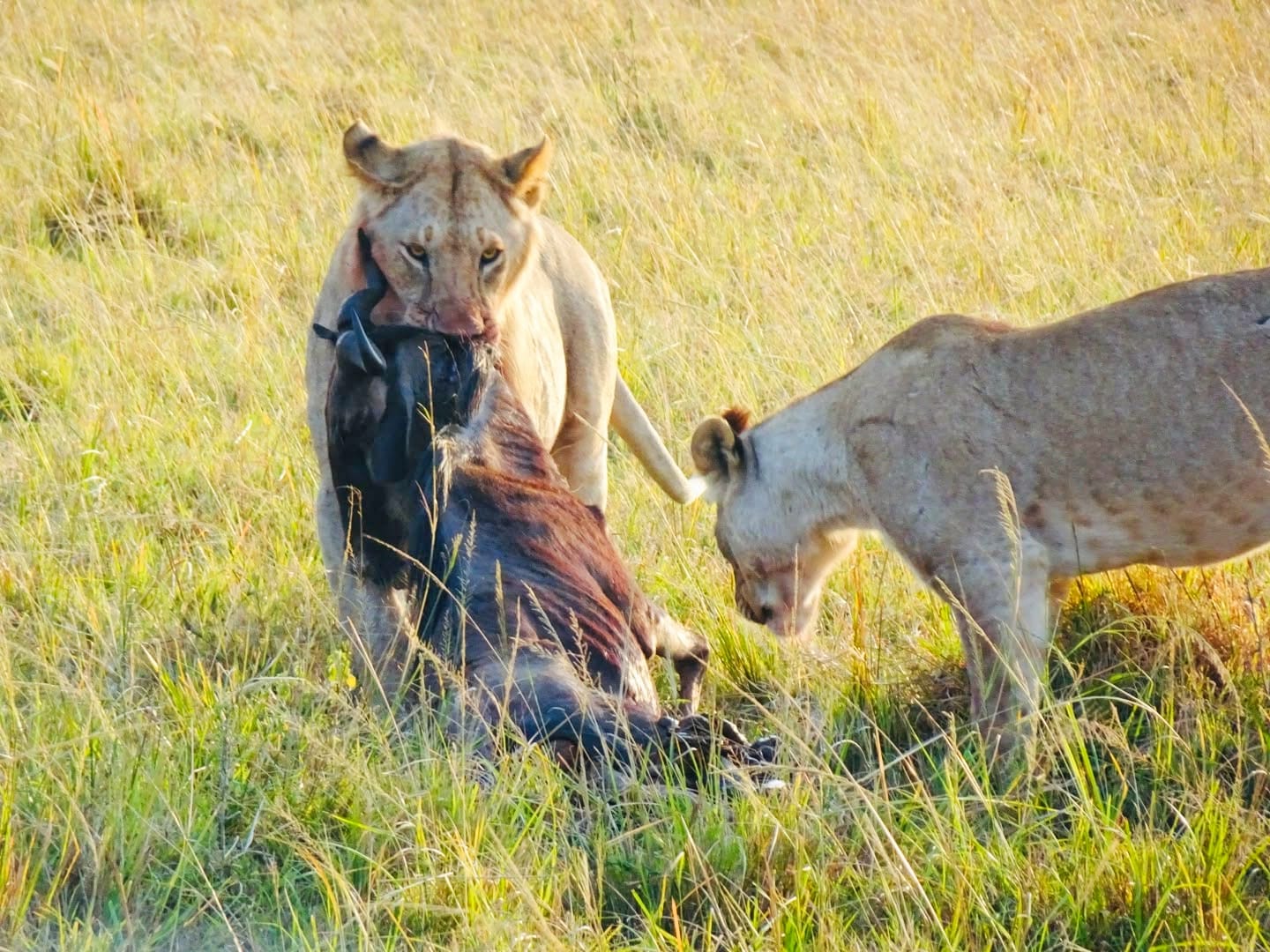
- Peter Ndungu, guide, Lake Nakuru, 9 years' experience: "Some of my best sightings happened because we simply waited. A pride resting in the shade for forty minutes can turn into a hunt in the last five — if you've already asked to move on, you miss it."
- Douglas Onsongo, guide, Masai Mara, 14 years' experience: "Nobody's first safari looks like a documentary. Real wildlife watching includes long, quiet stretches. That's not a failed drive — that's what the ecosystem actually looks like."
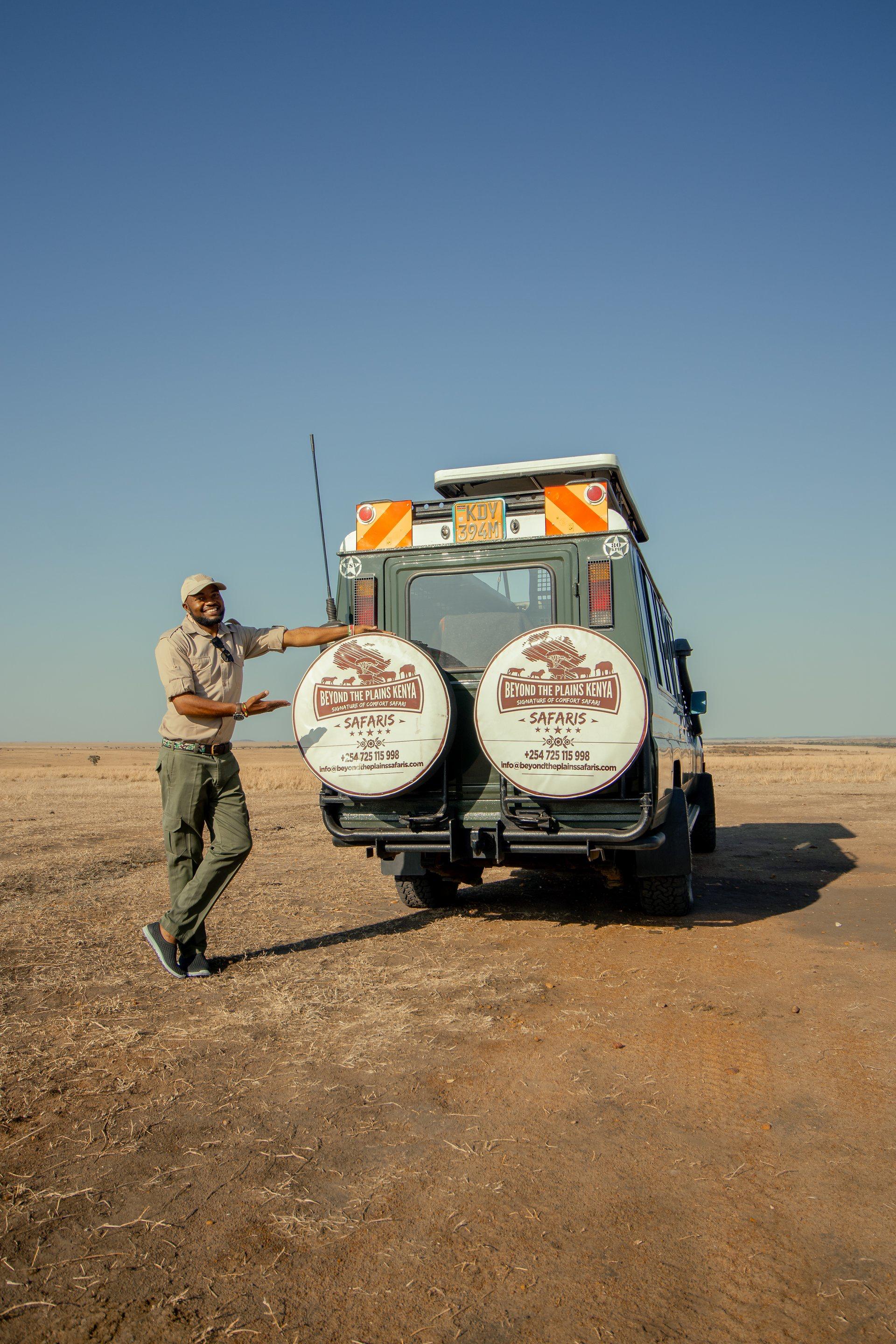
Douglas Onsongo, Beyond the Plains Safaris guide, standing beside a branded 4x4 safari vehicle in the Maasai Mara, Kenya
If seeing all five iconic species is still a priority for your trip, our Big Five safari guide explains realistically which parks and conservancies give you the best odds.
Safety: Rules Guides Say First-Timers Underestimate
- Stephen Ndavi, driver-guide, Tsavo West, 19 years' experience: "Stay seated during the drive unless I've told you it's safe to stand. Vehicles do occasionally hit uneven terrain, and a sudden stop with someone standing through the roof hatch is a real injury risk."
- Njungo James, guide, Samburu, 10 years' experience: "If you're doing a walking safari, listen to the safety briefing fully — it's short, but it covers exactly what to do if we encounter a buffalo or elephant on foot, which is a completely different scenario than being in a vehicle."
Our dedicated guide to walking safaris in Kenya and night game drives covers the added precautions for those specific experiences in more detail.
Tipping and Culture: How Much Should You Tip a Safari Guide in Kenya?
How much should you tip a safari guide in Kenya? Tipping a safari guide in Kenya typically ranges from $10 to $20 per guest per day on a shared safari, rising to roughly $25–$40 per vehicle per day on a private safari, according to multiple East African tour-operator tipping guides. Tipping in the Kenyan safari industry is considered a standard and expected part of the experience, not an optional extra.
- Dennis, driver-guide, Maasai Mara, 15 years' experience: "Tip at the end of the trip, in cash, directly to your guide — and separately to the camp staff tip box. Combining them or assuming one covers the other is a common first-timer mix-up."
- Lawrence Abura, camp manager, Mara North, 17 years' experience: "Learn jambo and asante sana before you arrive. It's a small thing, but Maasai and Samburu staff notice — and appreciate — visitors who make even a small effort with Swahili."
- Antony, guide, Amboseli, 8 years' experience: "Ask questions about our lives, not just the animals. Most first-timers are curious about wildlife but forget to ask a guide about his own community — and that's usually the more memorable conversation."
For exact per-role tipping amounts across drivers, camp staff, and specialty guides, see our complete safari tipping etiquette guide, and for cultural context before a village visit, our honest guide to Maasai village visits is worth reading in advance.
| Tipping Role | Typical Range (Shared Safari) | Typical Range (Private Safari) |
|---|---|---|
| Driver-guide | $10–$20 per guest, per day | $25–$40 per vehicle, per day |
| Camp/lodge staff (tip box) | $5–$15 per guest, per night | $5–$20 per guest, per night |
| Walking-safari guide/ranger | $10–$15 per guest, per day | $15–$25 per vehicle, per day |
| Transfer driver | $2–$10 per guest, per transfer | $5–$10 per vehicle, per transfer |
Ranges compiled from multiple East African tour-operator tipping guides current as of 2026; always confirm specifics with your operator before travel.
Practical Application: How to Use These Tips When Booking and Packing
How do you actually apply 25 different tips without feeling overwhelmed? The most efficient way to use this roundup is to convert it into a short checklist you review once while packing and once again before your first game drive. Below is that checklist, organized by the same themes as the tips above.
Before you pack:
- Choose neutral-toned (khaki, olive, tan) layers over bright colors or all-black outfits.
- Prioritize one reliable camera body over multiple bodies and lenses you won't use.
- Pack a dust-proof bag or case for phones, chargers, and camera gear.
- Bring closed, broken-in shoes if your itinerary includes a walking safari or conservancy stop.
- Bring a bean bag rather than a full tripod for in-vehicle photography stability.
Before you book:
- Confirm whether your trip falls in the June–October or January–February dry-season windows, and set expectations accordingly if it doesn't.
- Ask whether your camp is fenced or unfenced, and what the after-dark escort protocol is.
- Check if a walking safari or night game drive is included, and review the safety briefing expectations in advance.
- Budget separately for driver-guide tips and camp-staff tips, and bring enough US dollars or Kenyan shillings in cash.
Before your first game drive:
- Agree with your guide on realistic sighting expectations rather than a fixed checklist of animals.
- Practice staying quiet and seated during sightings, and let the guide manage distance and positioning.
- Learn two or three basic Swahili greetings — jambo (hello) and asante sana (thank you very much) go a long way.
For a deeper checklist on itinerary planning specifically, our guide to common Kenya safari itinerary mistakes and questions to ask before booking a safari both expand on the booking-stage decisions above.
What's Next: How to Choose the Right Safari Camp and Plan Your Itinerary
How do you choose the right safari guide or camp? The right safari camp or guide fits your priorities on wildlife density, group size, budget, and season — not simply the most photographed lodge on Instagram. Once you've absorbed the etiquette and packing advice above, the next decision is where you'll actually stay and how your days will be structured.
First, decide between a private conservancy and a national reserve. Conservancies like Mara North and Naboisho generally cap vehicle numbers per sighting, which supports the "patience over urgency" advice guides gave repeatedly above; our comparison of conservancy safaris versus national reserves walks through the trade-offs in detail, including our look at whether the Maasai Mara is too crowded.
Second, decide whether Amboseli, the Mara, Samburu, or a multi-park itinerary suits your priorities best. For example, a first-timer chasing Kilimanjaro backdrops and elephant herds will lean toward Amboseli, while a first-timer chasing the Great Migration will lean toward the Maasai Mara. If you're weighing Kenya against neighboring options entirely, our Maasai Mara vs. Serengeti comparison and Kenya vs. Tanzania safari verdict are useful starting points.
Third, use a proper checklist when comparing quotes from different operators — price differences often reflect real differences in vehicle exclusivity, guide experience, and conservation fees, not just profit margin. Our guides on how to choose a Kenya safari operator and how to compare Kenya safari quotes both walk through this line by line.
Finally, once your camps are chosen, build the route. Our first-time safari itinerary ideas page includes sample multi-park routes, and if you still need to sort out entry logistics, our Kenya travel visa and entry requirements guide and Kenya safari vaccinations and health guide cover what to sort out before you fly. If you'd rather skip the research and talk directly to a Kenya-based team, you can start a consultation with Beyond the Plains Safaris.
Conclusion
Twenty-five guides, one shared message: patience, preparation, and respect for wildlife matter more than any single item on a packing list or any guaranteed sighting. The guides who shared these tips have collectively spent well over two centuries in Kenya's bush, and their advice consistently points away from rushing and toward slowing down — packing smart instead of packing heavy, trusting the guide's read on an animal instead of pushing for a closer look, and treating tipping and cultural curiosity as part of the experience rather than an afterthought.
You don't need to memorize all 25 tips before you fly. Start with the checklist above, lean on your guide once you're in the vehicle, and let the rest come naturally — that's exactly how the guides who shared this advice would want your first safari to go. If you're ready to turn this advice into an actual itinerary, get in touch with our team or browse our Kenya safari tour packages to start planning.










Comments (0)
Leave a Comment
No comments yet. Be the first to comment!